Sunday, January 20, 2013

January 20- Everett AquaSox


Since 1995, the Everett AquaSox have been the short season-A affiliate of the Seattle Mariners. I bring this up first because I want to point out that it took them 15 years to introduce this ridiculously practical, yet awesome hat. The old-school pitchfork logo is a throwback to the Mariners teams of the 1970s and 80s, as well as homage to the throwback style the team has reintroduced into their hat and jersey combinations. Seriously though!? 15 years?

The hat was brought in as an alternate/road cap, and has proven to be a huge hit with folks in the Pacific Northwest. Hell, I fell to my knees and bought it immediately after the first glance. There’s something incredibly alluring about it, besides the logo. For some reason the combination of navy blue and teal is soothing to look at, but very entrancing at the same time.

Since the hat has only been in use for the last two seasons, I found it a tad difficult to really pick anybody out worthy enough to grace the front-right panel. After a bit of research only two names really popped out...

#27- Tom Wilhelmsen. I admit, I like to pronounce his name in the traditional German dialect (The “W” is a “V” sound), but most important, Wilhelmsen played for the AquaSox for three games during the 2010 season. While there he went 14 2/3 innings, posted one win and an ERA of 3.68 with 14 strikeouts. Needless to say, with the velocity that Wilhelmsen packs, he didn’t hang around very long. He moved on up to the west side and proved to be a reliable closer for the Mariners in 2012 with 29 saves and an ERA of 2.50. Granted, he had a few outings as a late innings guy before taking over his new role.

#1- Luis Rodriguez was a short range journeyman for six seasons in Major League Baseball. And by that, he only played for three teams in that time. In 2011 he got picked up by the Mariners but was sent down to Everett for a rehab stint, as the nearby AAA affiliate Tacoma Rainiers were on the road at the time. While there he played in three games batting .333 with two RBI. Then, he got sent up to Tacoma. That’s about it.

That’s the problem I have with new hats. There isn’t much of a history established other than what we see aesthetically. I’ll have to give it some time and hope an up-and-coming superstar sports it.

Saturday, January 19, 2013

January 19- Houston Astros


I think it might be fair to say that I totally doomed myself when marking this hat, but I’ll get to that in a moment. The Houston Astros wore this cap from 2000-12, at which some could argue the 13-year stretch was the greatest of the team’s history. 2005 is the only year that the Astros went to a World Series, losing to the Chicago White Sox in four games under then manager Phil Garner. But, I disagree with that statement, which I’ll get to later in the season. Like a few teams I’ve written about previous to this post, the changing of the colors, uniforms, not to mention a new ball park (Enron Field, now Minute Maid Ball Park) only served to be the closing act of an era since their humble beginning in 1962 when they were called the Houston .45s. This was the last stretch the Astros not only played in the National League, but also the longest tenure they had in the NL Central, which they had moved to at the start of the 1994 season.

If you’ve noticed on my hats thus far, I ted to stick to only two jersey numbers. The four numbers I’ve been marking make for a great fit without being too distracting to the logo and its placement; however, on this hat, I went with three numbers. Primarily for the sake of the four total numbers that fit. With these three guys represented, it’ll make it a little difficult when I decide to mark and write about their black road cap.

#5- An obvious choice, but perhaps one I should have used for an earlier style. Jeff Bagwell played his final game in The Show at the end of the 2005 season. Despite being born in Boston and being drafted by the Red Sox in 1989, Bagwell never played a game for anyone other than the Astros, and holds most of the offensive records for the franchise: .297 AVG, 449 home runs, 1529 RBI and 1401 walks. Only one man has him beat on career hits. 2000, the first year of this cap, was the last great year, and quite possibly the greatest of Bagwell’s career in the Majors. Bagwell played in 159 games that season and hit .310 with 132 RBI (Second highest of his career) and 47 home runs, the most he had ever slugged in a season. Unfortunately for Bagwell, only Richard Hidalgo had as positive of an impact on the season. The team finished in fourth place in their division with a record of 72-90 under Larry Dierker. I assure you that this is not the last time you’ll see Bagwell-related numbers on any of my hats.

#7- The man who holds the Astros career hits record, and a guy who clearly got hosed on his first Hall of Fame ballot, Craig Biggio. Unlike Bagwell, Biggio stuck it out for 20 years. That’s not to say that Bagwell didn’t want to stick around, but Biggio was clearly the healthier and more resilient of the two. 3060 hits for his career, Biggio started out back in 1988. Throughout his career he became a real utility guy, playing at second base, catcher and some platooning in the outfield. Much like Michael Young in Texas, Biggio always made himself useful for everywhere on the field when needed. The 2000-2007 years were mixed for Biggio as he hit career highs in home runs (24- 2004 and 26- 2005), and he only hit over .268 twice (.292- 2001 and .281- 2004) He also never batted in more than 70 runs in that time. But, much to the chagrin of baseball writers, he clearly earned his way in the Hall of Fame, which will more than likely be recognized in the next few years.

#17- The one guy who probably deserves the most recognition on this era of hats, Lance Berkman. Berkman came up with the Astros in 1999 and stuck around halfway through the 2010 season when he was dealt to the Yankees for the remainder of the season. During his time in Houston Berkman posted .296/326/1090 and quite possibly could have been the one guy to shatter all of Bagwell’s Astros records. But, the Astros rained heavily on that parade. Berkman wasn’t the greatest fielder the team ever had. Hell, he only made 5 All-Star teams despite finishing well in the NL MVP run in five years. Berkman was head and shoulders about the rest of the team, talent wise, plus playing for a team that failed to give him a supporting cast didn’t help his case either, unlike Biggio and Bagwell in their early years.

Friday, January 18, 2013

January 18- Las Vegas 51s


There are very few logos within baseball that bring me to my knees in a state of absolute awe. When it comes to the Minor Leagues, no one does it better than the Las Vegas 51s. This particular hat has been around since 2003, the early part of the Los Angeles Dodgers time frame of having them as their AAA affiliate. The Dodgers had them from 2001-2008, the Toronto Blue Jays had them from 2009-2012 and the New York Mets took over for the 2013 season. Which is actually a funny coincidence since Travis d’Arnaud spent all of 2012 there as a member of the Jays, only to be traded to the Mets as a key piece in the RA Dickey deal back on December 17, 2012; which will more than likely be where he’ll be starting out in 2013. Over the last decade a lot of Major League talent donned this cap, and I couldn’t think of two more talented guys to sport than #41 and #50.

#41 was kind of an obvious choice: Matt Kemp. Kemp played for the 51 from 2006-2007. Playing in only 83 games in those two years, he went on to put up .343/7/56. Yah, that’s right! Kemp only hit seven home runs during his time in Sin City. Obviously his performance the last few years in the Majors has proven his worth as a top prospect for the Dodgers, but still! Seven home runs in AAA? Unreal! A of other talent obviously swept through Vegas: Andre Ethier, Cody Ross, James Loney and Jayson Werth (WOOF WOOF WOOF WOOF!!!) for example; however, not one really had the talent as #50.

#50- Chin-Feng Chen. Unless you’re an avid Dodgers fan, you probably don’t have a clue who this guy is. Back in 1999 he played for the San Bernardino Stampede, along with other notables like Mark Grudzielanek, Bubba Crosby and former National League Rookie of the Year Todd Hollandsworth. 1999 was also the first year I was bat boy for the Bakersfield Blaze. So needless to say, I saw Chen do some work against the ball club I worked for. That season Chen posted .316/31/123; absolutely monstrous. At that time I was lucky enough to see him crush four bombs in Sam Lynn Ball Park; two of which cleared the sun visor in center field. Now, you’re probably thinking, what does this have to do with the 51s? I’m getting to that. Chen was a borderline lifer for the 51s, playing from 2002-2005. During those years Chen got called up for a total of 19 games. During his time in Vegas Chen hit 87 home runs, knocked in 298 RBI and batted .283. Pretty solid stats for AAA. Unfortunately, in the 19 games he played in LA, he was only able to muster two hits and two RBI. But, Chen was still the first Taiwanese player in MLB history and opted to return to Taiwan rather than signing an extension with the Dodgers after the 2005 season. Chen’s two hits both came in 2005, thus allowing Chin-hui Tsao to be the first Taiwanese player to get a hit in MLB back in 2003 with the Rockies. Chen currently plays in Taiwan still for the Lamigo Monkeys, and sadly is not a member of the World Baseball Classic roster. Shame.

Thursday, January 17, 2013

January 17- Los Angeles Dodgers


It’s pretty fitting that I’d be sitting in a study room in the library at the University of Oregon writing this post with two songs on repeat: “Green Onions” by Booker T & the MGs and “I Love LA” by Randy Newman. Both songs personified the eras in which the three players' numbers I have written on my hat dominated. But first… the hat.

The marketing and creative team that moved from Brooklyn to Los Angeles along with the Dodgers are quite possibly some the most intelligent people on the planet. By this I mean, the “LA” on the front of the cap was first introduced in 1958, their first year on the West Coast. And, since their first game, they’ve had the same logo affixed to their cap. That’s it. End of story. Two simple letters personified an entire culture of baseball fans inside and outside of the United States. No matter what race, creed or gender of who wears it on the baseball field, their presence has influenced scores of other fans to fall suit and scoop up the hat for more than just following team; it became a socioeconomical flag for some. Now, having said that, I feel a little bad for one of the numbers choices on my hat, so I’ll be sure to start with the first, which should come as no surprise to any baseball fans.

#32- Sandy Koufax’s career ran from 1955, the last year the Dodgers won a World Series in Brooklyn, through 1966. The first six years of Koufax’s career are truly hard to believe. He had little to no control over any pitch he threw, and his numbers are less than extraordinary. Koufax’s ERA hung at roughly 4.00 as he was used as both a starter and a reliever. Believe it or not, Koufax was sent down in 1957 and struck out 13 batters in his first appearance back in the Majors. This was the way things went. It wasn’t until 1961 that everything seemed to come together. Koufax had spent the winter working on his conditioning and got to Spring Training in the best shape of his life. Long time Dodgers scout Kenny Meyers also made a discovery in Koufax’s windup motion. Koufax was rearing back too far, thus obstructing his vision upon his follow through. In his first start of Spring Training Koufax walked the bases loaded on 12 straight pitches, prompting then catcher Norm Sherry to remind Koufax to take something off the ball for better control. The advice worked. Koufax struck out the side and threw sever consecutive innings of no hit ball. The rest as they say is history. Four no hitters, the breaking of Christy Mathewson’s single-season strikeout record of 267 (269 for Koufax in 1961) three Cy Young Awards (1963,65,66), one MVP (1963), 2396 career strikeouts, a 2.76 career ERA, 165-87 record, four World Series rings and spot in the Hall of Fame.

Koufax’s arm had been giving him problems since 1965, and rather than play through it and have it affect him the rest of his life, he gave it all up at the age of 31. After what he had all ready accomplished in his life, I don’t blame him. Had modern surgery been available, and at the ready like it is today, who knows how things would have turned out?

#55- Orel Hershiser. Now, as I had mentioned before about culture, I felt a little bad about this one shortly after I marked it last year. I had grown up hating and loving Hershiser. Loving him for his dominance, but hating him because of the 1988 World Series against my Oakland Athletics. 1988 was the best season he ever had, winning 23 games with a 2.26 ERA and 178 strikeouts. It would be the only year that he would ever win the National League Cy Young award as well as his one, and only Gold Glove award. The only other time that Hershiser could have contested to be the Cy Young winner came in 1985 when he went 19-3 with a 2.03 ERA and 157 strikeouts. Remarkably, Hershiser finished in third place as there was a young phenom by the name of Dwight Gooden lighting up the league for the New York Mets. In only four of his 18-year service he posted a season ERA under 2.70. He was good, but he wasn’t exactly a superstar by today’s standards.

Hershiser made three All-Star Game appearances (1987-1989) throughout his career and won one Silver Slugger award in 1993. 1995 and 1997 were the only other times when Hershiser came close to winning another World Series ring. In both of those seasons he and the Cleveland Indians made it to the end, but came up short losing to the Atlanta Braves and Florida Marlins respectively.

#34 was an interesting specimen. Having grown up playing ball in Mexico he was a diamond in the rough when he was brought into the league in 1980. In 1981, his first full season, Valenzuela went 13-7 with a 2.48 ERA and a league-high 180 strikeout to become the first, and only pitcher to win the Cy Young Award and Rookie of the Year in the same season. His dominance and pleasant manner made him a fan favorite amongst the hodgepodge of cultures that resided in Los Angeles and the surrounding area. Fernando-Mania, as they called it, took over the game and opened up the pathway for other talented players to cross the border and show off what they had.

From 1981-1986 Valenzuela made six consecutive All-Star Game Appearances, finished in the Top-five for the NL Cy Young three additional times(1982, 1985-1986), won two Silver Slugger awards (1981 and 1983), one Gold Glove award in 1986 and two World Series rings in 1981 and 1988.


Wednesday, January 16, 2013

January 16- Bakersfield Blaze


When I woke up this morning I blindly shuffled through the large sack of hats I had laying at the foot of my bed, half expecting to pull a team’s hat that I’ve already written about. Needless to say, I was a bit surprised to grab a hold of this Bakersfield Blaze hat. For starters, I had never worn this hat. All of the stickers were still stuck to the bill. Nothing personal, I just have a lot of hats that I roll through more often than my Minor League caps. It’s also a very fitting at to choose considering that the Blaze had switched to this logo after the 2000 season; the last year I was bat boy for the team. In fact, the Blaze had used this hat and color scheme from 2001-2011, and had housed three different franchises during that stretch: the Tampa Bay Devil Rays, Texas Rangers and the Cincinnati Reds, whom still serves as their affiliate. When doing research for this decade, I came across a bevy of names and numbers that I could have used.

Josh Hamilton was the first. He played in Bakersfield during the 2002 season while they were still linked to the Rays. What’s most interesting about Hamilton and the Blaze is that at he had played for all three franchises at the Major League level. But, I’m not the biggest Hamilton supporter so I nixed that idea. Rocco Baldelli was a possibility, as were CJ Wilson and Edinson Volquez. None of them really made my fancy either. Actually, the one player I really wanted to add was Jonny Gomes, who had played with Hamilton on the 2002 squad. That year he went .278/30/124; amazing stats for high-A ball. However, during my research I couldn’t find his jersey number anywhere. Even on old Blaze baseball cards I happened across didn’t show his number. So, I had to scratch him. Fortunately for me, his older brother Joey played on the team at the same time.

#21- Joey Gomes played for the Blaze from 2002-04 until he was called up to AA Montgomery to play for the Biscuits. Joey never moved higher than AA. Joey’s best year for the Blaze came in the 72 games he played where he went .300/7/45. It really wasn’t much of a surprise when he got called up after finding his swing. Now, not being able to find Jonny’s number isn’t the only reason why I rolled the dice with Joey. Back in 2001 Jonny was drafted by the Rays in the 18th round of the amateur draft; his brother Joey on the other hand was taken in the 8th round of the 2002 draft. What I don’t know is how much of an impact Jonny had on Joey getting drafted so much higher the following year. Or perhaps it was because the scouts felt Joey had more potential than Jonny. Either way, I’d love to find out.

#33 is another former Rays star. And by former, I mean as of a little over a month ago. James Shields had one of the longest tenures with the Blaze of any of the players currently playing in the Majors. From 2003-04 Shields served as the ace for then managers Oscar Munoz (2003) and Mako Oliveras (2004). Shields had a decent first year going 10-10 and posting a 4.45 ERA and a team-leading 119 strikeouts. The following year he went 8-5 with a 4.23 ERA and 92 strikeouts in 20 starts. And thank God for me, he’s always kept the same jersey number… so it was a pretty easy find.

It’s kind of a bummer that I left after the 2000 season to move to Vancouver, Washington. It would have been great to see these up-and-comers, but it made our meetings in 2012 all that more interesting. Shields I met on May 8th in the MLB Fan Cave and the only bit of conversation we had was how we both hated the sun shield in centerfield. Actually, Jonny and I touched on that a bit too, but we went more in depth on a few stories about the history and culture of Bakersfield. For a guy who was only there a year, he really took the time to get to know the town and its inhabitants. Jonny cared, and for that I look forward to seeing him succeed in Boston.

Tuesday, January 15, 2013

January 15- Atlanta Braves


I was a bit surprised that the Atlanta Braves didn’t point this out before the season started, but then again, how often does one celebrate the lifetime of a style of hat. Back in 1987 the Braves made a uniform and color switch; donning the old red and navy which dates back to their earlier days in both Boston and Milwaukee. The hat, on the other hand, hasn’t really gone through much of a change, logo wise, since 1981, but the current game/home style celebrated it’s 25th birthday this last year and has been a constant best-seller during that stretch.

A few days ago I had posted about the Toronto Blue Jays and how they had altered their uniforms and colors numerous times over a 17-year period and was met with minimal success on the field despite a higher win probability in correlation to a team changing its look. Oddly enough, the Braves fell into a similar hole for the first four years after making the switch. From 1987-1990 the Braves were on of the worst teams in baseball. Seriously! Look it up. The Chuck Tanner/Russ Nixon-managed Braves couldn’t buy a win if they tried, even in spite of Dale Murphy’s dominance at the plate in ’87 when he blasted 44 home runs and batted an impressive .295. However, the “Power Ally” era came to an end after the 1990 season, which coincidentally is the same time the Braves established their dominance in the National League Eastern (then Western) Division. So with that, I had to roll the dice with a few guys that wore this cap and personified the Atlanta Braves over the last quarter century. And who better than Greg Maddux, Tom Glavine and John Smoltz?

#31- Greg Maddux: Unless you’re a dedicated Braves fan, or baseball fan, Maddux didn’t start his career with the Braves until the 1993 season. The Braves had all ready flirted with greatness in 1991 when they matched up against the Minnesota Twins in the World Series, but fell to them in a grueling (in a good way) series which lasted all seven games. The Braves, needing another solid starter, picked up a solid started from the Chicago Cubs before the start of the ’93 season. Maddux had flirted with a Cy Young in 1989, but finished third in the voting after going 19-12 with a 2.95 ERA. He lost to San Diego Padres closer Mark Davis and Houston Astros ace Mike Scott in case you were wondering. In 1992 though, he took home the prize after going 20-11 with a 2.18 ERA and 268.0 innings under his belt. Baller!!! So, with a new team and a fresh season in front of him, Maddux took the mound for the Braves and had a pretty decent showing. And by decent I’m totally kidding. Dude pal won three more consecutive Cy Young Awards; winning 55 games and losing 18 in those three years. Glavine also won a ridiculous (in a good way) amount of Gold Glove Awards during his tenure in the South; a record 18 for his career, but an impressive 10 straight for the Braves. He only missed out in one time in his final year as a Brave in 2003. His punk of a teammate, Mike Hampton, robbed him late year. Aaaaaaaaand he also won a World Series ring in 1995, but that’s really not that big of a deal.

#47- To talk about Tommy Glavine, one can’t help but start with the 1984 NHL Entry Draft. That’s right; TG was a solid hockey player in his youth and was selected in the 4th round, 69th overall by the Los Angeles Kings. Even more impressive, Glavine was selected two rounds ahead of Brett Hull and Luc Robitaille (both of whom were inducted into the NHL Hall of Fame in 2009). So, needing a real challenge, Glavine opted to play baseball instead, and made his debut during the 1987 season. In 1988 Glavine lost a MLB-high 17 games for the Braves, but quickly turned things around toward the end of the 1990 season when Bobby Cox took over as manager. From 1991-1993 Glavine won at least 20 games and took home his first Cy Young Award for his effort during the ’91 season. Unfortunately, some computer nerd-looking guy (Maddux) kept him from getting his second Cy Young until 1998 where he went 20-6 with a 2.47 ERA. Oh yah! He also won a World Series ring in 1995. No big deal.

#29- The youngest of the three, John Smoltz had the unfortunate luck of playing alongside Maddux and Glavine, therefore didn’t have much of an opportunity to win much hardware. But, he scored big in 1996; going 24-8 with a 2.94 ERA and a League high 276 strikeouts. Smoltz was extremely dominant during his 21-year career, and was the only one of the three who dealt with possible career-ending injuries. After sitting out the 2000 season, Smoltz faced the harsh reality that he may not be able to be used as a starter again. Wanting to play, Smoltz took on the role as closer during the 2001 season and did a fair job. In 2002; however, he played out of his mind. Smoltz saved a MLB season high 55 games. Did I say season high? Sorry, I meant NL single season record. Smoltz defied the odds and continued to play through 2009. He also rotated back to a starting spot in 2006 where he went 16-9 with a 3.49 ERA. I think he also won a World Series ring in ’95 as well, but that’s not important.

As a youngling I only recall seeing the Braves play in this hat with the aid of TBS: The Superstation. So, I had to go with I know. And one thing I know is that Maddux, Glavine and Smoltz truly personified the Atlanta Braves organization for a generation of baseball fans. Well, except for Glavine. He really should have stuck with hockey. Kidding. :D

Monday, January 14, 2013

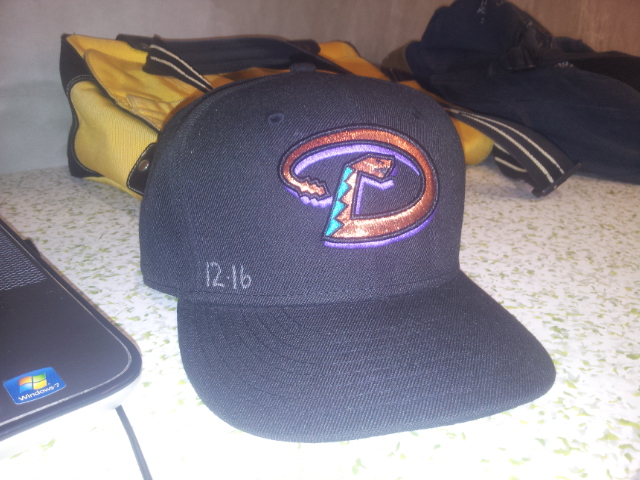
January 14- Arizona Diamondbacks


The idea for these numbers came during a night of drunkenness and tomfoolery three days after I had gotten the axe from the MLB Fan Cave. I was in an a rather cantankerous mood after I had been forced to move into a hotel for the remaining five days I’d be in New York before heading back to Portland with my tail between my legs. I had started drinking not too long after I got my stuff thrown into my hotel room as I had to walk ¾ of a mile with three ridiculously heavy bags since none of the cabs wanted to drive me as traffic was starting build in that area. I don’t usually complain about things, but “f--- that” popped into my head as my arms quivered, ready to drop everything on the sidewalk. I sucked it up and trekked between construction zones and narrow corridors. I passed actor Michael Fassbender on the streets and for some reason yelled, “Fassbender!” and gave him a high five after I shifted one of bags under my right arm. I checked into the Holiday Inn Express, which nestled right on the cusp of Chinatown, threw my stuff on my bed and hit the bricks for the closest public house. After a few rounds I made my way to downtown Manhattan to do some hat shopping and grab dinner as night was quickly approaching. Rather than going to a swanky restaurant I opted to hit up Foley’s Irish Pub. (For those of you who haven’t had the honor, go there. It is hands down, the premier baseball bar in New York.) After crushing a Caesar wrap and fries… along with 4 pints of Samuel Adams I leaned back in my chair and watched the Oakland A’s drop their third straight to the Minnesota Twins. My day just seemed to one punch in the nuts after another. The bartender who was working at the time and I got into a bit of a discussion, and while the details are still a bit hazy to me, somehow the conversation turned to the hardest baseball question he had ever been asked.

In order to set up the question, I have to tell you what was on the line when it was first proposed: A few moths prior, the owner of the pub, Shaun, threw out a proposal to the two bartenders on duty. (In a thick Irish accent) “Ok, here’s the deal. If you two can answer this question in 20 guesses, I will give you both the bar.” To my knowledge there wasn’t a consequence if the two got the answer wrong; however, both were champing at the bit to give it a go. The owner, confident the two wouldn’t get it correct, let it loose, “Name the seven players in MLB history who have hit 300 home runs and stolen 300 bases.”

Now, despite being a half case of beer deep on the day, three answers immediately came dribbling out: Willie Mays, Bobby Bonds and Barry Bonds. In the same breath I had also mustered out Carlos Beltran, but… I was wrong. Beltran at that time was still two stolen bases away from achieving this feat, something that Cardinals rep, and Cave Troll, Kyle Thompson didn’t even know. I then started firing names out that seemed like fitting answers, but were all wrong: Rickey Henderson, Derek Jeter, A-Rod, Ken Griffey, Jr. and like five others before I said Alex Rodriguez and Andre Dawson. Dawson and Rodriguez are in fact the fourth and fifth answers. Two to go. I burned through my other guesses without even coming close to the right answers. As it turns out, the bartended and his co-worker had fallen victim to the same enigma. We were all able to nail down five of the seven, but those last two killed us. Finally, I had to ask for a clue.

Clue- Both players were members of the 2001 World Series champion Arizona Diamondbacks. I slowly nursed the lager in front of my face, barely hanging onto the bar when I fired out Luis Gonzalez. Apparently I had all ready guessed him and was equally as wrong on the first try. I sat there for a second, staring at the walls, hoping an answer would be right in front of my face. I then got up and peed for the first time on the day and popped out for a smoke to mull it over. About three drags into my smoke I had it. I tossed my cigarette out into an Escalade that was driving by and stumbled back into the bar. “Reggie Sanders and Steve Finley!” I yelled. The bartender looked at me amazed and bought me a beer as my reward. Pretty sure I didn’t need it, but I drank it anyway.


#12- Steve Finley made his debut for the Baltimore Orioles in 1989 and played for a very quiet 19 years. Most people remember the name and face, but few have looked at his accomplishments. .271 career average, 2548 hits, 304 home runs and 320 stolen bases, as well as having played on eight teams. He also racked up five Gold Gloves and made two All-Star Game appearances; quite possibly a borderline Hall of Famer.

#16- Reggie Sanders, like Finley, was a bit of a journeyman in his own right. Sanders donned a jersey for eight teams as well, most of which was spent with the Cincinnati Reds over his 17-year career. Despite only having 1666 base knocks in those 17 years, Sanders still clubbed 305 home runs and swiped 304 bags.

Since that night I have clearly never forgotten all seven, now eightanswers, as I imagine most of you won’t either. What’s really interesting; however, is that if Carlos Beltran’s numbers stay consistent for the next four to five years, he’ll probably have a better shot at making the Hall than Finley for the sake of a slightly better average and possibly 100 more home runs. But, after 15 years of playing, how many more years does Beltran have left in him? Finley has him beat by 500 currently. I guess we’ll wait and see.