Showing posts with label AL. Show all posts

Monday, September 2, 2013

July 11- Oakland Athletics


I can’t believe how long it’s been since I’ve written an Oakland Athletics post; May 30th to be exact. Somewhere in my constant hat shuffling and not wanting to over-saturate my posts with just my team I became a bit too wayward. Time to remedy that lapse of judgment.

Up until today this cap was just chillin’ in my closet with all of the stickers still on it. I scooped it up a few days after this last Christmas along with about 10 other caps on the last day of my holiday run while working at Just Sports (@JustSportsPDX). For some strange reason this cap was never really been much of a priority for me to add to my collection even though it’s one of the harder ones to pick up in the correct color scheme and without the MLB and New Era Cap logos on the panels. Luckily there was still one cap left in my size… which I hid in the backstock room until I was finally ready to buy it.

The Athletics first wore this cap at the start of the 1970 season under then-manager John McNamara, who was replaced that the end of the season despite the fact that it was his first full season in which he led the team to a record of 89-73. To add insult to injury, McNamara managed the last 13 games of the 1969 season in which the team went 8-5 under his leadership. Just to do the math for you that’s a record of 97-78. For those of you who aren’t too familiar with McNamara he was actually a coach for the A’s for the previous two seasons, which also happened to be the first two seasons in Oakland. Prior to that McNamara was a manager in the AA system for the Athletics and won back-to-back Southern League championships with the Mobile Athletics (1966) and Birmingham A’s (1967). Oh, and before that McNamara had been playing in the Athletics farm system from 1960-1967 during their days in Kansas City. And before that he was just some kid growing up in Sacramento, California with dreams of making it big in the Majors. So basically what you have here is a kid who grew up in the Bay Area, became a man in the farm system for the A’s before they moved to the Bay, became a leader and won championships for the A’s before they moved to the Bay, then became “The Man” not too long after they moved to the Bay, had a pretty successful first season which ended with a second place finish in the American League Western Division, only to be canned and replaced with Dick Williams. Oh wait… Dick Williams? Weeeeellllll… I guess I don’t feel so sentimental toward McNamara anymore. Williams was “The Man.” No, I don’t really feel that way. I do believe that McNamara got a bit of a raw deal by the A’s, but the move to bring in Williams as manager proved to be one of the boldest, most successful moves in franchise history. But I’ll discuss all of that in a not-too-distant post.

From 1970 through the end of the 1982 season the A’s rocked this cap with a flurry of uniform combinations that inadvertently inspired my alma mater, the University of Oregon Ducks’ dozens of football uniform combinations. Or so I’d like to think. I mean, green and gold… AND AWESOME!!! Sometimes stealing from others is flattering, and the A’s teams of the 1970s and early 1980s were definitely worth stealing from. One of the key components of this cap was the ushering in of the new “A” logo which inevitably and perfectly morphed into the “A’s.” Prior to 1970 the Athletics caps were either blank, had a “KC” or feature only the “A” as shown here in my post from January 1st during the Philly days. Oh and trust, I have many more Athletics caps to come to break down and discuss all of these little variances. One thing to keep an eye on that has a tendency to change over the years in the bottom-left leg of the “A.” In some years and locations the extension at the bottom is small, sometime it’s long. Sometimes it has a sharper curve going off to the left; or in this case, sometimes the right extension is sharper. For some reason that has primarily been the only real difference in the logo throughout the 112-year history of the team; well, besides width, but I don’t consider that to be a dramatic difference. Also, the particular shade of Kelly green used for the hats changed to the most current, darker style that we're all used to today. The old shad of green had been used since the old Kansas City days dating back to 1963.


#35- Despite the fact that my father is an ardent San Francisco Giants fan, his favorite player growing up in San Leandro was Vida Blue. As a kid he used to tell me stories of all the games he caught at the Coliseum when he was a youngling, watching Blue and the Mustache Gang dominate in the 1972, 1973 and 1974 World Series. Actually, everyone except Blue was dominant. In the four games he pitched in at the Coliseum during all three World Series Blue went 0-3 with a 4.05 ERA and a blown save. I’m not sure if my father neglected that information on purpose or if he just blocked it out over the years. Kind of like how I’ve always elected to not care about the six years that Blue played for the Giants.


Blue wore many numbers on the back of his jersey, but it was when he wore the #35 that he had the most success from 1970-1973. In 1969 he wore #21 and #28. In the early bit of 1970 he wore #17. And from 1974-1977 he wore #14. Unlike most southpaws, Blue was a power pitcher who worked fast and blasted the strike zone. He possessed a stunning curveball and an above average change-up, but his signature pitch was a blazing fastball that could dial up to 100 miles per hour. For that time period it was unheard of for a lefty to clock that fast. In The Neyer/James Guide to Pitchers, all-time hits leader Pete Rose stated that Blue "threw as hard as anyone" he had ever faced, and baseball historian Bill James cited Blue as the hardest-throwing lefty, and the second hardest thrower of his era, behind only Nolan Ryan. At the same time Bill James is also a tool and completely forgot about JR Richard when making that comment. Sorry, I’m not a fan of James.

In 1969 Blue made his Major League debut, going 1-1 with a 6.64 ERA in 12 games. Needing more help with his control, Blue started out the 1970 season in the minor leagues with the Iowa Oaks of the American Association. Blue was then called up in September, making two starts that provided a glimpse of what was to come. On September 11, he shut out the Kansas City Royals 3–0, giving up only one hit, to Pat Kelly in the eighth inning. Ten days later he no-hit the Minnesota Twins 6–0 at the Coliseum with the lone baserunner being Harmon Killebrew, who walked in the fourth inning. Not bad for the first month of his career.

In 1971 Blue dominated the American League with a force that no one could have ever predicted including his teammates. He posted a 24-8 record with a 1.82 ERA and 301 strikeouts. Detroit Tigers pitcher Mickey Lolich had 25 wins and 308 strikeouts and pitched in six more games than Blue, and proved to be the only factor in preventing the Triple Crown for Blue. Nonetheless, due to the fact that Blue was so dominant and because the Athletics won the AL West title for the franchise's first postseason berth since the Philadelphia Athletics in the 1931 World Series, Blue was awarded with the AL Cy Young and the AL MVP award, becoming the third player in MLB history to win both awards in the same season and the second person in the AL to do so. That season he also became the only player ever to be a starting pitcher in the league opener (against the Washington Senators), the All-Star Game and the playoff opener (against the Baltimore Orioles) in the same season.

After Blue's breakthrough season in 1971, he and Athletics owner Charlie Finley clashed over his salary. Blue held out, missing much of the year, and ended up with a 6–10 record. He didn't make the Athletics' post-season starting rotation, instead pitching mainly in relief. Against the Cincinnati Reds in the 1972 World Series he made four appearances, including a save in Game 1, a blown save in Game 4, and a loss in a spot-starting role in Game 6.

Blue returned to form to win 20 games in 1973, 17 games in 1974, and 22 games in 1975, as an integral member of the Oakland Athletics' five straight American League Western Division pennants from 1971 to 1975, and three consecutive World Championships in 1972, 1973, and 1974. In the cases of 1973 and 1975, as well as in 1976, he only managed to crack the top-seven for AL Cy Young voting and the top-29 for the AL MVP. Perhaps his finest postseason performances were four innings of shutout relief work against the Tigers to save Game 5 of the 1972 American League Championship Series and a complete-game 1-0 shutout against the Orioles in Game 3 of the 1974 ALCS.

On September 28, 1975, Blue, Glenn Abbott, Paul Lindblad and Rollie Fingers combined to no-hit the California Angels 5-0. The no-hitter is, as of 2012, one of only two to be pitched on the final day of a regular season, the other being Mike Witt's perfect game in 1984. Blue also became the first no-hit pitcher to also pitch in a combined no-hitter; he has since been joined by Witt, Kent Mercker and Kevin Millwood.

In 1976, baseball commissioner Bowie Kuhn vetoed an attempt by  Charlie Finley to sell Blue to the New York Yankees, and in 1977, Kuhn cancelled a proposed trade of Blue to the Reds. In both instances, Kuhn said the trades would be bad for baseball because they would benefit already powerful teams without making them give up any significant talent in return. At the end of the 1976 season, nearly the entire A's roster of star players from Oakland's championship teams left with baseball's new free agency, or were traded off by Finley, leaving Blue, who was still under contract with Oakland, to mentor a new team of primarily rookies and other young players. In 1978, Blue was traded to the San Francisco Giants. Overall he finished his A’s career with a record of 124-86, an ERA of 2.95 and threw 1315 strikeouts.

Even though he is arguably one of the most accomplished pitchers of all-time, even by Bill James’s standards, Blue only managed to get 8.7% of the vote from the Baseball Writers Association of America in 1993 for the National Baseball Hall of Fame. Blue was never eligible for a vote from the Veteran’s Committee due to the fact that he only made it four years in the voting process. Pretty God damn ridiculous if you ask me.

.118- One of my favorite MLB trivia questions I was asked as a kid and I now ask to anyone who challenges me at overall knowledge has to be, “ Who was the last switch-hitter to win the AL MVP award?” Two names will generally ring out in even the most casual of baseball fan’s heads: Mickey Mantle and Eddie Murray, but both answers are wrong. Murray is wrong for the sake that he never won an MVP award in his career, but he did finish in second place twice in 1982 and 1983 while with the Orioles. Mantle would technically be correct if it wasn’t for another player winning the MVP after he last did in 1962. So? Who is it?

The only thing you really need to know in this case to help you remember is that up until 1973 the designated hitter rule didn’t exist. Therefore, any pitcher who won the MVP award before then gets to be thrown into the mix. It just so happens that Blue is a switch-hitter and batted a legit .118 on the season in 1971 with one double and two RBI to his credit. Pretty crazy eh?

Wednesday, May 29, 2013

May 27- Seattle Mariners


Before you make an attempt to read this article I must first ask that you click on this link and either watch the whole thing first, or having it playing in the background while you read on. I assure you, it’s not a virus or anything, just a little something to help get into the experience.

Prior to about a month-and-a-half ago I had never heard that song in my life. I’m not one to seek out newer music as my preference in new music/bands took a hiatus some time after the end of the year 2000. I’ve always been a bit of an old school guy, classic rock to be more specific. Most of that has to do with my upbringing; born and raised in the Bay Area I quickly became accustomed to one particular local band whose best-selling album was released the same year I was born, 1983. That band and that album; Sports by Huey Lewis & the News. I know a lot of you are feeling where I’m coming from on this, and a lot of you probably think I’m the biggest cracker around. It’s ok, to each their own. Truth be told I do listen to a lot of underground rap; mostly a lot of old school Bay Area stuff. There are certain sounds and instruments within songs that trigger a deep fondness from my past and the sensation it puts me through sends me into a frenzy to the point where I have to keep listening to a particular song over and over and over until I get my fix. In some cases, the same thing can be said about sports.

When I first heard “My Oh My” by Macklemore I was immediately hooked. As inspiring as the lyrics are, if you take them out you still have a pretty solid song comprised solely of a piano, drum and tambourine. But the one thing that gets me the most is hearing Dave Niehaus’s final call of the Seattle Mariners American League Division Series win against the New York Yankees, a game that still sends chills down my spine despite the fact that I didn’t grow up rooting for the Mariners. Nope, I’m an Oakland Athletics fan through-and-through, but one thing I have grown to know over the 30 years I’ve been alive it’s that you have to take a time out once in a while to appreciate the joys of others.

1995, first off, was kind of an interesting time period for me. I was 12-years-old and in my first year of Junior High School n Bakersfield, California. A few of my friends didn’t have a specific tam that they followed, but they were all very quick to say that Ken Griffey, Jr. was their favorite player. By default of Jr.’s presence with the Mariners that essentially made them my enemy; however, for that brief five-game series we all had a common enemy, the Yankees. My friends and I took turn watching each game at a different person’s house. I really didn’t care where, I was just happy to be watching playoff baseball, something that was taken away from all the baseball fans the previous season.

Until Game 1 of the series I had never really heard Niehaus’s voice. Living in Southern California we primarily got Los Angeles Angels and Dodgers games, and of course became very familiar with Vin Scully. Within the first few innings I was hooked on Niehaus, an appreciation that grew stronger once I moved to the Pacific Northwest in 2000. There’s a certain grainy ripple that catches the back of his throat when he talks, much like Mick Jagger’s voice if you ever listen to the Rolling Stones’ albums “Exile on Main Street” or “Sticky Fingers.” 

I think the line in “My Oh My” that gets me the most is, “the voice on the other end might as well have been God’s.” It’s an eerily true, but non-sacrilegious truth. No matter if it’s Niehaus, Billy King, Bob Sheppard or any other vocal figure of the game, to us, this is exactly how God should sound. The level of genuine excitement that exudes from Niehaus’s mouth as Griffey, Jr. is more than enough to make anyone believe that the unthinkable can happen.

Like my other Stars and Stripes posts, I compiled the Mariners Memorial Day record, but all ready wrote it in another post on May 13th. So, without further ado, my marks

“My Oh My”- I couldn’t think of a better way to mark this cap. David Arnold Niehaus was the lead play-by-play announcer for the Mariners from their inaugural season in 1977 until his death after the 2010 season. In 2008, the National Baseball Hall of Fame awarded Niehaus with the Ford C. Frick Award, the highest honor for American baseball broadcasters. Among fans nationwide and his peers, Niehaus was considered to be one of the finest sportscasters in history.

Niehaus graduated from Indiana University in 1957, entered the military, and began his broadcasting career with Armed Forces Radio. He became a partner of Dick Enberg on the broadcast team of the California Angels in 1969. Niehaus also broadcast the Los Angeles Rams of the NFL and UCLA Bruins football and basketball during this period.

In 1977, Danny Kaye, part-owner of the expansion Seattle Mariners, recruited Niehaus to become the franchise's radio voice. Despite working for a franchise who from its first year in 1977 until 1991 was without a winning season, his talent was recognizable, and Niehaus was considered one of the few attractions for Mariner fans. Even in the period before the team's memorable 1995 season, the Mariners were regularly one of the leading major-league teams in terms of the percentage of radios in use.

If there’s one moment I love to remember Niehaus by, besides the ’95 ALDS, it has to be what took place on September 27, 2009 in Toronto as the Mariners were set to square of against the Blue Jays. During the pre-game broadcast Blowers predicted Matt Tuiasosopo’s first career home run. What started as simply selecting a possible notable player for the day's game became an extended humorous rant by Blowers. In the course of pre-game banter, he stated that the home run would come in Tuiasosopo's second at bat, on a 3-1 count fastball, and that the ball would land in the second deck in left center field. This then happened - with correct prediction of player, at-bat, count, pitch and general landing area - in the top of the 5th inning.

Blowers was on the television side of the broadcast when the prediction came true, and was simply laughing, with no explanation to the TV audience. Radio announcers Rick Rizzs and Dave Niehaus, however, recalled the prediction, restated it for the audience, and were beside themselves in laughter and disbelief as the prediction came true. Said Niehaus on-air, seconds before the event, "I've never been so excited on a 3-1 count in my life!” Here’s the clip so you can fully appreciate it if you haven’t seen it yet. Being the voice of a team was its pluses and minuses. On one hand you’re always the bearer of bad news if the team loses, but on the other hand, like in this moment, you can rekindle the childlike wonder of the game, that first feeling you had when you saw baseball for the first time. At soon as Tuiasosopo makes contact with the ball you can feel it tingle through your body as Niehaus giggles while trying to get the call out. Only something so absurdly brilliant came make a grown man act like that.

Niehaus suffered a myocardial infarction (heart attack) at his Issaquah, Washington, home on November 10, 2010, and died at age 75 while preparing to barbecue some ribs on his deck. Heart problems had forced Niehaus to undergo two angioplasties in 1996, causing him to give up smoking and change his diet. He is survived by his wife, three children, and seven grandchildren. In a formal statement, Mariners Chairman Howard Lincoln and President Chuck Armstrong said "Dave has truly been the heart and soul of this franchise since its inception in 1977... He truly was the fans connection to every game." Washington Governor Chris Gregoire said "Today the Pacific Northwest lost one of its sports icons...Dave was an institution here starting with the team's first pitch in 1977. With all due respect to the great Alvin Davis, Dave is 'Mr. Mariner.'" At news of Niehaus's death, tributes came from Jay Buhner, Griffey, Jr., Seattle Mayor Mike McGinn, other Mariners broadcasters, and fans.
Prior to the Mariners' home opener in 2011 against the Cleveland Indians the city of Seattle and King County declared that April 8 be "My oh My! Dave Niehaus day". A successful petition drive by Mariners fans Glen Garnett and Mark Caylor got the city of Seattle to give the block of First Avenue S. between Edgar Martínez Dr. S. and S. Royal Brougham Way the honorary designation of Dave Niehaus Way S. Up in the press area at Safeco Field a sign was unveiled giving tribute to Niehaus as well. A bronze statue of Niehaus was unveiled on Friday September 16, 2011 at Safeco Field. Niehaus 's longtime broadcast partner Rizzs presided over a private ceremony to unveil the statue. The statue depicts Niehaus at a desk, behind a microphone, wearing headphones with his Mariners scorebook in front of him. Niehaus is wearing a favorite necktie with tiny baseballs on it and a sport coat. He's holding a pencil in his right hand and wearing the 2001 All-Star Game ring on his left. The scorebook in front of him is open to the 1995 ALDS game against the Yankees. The pages are engraved with Niehaus's actual notes and scoring of the game. The scorebook is so detailed, you even see the word "Unbelievable" scribbled—and misspelled—at the top in Niehaus's handwriting.

Saturday, April 27, 2013

April 27- Cleveland Indians


Whether you’d like to admit it or not, the Cleveland Indians were once a pretty stellar baseball team. In 2007 then manager Eric Wedge, who now manages the Seattle Mariners, led the Indians to an impressive 96-66 record in his fifth year at the helm. The season unfortunately ended a game way from the World Series despite the fact that the Indians had taken down the New York Yankees in the American League Division Series three games to one, as well as jumping out the same lead against the Boston Red Sox in the American League Championship Series. I’ve never been too much of an Indians supporter, but I was certainly on the bandwagon during their series against the Red Sox, much to the chagrin of my mother. But alas, the Sox came back and won the series in seven games. For the first time since the mid-to-late 1990s the Indians’ fortune seemed to be on the right track. Outfielder Grady Sizemore fueled the Indians offense and took home a Gold Glove at centerfield while CC Sabathia won the AL Cy Young award becoming the second pitcher in franchise history to do so. Needless to say, spirits in Cleveland were running high as the 2008 season approached.

Since 2003 the Indians have been slowly phasing out the classic smiling Chief Wahoo, first by shrinking its size on the front of their caps and then by bringing back a classic emblem from their early days (1915-1920). Originally brought in as an alternate logo, the navy blue hat with a red “C” took over as the team’s official road cap in 2011, much in the same way the all-red cap with navy blue “C” logo became the team’s official home cap in the same season, but that post will come in the future. While I realize that Native American tribes in the surrounding Cleveland area have protested the Wahoo logo for decades, it’s still a bit weird to not see its presence within the game anymore. But then again, it’s rhetoric like that which reminds me of an old episode of “South Park” when Stan Marsh’s uncle Jimbo protested the changing of the town’s flag, a black man being lynched by white people, on the grounds that one cannot change a logo because it’s a part of history. If I recall correctly, Jimbo used the Indians as an example. Now, I’m all for change, but that doesn’t mean it won’t be difficult to not see Chief Wahoo anymore. I suppose it’s a good thing I have it tattooed to my torso as a constant reminder.

I’ve gotten a little off topic, so let’s bring it back. The 2008 Indians were heavy favorites to repeat as the AL Central champs. Sabathia, Paul Byrd and Roberto Hernandez all won at least 15 games in 2007 and the tam batting average was pushing .272. However, like the Toronto Blue Jays after winning back-to-back World Series, the Indians made a change to their uniform at a poor time. Much like gambling, never change your bet on a hot streak. The Indians finished in their place in the Central and have yet to make the postseason again since 2007. On top of that, the three top pitching performers in 2007 (Byrd, Hernandez and Sabathia) all failed to win more than eight games each. The Indians finished the season with an 81-81 record, seven-and-a-half games behind the Chicago White Sox. What very few realized at the time is that the dark years were upon the Indians.

I don’t want to dabble too much on what happened in the years following the 2008 season; I have plenty of time throughout the season to touch on it with additional posts and hats. So with that, I’ve decided to pay tribute to the brighter side of the 2008 season, which in turn also shows where everything started to go wrong. Sorry. My marks are ones that I feel Indians fans will completely agree with.

#24- It’s really hard to see how far Grady Sizemore has fallen. With the steady grocery list of injuries he’s sustained over the last few years, it’s hard to believe that 2008 was the last year in which he was a staple of the lineup, taking the field in a team-high 157 games that season. Sizemore was a product of the now “defunct in name” Montreal Expos as a 2000 third round draft pick out of Cascade High School in Everett, Washington. Sizemore was originally going to go to college; however, the Expos lured him away with a $2 million signing bonus. Sizemore never saw a second of playing time with the Expos in the Majors as he was traded away… along with Cliff Lee, Brandon Phillips and Lee Stevens to the Indians of June 27, 2002 in exchange for Bartolo Colon and Tim Drew; hands down one of the most lopsided trades in MLB history. It didn’t take Sizemore very long to move through the ranks of the Minor Leagues. The kid personified the term five-tool player and he made his MLB debut on September 22, 2004.

In 2004 Sizemore exceeded the amount of at-bats to qualify him as a rookie in 2005, but that really didn’t matter as he went .289/22/81 which gave him the 23rd-most voted for the AL MVP. Over the next three years Sizemore didn’t disappoint. He made the All-Star team every year, not to mention the fact that he finished 12th or better for the AL MVP vote in all three years. He also took home back-to-back Gold Gloves in 2007 and 2008. In 2008 he hit a career-high 33 home runs and career-high 90 RBI, which are made even more impressive with the fact that he was the team’s leadoff hitter that season. Minus the stolen bases, he had the makings of being the next Rickey Henderson from an at-bat perspective; a solid-hitting outfielder in the Majors, but knee injury after knee injury and then back surgery have kept him from taking the field since after the All-Star break in 2009. In 2010 and 2011 he played in a combined 104 games. His batting averaged suffered tremendously, and despite signing a $5 million extension in 2012, he never saw a second of playing time thanks to his back surgery and microfracture surgery on his right knee. As of now he remains a free agent, vowing not to sign with a team until he is back in full-game shape. Who knows when this will be? It’s truly a damn shame.

#31- Cliff Lee went through a series of jersey numbers from 2002-2004 (65, 34) before landing on #31 for the 2005-2009 seasons. As I mentioned above, he was originally a draft pick of the Expos. In fact, he was taken in the same draft as Sizemore, but in the fourth round. Like Sizemore, he never saw a second of playing time with the Expos; however, he did make the jump to the Majors in the same year the trade went down, 2002. A September call-up, he made two starts for the Indians that year going 0-1 with a 1.74 ERA and six strikeouts. 2003 didn’t fair too well for him, but 2004 and 2005 did. He went 14-8 with a 5.43 ERA and 161 strikeouts in ’04, giving him a fourth place finish for the AL Cy Young that season; however, even though he pitched better in ’05, he didn’t receive the same accolades. In fact, with his 18-5 record, 3.79 ERA and 143 strikeouts, he didn’t receive a single vote for the award. I’m still trying to figure that one out. Things kept at a pretty average rate for Lee, until he posted less-than-average marks in 2007 while everyone else in the rotation was dominating. Something needed to change. And it certainly did in 2008.

As I mentioned above, none of the “big three” were able to win more than eight games; however, Lee was able to score a league-high 22 wins along with 170 strikeouts and a league-best 2.54 ERA. He won the AL Cy Young that season without question, and even got his first All-Star Game nod as well. Even when you take his performance with the Philadelphia Phillies the following year, which led to a World Series ring, his performance in 2008 stands as his best achievement, especially considering that he only had three losses on the year to give him a win percentage of 88%, the best for a pitcher since Randy Johnson (Mariners) and Greg Maddux (Atlanta Braves) both posted 90% in 1995.

I realize there’s nothing substantial to prove that a change in uniform can make a difference in the outcome of a team’s future, but then again, there isn’t exactly anything to disprove my theory either. Baseball is a game of superstition, and outside of Turk Wendell, you won’t find my guys more superstitious than me. As much as I like the “C” logo caps, I hate what they’ve done to the franchise. Long live Jobu!

Thursday, April 25, 2013

April 25- Texas Rangers


If there’s one person I haven’t given enough praise to for the 2012 Major League Baseball season, and especially for my time in the MLB Fan Cave, it’s my friend Taylor Smith (@Tayloraksmith). Taylor was born in Louisiana, but spent the vast majority of his life in Portland, Oregon. For as long as I’ve known him he’s been one of the few Texas Rangers fans who can dish a great deal of banter. We first met at Max’s Tavern, the bar that another mutual friend of ours, Matthew Alpert, and I both worked at. I had just gotten off of my shift, 4 PM- 9 PM, and was standing on the patio watching the day’s baseball highlights while smoking a cigarette and enjoying a tall, cold glass of Pabst Blue Ribbon to unwind. Matt and Taylor both walked in through the back entrance and Matt introduced the two of us. What I didn’t now at the time is that all three of us were enrolled in the University of Oregon School of Journalism and Communication, so we always had plenty to talk about outside of jokes, music and baseball. Off-and-on we’d spot each other in the hallways; however, all three of us had a different of focus of journalism: Matt was in video production, Taylor in advertising and I was enrolled in news/editorial and magazine writing. With our powers combined we would have made for a pretty badass team.

For only one day in the three years that we’ve known each other can I recall Taylor not wearing a Rangers cap. That day, our graduation day in 2011…

Taylor is in the sunglasses and Matt is the shorter cat with some decent beard growth. At the time I had finished up two of my degrees, one in English and the other in journalism, but my life got a little sidetracked in 2012 when I moved to New York City to be in the Fan Cave and had to put degree number three on hold for a bit.

Most of his Rangers loyalty came to fruition during the 2010 World Series against the San Francisco Giants. He was able to score tickets to Game 2 at AT&T Park, but regretted every second of it when I saw him in Eugene the next day after the Rangers suffered a 9-0 loss at the hands of the Giants. Based on my Oakland Athletics loyalty, it was a hard one to swallow for the both of us.

After graduation Taylor had gotten on with an advertising firm on the East Coast. Despite seeing photos on a regular basis on Facebook, I had totally forgotten that Taylor was living in New York, literally at the base of the Brooklyn Bridge on the Manhattan side. When I got the call to move to New York for the Fan Cave this important little detail didn’t creep back into my head until a few weeks into our experience. In fact, it was Taylor that reached out to me. During one of the few days in which we had after noon games one of the security guards, Robert, yelled at me from across the room to let me know I had a visitor. I remember just looking back at him, lifting my arms up and saying, “Me?” I didn’t know anyone in New York, let alone get a tip from anyone that they would be coming to town. As I got up out of the couch I lurched about three steps and say the bright red Rangers hat I had been so accustomed to seeing at Max’s Tavern staring right back at me. With a wide grin on my face I opened the door, gave him a hug and invited him inside to give him the grand tour and introduce him to everybody.

As it turned out, Taylor and I only lived about a mile away from one another, so we did our best to meet up two to three times a week for a beer or even for him to just stop by the Fan Cave in the evening to catch a few games with us. It was great to have a familiar face from home around when he could, but since he was busy himself his visits became less frequent as the weeks rolled by. What I later found out toward the end of May was that Taylor’s contract with the advertising firm had expired and he was in a bit of a haste to look for a new gig otherwise he’d have to move back home to Oregon. This bit of news he told me over drinks one night at a regular bar we visited, but he did his best to keep a smile on his face.

Finally, on May 29, 2012 everything came to an end. I was given the axe by the Fan Cave and he had booked his plane ticket home. Neither of us, at the time, knew about each other’s news. It would be five days before we were able to see each other again, and the circumstances behind it were accidental. A few days after I had my last day in the Fan Cave I took in a game at Yankee Stadium as the New York Yankees were hosting the Tampa Bay Rays. This was during the period of time when I had also been kicked out of the apartment and moved to a hotel about a half-mile away, so he and everyone else still associated with the Fan Cave had no idea where I was staying. The game that night was a gift from David Price who had hooked me up with tickets on account of the bad news I had received, a pretty sweet gesture if you ask me. Price wasn’t pitching that night and the Yankees won 7-0 to tie the Rays for the lead in the American League Eastern Division. After the game I took the subway back to around the Fan Cave so I could walk by to see if anyone was still there. They weren’t. Instead, I was greeted by another one of the security guards and we chatted for a good hour about everything that had gone down. After we said our goodbyes I headed back toward the Blue Haven, the bar we frequented, for a night cap before heading back to the hotel. As I walked in I was greeted by Ricardo Marquez, Ashley Chavez and Taylor. Most people would normally be happy to see their friends; however, in this case I was confused to see my friend with the people that I worked with. As I came to found out Taylor had stopped by the Fan Cave to see me, they let him in and for a solid 15 minutes no one told him where I was. I don’t remember who he said finally cracked, but dear lord! 15 minutes? I wasn’t upset with Taylor in the slightest. After all, how could he know? As for everyone else, that was the first day I realized that I didn’t have any friends in the Fan Cave, merely acquaintances.

Taylor and I only got to see each other one more time after that which came on my second to last night in New York. The timeframe on my hotel had expired and I was left with not having anywhere to go. I ran through a few numbers at first, but no one had the room or the availability to let me crash. All of my stuff was at one of the apartments until my final day, so I was good on that. Without anyone else to turn to, I hit up Taylor and he happily took me in. It was late and all of his roommates had gone to bed. Always being the good host he let me sleep in his bed while he took the couch despite all of pleading I did to just let me take the couch. Before we went to bed we went up on his roof with a couple of beers and swapped stories on what exactly happened to us as he and I were slated to head back to Oregon on the same day. I t was one of the few perfect night I had in New York. Both of us knew what was going to happen next, but neither of us cared in that moment. We drank our beers, smoked a few cigarettes, talk and just stared into the night sky as the lights of the Brooklyn Bridge shone down upon us.

Taylor and I continued to text back and forth to one another, but we weren’t able to see each other again until July. I had busied myself with my baseball road trip and he found a temporary gig with a firm in San Francisco. On Wednesday, July 18th he had a short day at the office, which worked out swimmingly considering that was the day I was throwing out first pitch for the A’s. I had hit him up a few days prior to let him know and he told me he would do his best to get there. I made sure to leave a ticket for him at Will Call and all I could do was hope that he would show up. The events went off without a hitch, with the exception of my pitch going a little bit outside. As Josh Reddick, the other participant and I walked back toward the dugout I heard someone yelling my name from a distance. As I looked up, I saw a familiar face. This guy.

Both of my parents, as well as my best friend Laurin Mitchel had come to town, as well as my friends Tim and Stephanie from San Francisco, so I made sure to introduce him to everyone. For the majority of the game he hung out with my mom, Laurin and me and we swapped stories from our time hanging out in New York. The game itself was close throughout. Taylor’s Rangers had built themselves a lead against the A’s, but the A’s chipped away it and tied it up going into the ninth inning. With no runners on manager Bib Melvin elected to pinch hit Brandon Hicks in the leadoff spot. What no one expected, including Hicks, is that one pinch hit would lead to his first career home run as well as yet another walk-off win for the A’s. I was pumped. Taylor, not so much.

After the game we all met up in the parking lot for photos and to say our goodbyes. We’ve talked a few times since that day, but we haven’t seen each other since. Taylor got himself a new job in New York not too long afterward, so it’s been a bit tough. He’s doing pretty well. I can only hope to visit him again in the near future.

My timing was a bit off in regard to the Rangers hats I’ve chosen to rite about thus far. My piece I did on Alex Rodriguez is fine, it’s this one and the one I did on January 6 that are causing problems right now. This cap, the all blue with a white “T” and red outline was first introduced as the Rangers’ road cap during the 2000 season. From 2001-2010 it served as the home cap. Since 2011 it has taken over as the team’s game style, while the red cap from January 6 has served as the alternate cap. The reason this causes issue is because I kind of blew it when I decided to mark up the red cap. If you go back and look, I wrote all about Michael Young’s career stats; however, Young hardly ever played under that cap. One guy in particular that I was left to mark up this cap with did, for many years as that. All three of the numbers I threw on this cap serve a particular meaning to the 2012 season. One of the other funny things about this post is that I really should have used it to write about the team’s all-red game cap as that was the one Taylor primarily wore throughout the time we’ve known one another. So, without further ado, watch me try to bail myself out of this little mess I put myself in.

#5- Ian Kinsler was drafted in the 17th round of the 2003 amateur draft by the Texas Rangers out of Arizona State University (Go Ducks!!!). On April 3, 2006 he made his Major League debut as the Opening Day starting second baseman where he continues to hold reign to this day. That season he only played in 120 games and finished a respectable seventh place in the Rookie of the Year vote after going .286/14/55 on the year. If you don’t remember, Justin Verlander won it that year with little-to-no problem. In 2008, 2010 and 2012 Kinsler has been named to the AL All-Star team and in 2008, 2009 and 2011 he finished in the Top-26 in the AL MVP vote each of those three years. A perennial power-hitting second baseman, Kinsler has a .272 career average, 148 home runs, 480 RBI and surpassed 1000 hits for his career a few games into the 2013 season. My connection with him takes place in Boston on Tuesday, August 7th.

I had been staying with my friend Dave Kaufman (@TheKaufmanShow) up in Montreal, Quebec, Canada for a few weeks. Along with two members of the Canadian rock group, The Arkells, we packed up Dave’s car and made the long journey down to Boston for that night’s Boston Red Sox game against the Texas Rangers. Another friend of mine, Neil Beschle, met up with us outside of Fenway Park, as he would be who I was staying with for the next week of my trip. I’ll get to a much more detailed version of the game in October, but all that matters now is that the Rangers won 6-3. Dave and company were crashing the night in Boston, but Neil and I were going to head back to his place in Worchester (pronounced Woostah) that night. Not wanting to leave it on a weird note we all elected to go out for one more beer before moving on. One beer of course meant two pitchers between the five of us, as none of us really wanted to hit the road quite yet. Dave had been to a great bar near Fenway a few years prior and elected that we go there. None of us took issue with that. Apparently the place Dave had been thinking of originally only fit about 150 inside; however, the place expanded into three stories, but we still got our drinks there. The A’s were playing the Los Angeles Angels that night and as long as I had a television on I was in good shape. About 20 minutes into our time there a group of Rangers fans walked into the bar, and quite amused at that. I wasn’t in a bickering mood so I kept to the game I was watching, only moving my head whenever I noticed a large rat scuttle across the floor. Out of the corner of my eye I noticed Dave motioning to me so I got off of my chair and walked over to listen to what he had to say. “Isn’t that Ian Kinsler?” he said. I slowly turned my head and made sure to look past the area he motioned to. “Yup,” he retorted. From this point forward I decided to stand, mostly because I was curious to see how this was going to pan out. Kinsler was drinking out of a water bottle and conversing with the group of Rangers fans. I had gone back to watching the A’s game when I overheard a few of them talking about my beard. Nothing bad about it, just talking about it. With that, I knew I had my in. I could tell by his body language that he was ready to bounce, so as soon as one of the members of the group moved out of the picture, I swooped in.

“Hey,” I said. “Do you mind if I snap a photo with you?” This whole exchange was made better by the outfit I was wearing, all Red Sox gear. “Only because you have an awesome beard I’ll say yes,” said Kinsler. With everything in motion I handed my phone off to Neil, lifted up my shirt a little bit and took the photo. Now, the reason I lifted my shirt was to show off the Rangers tattoo I have. Nothing else weird. Upon doing so; however, Kinsler looked down after the photo was taken and said, “Wait a minute, I remember you from Oakland!” He had spotted me showing off my tattoos prior to throwing out first pitch and we ended up chatting for a bit longer while all of his friends got photos of me. Really sweet guy.

#7- This is the guy where I totally blew it and should have reserved the all-red cap for him. Ivan Rodriguez was signed as a free agent out of Lind Padron Rivera High School in Vega Baja, Puerto Rico in 1988. On June 20, 1991 Rodriguez got called up to the Majors where he made him MLB debut and played almost everyday from then until the end of the 2002 season. As for the hat; Rodriguez did wear this cap for three seasons; however, the Rangers wore the all-red cap from 1994-2000 which just so happened to be his best years with the club. That’s my dilemma. Moving on… In 1991 Rodriguez finished in fourth place for the ALL Rookie of the Year award, losing to Chuck Knoblauch. Until 2002, that would be the only year in which he wouldn’t win a single piece of hardware.

Rodriguez made the All-Star team every season from 1992-2001, not to mention every Gold Glove during that time frame too. In 1997 he finished in 16th place for the AL MVP, in 1996 and 1998 he finished in 10th place; however, 1999 would be the one year in which he would take home the prestigious award after batting .332 with 35 home runs and 113 RBI. The other thing to take into account is that he led the league in caught stealing percentage (as in him throwing out batters) every year from 1996-2001. After 21 seasons he finally called it quits officially in 2012; however, his final game was on September 28, 2011.

My connection to him came on the day in which he made his announcement to retire, April 21. I was asked to write a Top-five list on the greatest catchers of all-time, something I found to be quite arbitrary considering that and opinionated piece like that was only going to lead to trouble and argument. I’ve always preferred to analyze my articles more deeply, to educate thus negating any mean for argument. For something like this, people were going to argue no matter what. I, as anyone writing the same list should have, put Rodriguez on the list at number 3. Besides being a great backstop, Rodriguez has the most hits all-time for a catcher (2844), not to mention 311 home runs, 1332 RBI and a .296 average. In a nutshell, with one MVP and one World Series ring to boot, he’ll be a first ballot Hall of Famer. You could also contest that he is the greatest catcher of all-time, but I think Yogi Berra will have something to say about that.

#17- Nelson Cruz was originally signed to the New York Mets as a free agent in 1998, but didn’t make his MLB debut until September 17, 2005 with the Milwaukee Brewers. Now, it sounds weird, but it’s not. The Mets kept Cruz playing in the Dominican Republic for three years until trading him to the A’s in 2000. Cruz played in the Minor League system for the A’s until 2004 when they traded him to the Brewers for Justin Lehr and Keith Ginter. In 2006 the Rangers traded Laynce Nix, Kevin Mench, Francisco Cordero and Julian Cordero for Cruz and Carlos Lee.

Throughout his career Cruz has only made one All-Star game appearance (2009), but he has been to two World Series. The most iconic of which was the 2011 Series against the St. Louis Cardinals in which Cruz misplayed a shot from David Freeze, which could have ended the game, but turned into a two-run triple. The Cards were then able to win the game with a Freese home run in extra innings, forcing a decisive Game seven which they won. Blah! Not being one to just let things go away, I did one of the “jerkiest” things I’ve ever done; made a hashtag out of it.

My connection to Cruz came on the first game of the 2012 season for the Rangers when Cruz once again misplayed a ball which allowed for extra bases by the batter. As a result of the Game six of the World Series, and now this moment, I came up with #NellyCruzed while I was in the Fan Cave. It has started as a subtle jab, but I then let it loose up other suspecting players who were guilty of the same defensive misread on the ball. The importance of this hashtag is that it gave a name to something that should have been marked as an error but is actually called a base hit despite it being a defensive mistake. It caught on so much that other Twitter users started using it, and then commentators started using it, and then MLB Network analysts started using it until the point where an actual stat was created (defensive misread), but not actually used… yet. Who could have ever imagined that something so stupid could spiral into something so big? Actually… I could, as it was merely one of many things I created which are still being used well into the 2013 season. All things which I don’t collect a single cent for at that.

I feel a little bad for Cruz, mostly because he's such a pleasant person. He’s a solid hitter, I’ll give him that, but he’s a pretty fragile dude for as big as he is. He’s off to a stellar 2013 thus far, hitting .300 with five home runs and 17 RBI. He’s the kind of guy who can easily hit 30 home runs and knock in 100 or more runs, even though he’s only done the first half once in his career (33 home runs in 2009). Without Mike Napoli and Josh Hamilton around to steal his thunder, I don’t see why he can’t do it. Personally, I hope the best for him. He's great for baseball, great for the Rangers and a whole lotta fun to bust his chops when he comes to Oakland and mixes it up with the right field bleacher crew.

Tuesday, April 23, 2013

April 23- Minnesota Twins


I probably should have written about this a few days ago, but I was just too darn happy to be with Angie Kinderman (@sconnieangie) to put the proper thoughts together and focus on something so detailed. If you’ve been a regular follower of my blog then you’ve probably noticed on more than one occasion that Angie is a die-hard Minnesota Twins fan. If you’re new to my blog then you should know that my girlfriend is a die-hard Twins fans. I, on the other hand, am an Oakland Athletics fan and for some reason have developed a bit of angst against the Twins since we lost to them in the American League Division Series back in 2002. For those who are unaware that was the “Moneyball” season. Anyway, in the seven months that we’ve been together we’ve only physically been together for a little less than a month’s worth of time due to the fact that we live 3000 miles away from one another; she lives in Florida and I live in Oregon. Being the hopeless romantic that I am I decided to “take one for the team,” so to speak, and wear a Twins hat whenever we meet at the airport. On December 31st I wore the “M” logo hat from my blog post on January 21st when I flew into Ft. Lauderdale to see her and I wore the navy blue “TC” logo cap from my post on February 15 when she came to visit me. This last Friday when I flew in to see her again I decided to roll with this cap.

This cap is only the fourth one the team has won on the field in their 53 years of existence. The navy blue panel with red bill “TC” logo was first introduced at the start of the 2010 season and has served as the team’s road cap ever since. It especially seemed like the perfect cap to wear as I traveled to see Angie due to the fact that I was literally going on the road to see her; however, I would love more than anything to make it more of a permanent stop sometime in the near future because I love being with her so damn much. Like with a lot of other teams, the introduction of new caps can have detrimental consequences on a team’s success, and no one found this out the hard way much like the 2010 Twins.

I purchased this cap in late April along with six other hats from the New Era Flagship store across the street from the MLB Fan Cave as well as two from the Lids store about three blocks away. I was in a bit of a spending mood that day on account of the fact that a few of the afternoon games had been rained out after we wrapped up our filming for the day. Fellow Cave Dweller and Twins fan Lindsay Guentzel (@LindsayGuentzel) had a few friends from Minnesota visiting town that week which turned out to be a huge coincidence that I had perfectly timed the purchase. They were all collectively happy about it.

For some odd reason my relationship with Lindsay was rather hit-or-miss at times and I have yet to come up with a reasonable explanation as to why that is. Some days we joked back and forth to one another while others we became highly competitive based on the environment and circumstances we were dealing with. To be honest, I’m pretty sure more of that had to do with my overall attitude. She never wronged me, and sometimes I was a total jerk, something I apologized to her about at great length over the phone while I was on my country-wide baseball road trip a few months after I had been kicked out of the Fan Cave. I think the one moment that really solidified things between the two of us came on the final challenge I had participated in when our assignment was to create an All-Star campaign video for one of the players on the team were representing. I talked about this in my post from April 1st. I chose to do mine on Reddick at which the final product turned out incredibly well. I had gotten help from the New York chapter of the Oakland Athletics Fan Club which happened to feature a former Miss Oakland named Sophia Andrade. I was also fortunate enough to get former Athletics Eric Byrnes and current Cincinnati Red Jay Bruce to endorse Reddick as well. It also didn’t hurt in the end that Reddick himself endorsed it as well as former WWE talent scout and play-by-play commentator Jim Ross backing at well. Unfortunately for me, the last two parts I had forgotten to relay when we then had to give a one minute presentation and pitch for our player. Lindsay’s video was kind of plain, but still a good idea. Since the team has planter boxes with flowers in the outfield, Lindsay decided to revolve her video around a Twins garden gnome that she had who would then be kidnapped and not returned unless people voted for Josh Willingham. The only catch for her video was that she needed someone with a British accent to do the voice. Cue me. One of the many talents I have is that I can do voice impersonations, a skill I rarely ever discuss with people, but work on regularly throughout my days as I once wanted to do voiceover work for cartoons. So, not being one to turn down requests, I happily helped Lindsay out with the voiceover work… and nailed it in one take. After we had completed our pitches and played our videos it finally came down to the judges’ decision for who the winner would be. At the time I hadn’t won a single challenge we had; however, Lindsay had won two and everyone else except Philadelphia Phillies fan Gordon Mack had all won at least one. I honestly thought I had it in the bag… until they announced Lindsay’s name. I was vapor locked. I did everything I could to keep from reacting emotionally until production wrapped. When that came to pass I walked downstairs and cried. Ricardo Marquez followed me down and did his best to console me. I wasn’t mad at Lindsay because she had won, I was mad at myself for helping her win. And with only a week to go before the first elimination I thought I was done. Which, as it turned out, I was.

On the last day that I was officially a Cave Dweller the A’s and Twins had started a three-game series in Minnesota on May 28th. Things had started off well on my end; Travis Blackley was pitching a great game as the starter and Reddick had crushed a first inning solo home run off of Twins pitcher Scott Diamond, at which I yelled out, “Diamondcutter!!!” and made the diamond symbol like Diamond Dallas Page of World Championship Wrestling fame. However, my joy, little by little came to an end as the Twins came back to win the game 5-4 in the bottom of the eighth inning. During the comeback Lindsay shouted with as the final runs crossed the plate. She even apologized to me afterward; something that I thought was a bit weird considering that I never had a problem with anyone cheering for their team as they played mine. But alas, that would turn out to be the final A’s game I would watch in the Fan Cave as I was eliminated the next afternoon following the conclusion of the Chicago Cubs versus San Diego Padres game. Of all games. Yeesh!

The Twins would go on to sweep the A’s and my bitterness boiled over as I spent my nights at Foley’s Pub in downtown Manhattan, drinking and watching the last two games of the series with the A’s Fan Club. When I returned to the apartment complex on the night of the third game I arrived just as the other seven remaining Cave Dwellers were getting back. Lindsay, Ricardo and Ricky Mast all shared an apartment so I went upstairs with them for an additional bit of drinking. Lindsay decided to call it a night early, leaving the three of us to our own devices. Not too long after her lights went out I scanned the living room, looking for the garden gnome she used in her video, but I couldn’t find it. Next to the sink in the kitchen sat three Twins bobbleheads she had brought to New York from Minnesota. When Ricky and Ricardo weren’t paying attention I snatched the Dan Gladden bobblehead and bid them a good night. As I reflect back on that night I feel incredibly stupid for what I did; however, I had all the intention in the world to return it at the end of the season. What I didn’t know at the time was that little Dan Gladden would be taking my countrywide baseball tour with me.

I’m not going to go into too much detail on this part of the story as I have a much more detailed post that I’ll be writing in the future; however, what I will tell you is that Gladden made the journey with me to the 27 stadiums I was able to visit (including Canada), to Disneyland, to the National Baseball Hall of Fame and a slew of other baseball related events including a few Minor League stadiums. When I talked to Lindsay on the phone to apologize for the way I may have treated her I had debated on informing her that I had the bobblehead, but the words didn’t quite come out of my mouth. I had only knocked out about half of the stadiums ad wanted to finish my quest before I gave her the slightest hint that I was the one who had abducted it. Unfortunately for everyone, including little Dan Gladden, he has since fallen apart quite a bit. Here is a before and after on the punishment he has taken.


I assure you, it wasn’t my intention for it to end up in as rough of shape as it is. Back in January I hit up Ebay to try and find her a brand new one to send to her so I can finish up my tour with him. Once again; however, fate stepped in the way. Three weeks after I paid for a new one I got an email from the dealer informing me that he had returned my money as the shipping company he had used completely shattered the new on I had purchased. Talk about irony! So with that, I figured a Twins road cap post would be the perfect time to come clean as little Dan Gladden did fall apart on the road. Oh, and in case you’re wondering, yes, I do fully intend to get Lindsay a new one, but I’ll wait to give it to her when I get to Target Field, the final stadium on my checklist after Turner and Coors Field. Seems like a perfect time and place to wrap things up.

Since this cap has only been used for so many years I couldn’t think of two better guys to mark it up with and pay tribute to.

#7- Joe Mauer was taken with the first overall pick by the Twins in the 2001 amateur draft out of Cretin-Derham Hall High School in St. Paul, Minnesota.  He made his debut on April 5, 2004 as the predecessor to A.J. Pierzynski who had been traded to the San Francisco Giants at the end of the 2003 season. Maurer only played in 35 games that season due to swelling in his knees which sidelined him in July through the end of the season. In 2005 he played his first full season, batting an impressive .294 with nine home runs and 55 RBI. From 2006-2010, Mauer was the man, winning three batting titles in 2006, 2008 and 2009 on top of making four All-Star Game Appearances, winning three Gold Gloves (2008-2010), four Silver Slugger awards and the American league MVP in 2009. In 2006 he finished in sixth for the MVP, in 2008 he finished in fourth and in 2010 he finished in eighth. While Mauer has continued to hit well throughout his entire career (.324 lifetime average), it was during the 2011 season that problems began to arise. He signed a $184 million deal in March of 2010 which wouldn’t kick in until the 2011 season; however, he only ended up playing in 82 games that season and underwent arthroscopic knee surgery in the offseason. In 2010 the Twins finished the season in first place in the American League Central Division and lost in the first round of the American League Division Series to the New York Yankees. In 2011 they finished in dead last, and have been there ever since. I kind of want to blame the hat, but I suppose I need more conclusive evidence other than this one guy to prove that theory. Soooooooo…

#33- Justin Morneau was a third round draft pick by the Twins in 1999 out of New Westminister High School in beautiful British Columbia, Canada. He made his MLB debut on June 10, 2003 when he played in 40 games that season and 74 in 2004 where he clubbed 19 home runs along with 58 RBI and a .271 batting average. In 2005 he played his first full season as the Twins first baseman, fairing well at the plate with another 22 home runs and 79 RBI.

In 2006 Morneau dominated the AL. Despite not making the All-Star team that year (ridiculous) he managed to win his first, and only thus far, AL MVP award after going .321 on the season with 34 home runs and 130 RBI. Over the next four seasons he batting average went down and then back up again, but his power numbers stayed consistent. From 2007-2010 Morneau made four straight All-Star Game appearances and even finished in second place to Boston Red Sox second baseman Dustin Pedroia for the AL MVP again in 2008 after hitting .300 with 29 home runs and 129 RBI. When the 2010 season came Morneau started off hot. So much to the point where I flipped him the bird during a game in Oakland after he crushed a home run off of Dallas Braden on June 4th, the third home run I had seen Morneau yak in the two Twins victories I had seen in the Coliseum. However, only a month later on July 7th Morneau would be taken out of a game in Toronto after sustaining a concussion which took him out for the remainder of the season. At the time he was batting .345 with 18 home runs and 56 RBI, well-enough on pace to lock up the AL MVP that season. Without Morneau in the lineup the Twins continued to do well with out him, but unfortunately for himself, he was never the same player in the seasons to follow. In 2012 he got a bit of his power back, hitting 19 home runs and knocking in 77 runs, but his average hovered around .267.

What’s most interesting about this hat is that both players were wearing it when their injuries had first occurred; however, they were also wearing it when they had their largest fortunes of success in the first year it was worn. Mauer hit eight of his nine home runs on the road in 2010 and his batting average was 25 points higher on the road (.339) than at home (.314). For Morneau 14 of his 18 home runs that season came on the road, not to mention his .375 batting average outside of Target field along with his 1.205 OPS. If there were ever two guys who had the Midas touch and a drink from the poorly chosen Holy Grail from “Indiana Jones and the Last Crusade” while wearing this cap, it was certainly there two.

Thursday, April 4, 2013

April 4- Chicago White Sox


The last four days have been truly spectacular. The Oakland Athletics and the Seattle Mariners played an amazing four games series ending in a 2-2 decision as both team hit the road. I have decided to stay in the Bay Area for another day to let the intense baseball experience I just lived sink in a little bit more as well as to get some much needed rest before I take an 18-hour train ride back to Portland on Saturday night. I must apologize to all of you who have been loyal readers to keep you hanging for my blog posts. Things have been a bit hectic as I’ve been running around to different corners of the Bay, meeting up with long-time friends and making new ones. If there’s anything that I’ve learned from this it’s that I need to figure out a new way to balance my days, especially if I’m going to hitting the road and finding work over the next few months of the season. Busy busy busy!!!

It may not seem like it, but there is a surprising amount of work that goes into these daily posts, something I really took for granted in the first month. I originally started doing this as a side project to motivate me to write on a daily basis, as I had been somewhat lazy about keeping a better habit for the last two years. As I’ve gone back and re-read the ones I’ve all ready written I’ve noticed that the length and depth of information I’ve provided grew exponentially after the first two weeks, something I’m very proud of as a researcher. More important, I felt that adding my own personal twist to each story was vital to my storytelling. After all, hats are easy to come by, and researching a particular time frame can be just as so, but adding intricate details about the time of when I purchased them, the mood as well adding my own personal touch to each hat, I feel, goes further. I appreciate all the time you’ve taken to read these posts and I am more than welcome to comments and suggestions for future posts. After all, this experience isn’t all about me; I do it mostly for you, the fans.

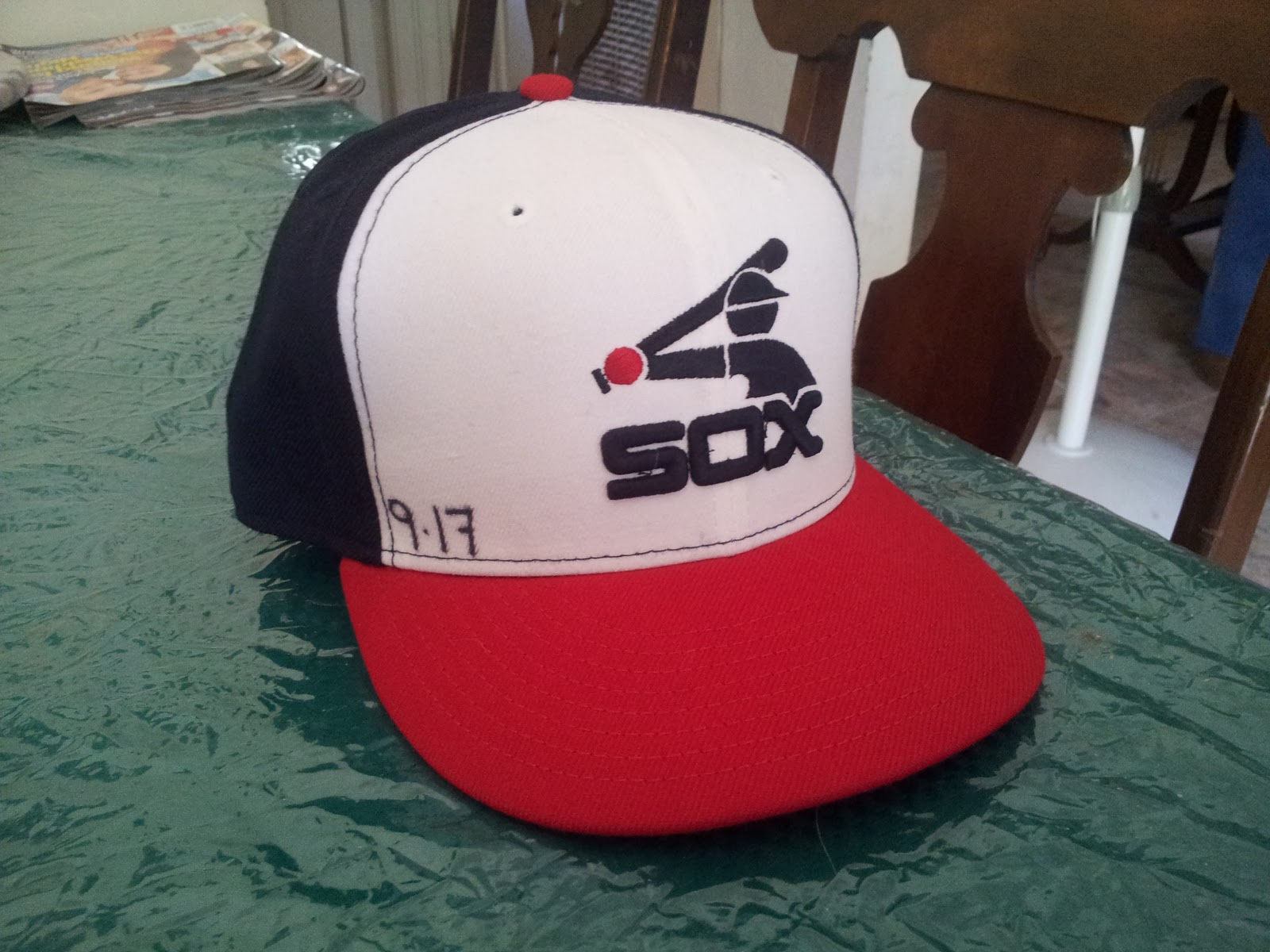
This Chicago White Sox hat is one that I really liked from a distance, but never fully understood why I picked it up. If you recall in my Cincinnati Reds post from yesterday, custom hats can be cool, but only as long as they make sense and have a purpose. This is one of the few hats that I definitely enjoy having on my wall, but always feels a little weird wearing it as the White Sox themselves never wore in their history. Rather, like the Reds hats from yesterday, the logo on the center of this cap was never featured on any of their hats. This logo, which is one of my favorites in MLB history, served as the team’s primary logo from 1976-1990, and was a frequent attraction on a lot of the baseball cards I came across during the 1980s. In fact, I like it so much that I had it tattooed on me as my representation of the White Sox for the American League half of my MLB tattoos.

There is a very similar hat that the White Sox did use and are bringing back for the 2013 season, but I will write about that in a future post. To be honest, I totally would have been on board if they ever made this into an actual hat. There’s something about it that doesn’t fit entirely with the old and current history of the team, mostly the colors and the lack of the classic interlinking “SOX” logo; however, it is an iconic throwback to the time when legendary, visionary owner Bill Veeck owned the team from 1959-1961 and then again from 1975-1980. This logo made its debut during the 1976 season as an innovative bicentennial themed emblem, hence why their colors changed to red, white and blue. While other teams opted the 200th birthday of our country by keeping things relatively the same, Veeck always knew how to make an extra buck, but also give the fan a much more intimate, original experience.

The marks on my hat were originally going to be used for another White Sox hat in my collection; however, I changed my mind in order to pay tribute to a Veeck-created even that I will write about in July. Since the numbers I have in mind fall suit with the time frame in which this logo was used, I felt it was a perfect choice.

#9- One of the first, and most prominent Cuban-born players in MLB history, Minnie Minoso broke out was signed by the Cleveland Indians as a free agent in 1948 and made his debut in 1949, only playing nine games. It would be two years before he stepped onto a Major League field again at which it turned out to be the most successful of his career. In 1951 Minoso played eight games for the Indians before getting dealt to the White Sox. He finished the season in second place for the AL Rookie of the Year award as well as in fourth place for the MVP after batting .326 with 10 home runs, 76 RBI and a league-leading 14 triples and a league-leading 31 stolen bases. He also made the first of seven All-Star Game appearances with that campaign. Throughout his career Minoso finished in the Top-five for AL MVP voting a total of four times; 1953-1954 and 1960 being the other three years. In 1957 he was one of the first few players to receive a Rawlings Gold Glove award for being the best defender at his position, left field, an honor he would go on to receive two more time throughout his career (1959-1960). Minoso was a very disciplined batter, always sacrificing his body for the good of the team which he did to the tune of leading the league in hit-by-pitches a total of 10 times. He also led the league in stolen bases and triples three times each. He finished his career with a .298 average, 1963 hits and 1023 RBI. Of all of his accomplishments in the field the one thing Minoso is most known for is being one of two players in MLB history to play in five different decades: 1949-1964, 1976 and 1980; three-time World Series champion Nick Altrock is the first to accomplish this feat. Minoso’s professional career did not end after the 1980 season; he went on to make appearances in with the St. Paul Saints in 1993 and 2003, being the only player in professional baseball history to play in seven decades. In 1990 Minoso presented the lineup card for the White Sox in a new uniform they were debuting on September 30, the final game ever played at Comiskey Park.

#17- This one is kind of an interesting pick, but Oscar Gamble’s best year of his career came in the first of two years that he played for the White Sox; those years being 1977 and 1985. Gamble made a few stops around the league, but the two teams he is mostly remembered for al the Indians and the New York Yankees; however, the best year of his career came during the ’77 season when Gamble finished in 29th place for the AL MVP awards with a career bests in home runs (31), RBI (83), doubles (22), games played (137) and runs (75). Also, when you look this awesome as you accomplish all of these feats, it’s totally worth recognizing.