Showing posts with label Los Angeles Angels. Show all posts

Thursday, June 20, 2013

June 15- Fort Wayne Wizards


If there is a particular line in any baseball-related film that’s stuck with me throughout the years it has to be this one said by Shoeless Joe Jackson, played by Ray Liotta in “Field of Dreams” getting thrown out of baseball, “Getting thrown out of baseball was like having a part of me amputated. I've heard that old men wake up and scratch itchy legs that been dust for over fifty years. That was me. I'd wake up at night with the smell of the ball park in my nose, the cool of the grass on my feet... The thrill of the grass.” There’s something truly haunting about never being able to do what you love again, and it’s definitely a feeling I hope to never experience. I love baseball; probably more than a grown man should. As a kid all I ever wanted to do was play baseball. Morning, noon and night my friends and I went to the school yard and played until we couldn’t see the ball anymore. I played Little League until I was 13-years-old, not that I didn’t want to keep playing, the unfortunate reality of my parents’ divorce prevented me from continuing to play every summer as my mother had moved to Pismo Beach, California, about an hour-and-a-half away from my hometown of Bakersfield. My father had been the coach of my teams ever since I was nine-years-old, and no one took it harder that I wasn’t going to be around to play as much as he did. For the next four years I played baseball off-and-on, alternating with basketball and soccer on occasion. I was good at the other two sports, but the reality was that I was truly a prodigy when it came to baseball. I know it sounds arrogant for me to say, but it’s the truth. It didn’t matter if I stopped playing physically, my mind kept going, analyzing new and better ways to get a read on a ball once it was thrown or hit so I knew how to move my body. I played one year of summer league ball once I got into high school, but once again had to move away for the summer to be with my mom, this time in Vancouver. Washington. In 1999 I stayed in Bakersfield for the whole summer. I had scored my bat boy gig with the Bakersfield Blaze and had no intentions on leaving it. This summer, as it turned out, would be one of the last times I’d ever play organized baseball.

I touched on this in a previous post on March 7th.  Since the Blaze were on the road my friends and I had the privilege of using Sam Lynn Ball Park to practice and play scrimmages in. Word got out and a few guys from the high school teams around the city starting hitting me up, asking if they could play as well. It was almost like my little clubhouse and I somehow became the leader. I obliged. There was no sense in keeping anyone out, especially considering the fact that I would be able to study them as I had intentions of going out for the varsity team the next season.

On an extremely hot 105 degree day in the middle of July my life was forever changed. The thing about Sam Lynn Ball Park is that it was built in the wrong direction. By this I mean the sun sets directly behind the center field wall. Even more important is that a sun shield was built to help get games started earlier as the sun goes down. Even funnier, the sun shield was built a few feet off. See?

It should also be noted that dead center is only 354 feet away, and not that difficult to knock one out during batting practice. Believe me, I don’t have much power but I’ve been able to do it. Anyway, on this particular day the sun was practically blinding everyone who came to the plate as it was around 3:30 in the afternoon. We were playing a full nine innings and I came up to bat for the third time, set to face off against my friend Jason who was on the pitchers mound. The first two pitches I took for a ball and a strike. I lucked out on the ball. I really couldn’t see it. On the third pitch I could tell by his wind-up that he was going to try and throw me a slider. Having known him and played on the same team as him for so many years it all seemed like it was going in slow motion. As he released the ball I could tell he screwed up. The ball was coming in way too high. For some reason my eyes looked upward briefly, catching the sun and I could no longer see the ball. Knowing that it was more-than-likely go in for a ball, I stood there. Within a split second my vision came back, but it was too late. The ball struck me dead center between my nose and my upper lip. I had been hit by plenty of baseball in the past; some in the back, a few in the leg and one or two in the ribs. But the pain of getting tagged in the face was excruciating. I stumbled back and bent down. Somehow I never fell to the ground. Jason came sprinting off the mound to make sure I was ok. I had difficulty finding words. The pain was too much to get anything out. Tears feel from my eyes, but I didn’t cry. When you get tagged in the nose it sets off a chain reaction that waters up your eyes, and I had it bad. Blood poured from my nose, onto my jersey and the ground. I looked up briefly and patted him on the back to let him know I didn’t have any hard feelings against him. Still a bit dazed, I started walking to first base. In my head I knew I got a free base after being hit, but the gravity of the situation hadn’t set in. A few of my other friends and the guys on the field tried to get me to sit down and have some water, but I just wanted to keep playing.

I never went to the hospital. It would be two years before I learned that I suffered post-concussion syndrome which I found out through an electroencephalography (EEG) test. I also learned that my brain rarely shuts down, which is why I usually never sleep. Either way, the damage was done. I was so mentally scarred from that event that anytime I stepped in the box after that I froze. I had no confidence. I was useless. Any dream I ever had of playing professional was gone. It took a few years to muster up the courage to play Portland City League and I was fortunate enough to hit .712 in my only season, but I felt I was too old and missed my window. I pretty much hung it all up after that.

I still have dreams of being in the box on a near-nightly basis. Not necessarily of me getting hit, but scenarios and pitch counts, and knowing what to do in any given situation. That part will never go away, and deep down, it truly saddens me. It’s been almost 14 years. Nearly half of my life, a glimpse of an unattainable moment from my past that will play on repeat for the rest of my life.

I realize I took you all down a weird road, but I promise you it has a point that has everything to do with this cap. I can pretty much come close to guaranteeing that had that moment never happened I probably would be sitting here today to write this story; nor would I have had the opportunity to be one of the nine Cave Dwellers in the MLB Fan Cave last season. Of all the people I had the pleasure of meeting, then-Los Angeles Angels and current New York Mets relief pitcher LaTroy Hawkins certainly rounds out the top.

For those of you who don’t know Hawkins turned 40-years-old on December 21st of this last year. The occasion took place in Las Vegas and was orchestrated out by his wife. I won’t go into too heavy of details, but the only reason I know this is because he was kind enough to invite me, but I unfortunately couldn’t afford to take the time off of work as I was saving my money to fly to Florida to see my girlfriend Angie Kinderman. The reasons behind how I got invited are insignificant, but all I can really tell you that it was by far one of the most thoughtful gestures I’ve ever received from a truly amazing person. The reason I went into so much detail on how I lost my ability to play baseball over half a lifetime ago is because Hawkins has literally been playing professionally for a little more than half of his. He and I, from a professional stand-point, are polar opposites.

Hawkins was born in Gary, Indiana in 1972. For those of you who don’t know, Gary is roughly 25 miles southeast of Chicago. Gary's fortunes have risen and fallen with those of the steel industry. The growth of the steel industry brought prosperity to the community. Broadway Avenue was known as a commercial center for the region. Department stores and architecturally significant movie houses were built in the downtown area and the Glen Park neighborhood. In the 1960s, like many other American urban centers reliant on one particular industry, Gary entered a spiral of decline. Gary's decline was brought on by the growing overseas competitiveness in the steel industry, which had caused U.S. Steel to lay off many workers from the Gary area. As the city declined, crime increased. The first time I ever heard about Gary was when I was 11-years-old, trying out for the roll of Winthrop in a church production of “The Music Man.” There was a particular song that I had to sing in which the character thinks that Gary is basically the greatest place ever; something that I’ll never forget. Another key note of Gary is that it was also the birthplace of pop music sensation Michael Jackson.

Hawkins was drafted in the seventh round of the 1991 amateur draft by the Minnesota Twins out of West Side High School in Gary. He immediately reported to the Gulf Coast League (GCL) Twins of the Rookie League soon after, were he went 4-3 with a 4.75 ERA and 47 strikeouts in 11 games as a starter. He spent the next four years in the Twins' minor league system until making his Major League debut on April 29, 1995 against the Baltimore Orioles as a starter. From 1995-1997 Hawkins struggled a bit as a starter and was moved to the bullpen to take over closing duties. In 2000 and 2001 where he saved a combined 42 games. When Eddie Guardado was tapped to start closing games Hawkins become a set-up man in 2002 and 2003, and had his best years statistically with the Twins during this time. He went 15-3 combined for those two years with a 1.99 ERA and 138 strikeouts. At the end of the 2003 season Hawkins became a free agent and was singed to a three-year deal with the Chicago Cubs.

Hawkins was assigned by the Cubs to pitch the 8th inning to set up for Joe Borowski, but Borowski went down with an injury early in the season, and Hawkins took over closing duties. On September 11, Hawkins struck out the side on only nine pitches in a game against the Florida Marlins. He finished 2004 with a better-than-average ERA of 2.63 on the year and 25 saves, but he was traded to the San Francisco Giants on May 28, 2005 in exchange for pitchers Jerome Williams and David Aardsma. At the end of the 2005 season Hawkins became a proverbial “gun-for-hire” as he went to the Orioles in 2006, the Colorado Rockies in 2007, the New York Yankees for half of a season in 2008 before going to the Houston Astros for the next year-and-a-half, the Milwaukee Brewers for two seasons (2010-2011), the Angels this last season and the Mets now. During this time frame he pitched a few games at the Minor League level as well, but mostly for the sake of rehab appearances. All in all, Hawkins has donned the jersey of 10 different Major League teams as he is now in his 19th season in the Majors, but 23rd year overall as a professional, just a little more than half of his life. Many at any level would give anything to be in the game at the highest level for so long, and Hawkins is surely one who praises every day he steps into the clubhouse.

During the time we met each other in the Fan Cave we only said a few words to once another, mostly about what it was like to be stuck in a room for so many hours during the day. When I got my Instagram account set up back in June of 2012 he, Collin Balester and I would swap jokes back and forth amongst each other, and every now-and-then I found a “like” by Hawkins on a few of the photos I added. The most notable being the Jackie Robinson statue that sits outside Olympic Stadium in Montreal, Quebec, Canada, one of my favorite nights from my North American baseball tour.

When I was down in Corpus Christi, Texas visiting my little sister at school after we had gone to the Houston Astros game the night before, I talked to Hawkins for the first time in a few months on Twitter, but only after he had gotten into a bit of a spat by some punk talking smack. This is an unfortunate occurrence that I see more regularly than I’d like, all of which is started by raucous fans. I always make sure to applaud Hawkins for standing up to all the smack talk, no matter the consequence. I suppose after nearly 20 years of service, not to mention coming from one of the toughest towns in the United States, you can’t help but let his words slide. He earned the right to defend himself.

In the upcoming week I gave Hawkins a heads up that I would be in Arlington for when the Angels visited to play the Texas Rangers. During batting practice my friend Monica Gonzalez (@MissMoniRose) and I went up against the railing to spot him, and sure enough he spotted my big-ass beard and came rolling over to visit. We caught up as best we could. I had no idea of invested he was in my travels as he had been following my tour through all the photos I was posting on Instagram. We talked about food, the ballparks and pretty much everything else baseball related on top of how the season was looking tight between the Angels, Rangers and my Oakland Athletics as the last few games were shaking out. It was within this conversation that the topic of his birthday came up and he asked me to send him a direct message with my info to get to his wife. I of course obliged as soon as I could. We said our goodbyes and he went back to shagging balls during BP. As Monica and I walked away it dawned on me that I forgot to take a photo. I ran back across the left field bleachers, hailed him down again and popped this shot. I don’t normally ask people to pose for my photos, but in this case, based on the fact that he mentioned my photos, I had to do it.

It’s hard to say if we’ll ever meet again, my sources say yes only because I always seem to find myself in the right place at the right time more times than one could imagine. But until then, I hope this piece serves as a solid tribute to one of the iron men of Major League Baseball.
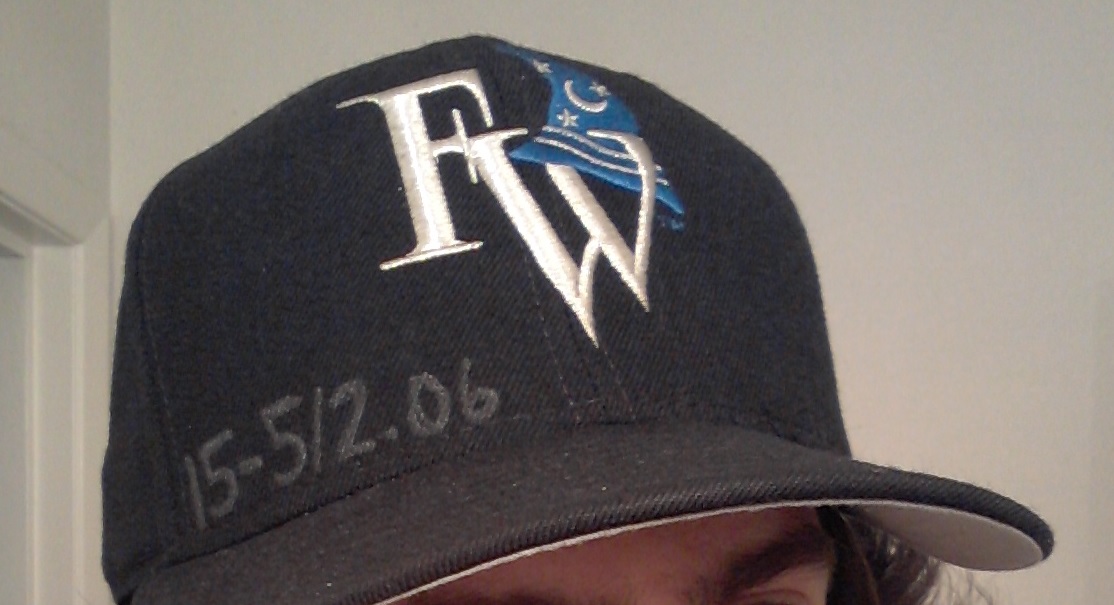
15-5/2.06-  I was fortunate enough to come across this cap on Ebay thanks in part to a fellow New Era Caps enthusiast by the name of John Beare (@Interstate19). He had casually mentioned that he saw it and thought I might be interested. Believe it or not, I had been trying to track down the hat for some time and immediately purchased it for the excellent price of $12 including shipping. Hell, it still had the tags on it.

The Fort Wayne Wizards used this cap from 1993-2004, changing it once to a wider "FW" logo without the wizard's cap in 2005 before they changed their name to the Tin Caps for the start of the 2009 season. The Midwest League came to Fort Wayne, Indiana in 1993. The franchise dates back from the league's days as the Illinois State League, starting in 1947 in Mattoon, Illinois. In 1958 the team moved to Keokuk, Iowa, where it spent five seasons; it was based in Wisconsin Rapids, Wisconsin (1963–1983) and Kenosha, Wisconsin (1984–1992) before moving to Fort Wayne. From 1993-1998 they served as the single-A affiliate of the Twins before converting to the San Diego Padres in 1999 which still stands as the main affiliate to this day. The one detail about this cap that still puzzles me is why they chose the Wizard hat style that they did. To be honest, it reminds me of the hat Mickey Mouse wore in the Disney animated feature “Fantasia.” Even more surprising, I’m shocked Disney didn’t come to the same realization and get sue-happy.

Of all the moments in the team’s history that I could write about I still find myself drawn to Hawkins’ career; specifically the 1993 season, which, as mentioned above, was also the first season in the history of the Wizards era.

Fort Wayne is roughly 132 miles east of Gary, so not too much of a culture difference for Hawkins when he took the mound for the Wizards in 26 games, 23 of which were as a starter. That season Hawkins had undoubtedly the best year of his career (statistically) including the Majors. He went 15-5 with a 2.06 ERA and 179 strikeouts. Sadly I ran out of room to add the 179 in on my hat, but I made due with what I had. I was also lucky enough to come across some photos of his time with the Wizards which were taken 20 years ago to the date.

It’s moments like this where I realize I ended up where I need to be. As much fun as it would have been, and as great as a fat paycheck would be, I just love researching and telling these stories. God has a plan for all of us. Sometimes we know it on the spot from birth, other times we have to go through half of our lives for the light bulb to click on. I’m perfectly content with the gift and the path God ultimately chose to bestow upon me. It took some time, but the itch is gone. Now, it's just fun to play when I can.

Friday, May 3, 2013

May 3- California Angels


It took me a while to get my thoughts together for this post as I really didn’t have anything to inspire where to start. If you haven’t noticed in any of my other New Era Cap posts you can get a sense of my mood on the day. Some times I can put together something truly extraordinary, while with others it turns into a bit of struggle and I find myself writing more about historical facts with little-to-no personal investment. With this one I sat at my computer for a solid two hours shuffling through You Tube videos and watching a bit of the day’s games to find something to help make the words come out, but nothing was working. As the Oakland Athletics and New York Yankees game came to a close I hit play on the first song dialed in on my Itunes; “The Entertainer” by Scott Joplin. Chances are you’ve heard it. And if you haven’t then may God have mercy on your soul. Here you are: http://www.youtube.com/watch?v=fPmruHc4S9Q

One thing that very few people know about me is that I’m a huge music buff. Even though the vast majority of my music collection is derived of classic rock hits from the 1960s through 1980s, I honestly can’t concentrate on my writing when I know all of the words to the songs. In most cases I end up writing out what I’m listening to. It’s kind of funny, but it really isn’t productive. Roughly three years ago I started experimenting with only instrumental songs; mostly scores and operatic melodies by the likes of Mozart, Bach, Beethoven and even a few from Jaqueline Schwab who did the score for Ken Burns Baseball. What I soon realized is that I was able to articulate myself better and not just interject points in a rant style. In the case of “The Entertainer” I noticed that my brain was bringing up moments from my past; including old highlight reels from the earlier days of baseball. So, like today, I can put together a better story; because after all, it’s hard to take information of something I wasn’t alive to see and turn it into something that can provide visuals and a real-time experience for the readers. I’ve done this for 122 straight days and still have 243 days to go including today. That’s a lot of baseball and storytelling right there.

I’m a huge fan of “The Simpsons.” Yes, I’m one of those people who can rattle off quotes and otherwise useless knowledge of the show that very few people have ever given though to. One of the biggest things I’ve taken pleasure in over the years is outsmarting anyone who says they’re a big Simpsons fan themselves. Usually the conversation starts with one person making a reference, I laugh and then the person will remark something to the tune of, “Oh! You know that quote? Do you watch “The Simpsons” often? If you do, I bet I know more than you.” This has been a similar start of conversations I’ve had with people concerning rock and roll, films and of course baseball. To me, it’s amusing. To them it’s a slow, yet inevitable death. I don’t mean to brag about it; I have no control over the way my brain processes and retains information, but I am grateful for it. The reason I bring all of this up is because of the song I listed above, “The Entertainer.” If you know the song and you know “The Simpsons” you might remember the first episode of the ninth season called “The City of New York versus Homer Simpson.” In it Homer’s friend Barney Gumble loses Homer’s car in New York City and Homer has to go back to retrieve it as parking tickets have continued to pile up on his windshield. Homer doesn’t wan to go as his one and only trip to the city was met with folly as shown in an old-style black and white film form with “The Entertainer” playing in the background. Every time I look at the California Angels cap with this song playing the background I can’t help but have a similar story being told in my head. Not necessarily Sandy Alomar losing his car in New York City, but as system of poor playing resulting in a field of errors for the Angels that season. With that, here we go…

This cap is one of the more ingenious, but shortest-lived hats in the Angels history. It was only used for one season in 1971 to accompany the new uniforms the team had introduced which featured the lower-case “a” with a little halo in the top-left corner that said “angels” across the chest. Even though the team only used the hat for one season they used the jersey for an additional season in 1972 to pair with the upper-case “Å” cap that I wrote about back on February 25th; thus proving that questionable decisions have always been a longstanding part of the Angels organization.

’71: 1971 had to be one of my marks as a reminder of when the cap was actually used, but more important I couldn’t find the jersey number for their manager that season. ’71 was the final year of then manager Lefty Phillips who had his only stint as a Major League manager from 1969-1971, all of which came with the Angels. Lefty joined the Angels at the start of the 1969 season to work in the front office alongside his good friend, and former Los Angeles Dodgers executive Dick Walsh who had just been hired as the Angels’ general manager. Prior to joining the Angels Lefty had been the pitching coach for the Dodgers from 1965-1968, working with such notables as Don Sutton, Don Drysdale and Sandy Koufax. I’m not sure what happened to those three, but I’m sure they all did good things in their careers. Kidding. All three went on to get elected into the National Baseball Hall of Fame and the Dodgers won the World Series in 1965 behind the trio. When Walsh took the job with the Dodgers he convinced lefty to follow, assigning him to the post of director of player personnel. Lefty only lasted in that position for a little over a month into the season before being assigned to take the helm of the Angels.

Lefty’s “rookie” season came as a midseason changing of the guard when the Angels fired then manager Billy Rigney who had been the team’s first and only manager since 1961. After going 11-28 to start the ’69 season he was replaced by Lefty who ended up going 60-63 for the rest of the year. In 1970 the Angels tied their best season record of 86-76, a mark previously set by Rigney and the 1962 Angels squad. In ’71 the Angels finished with a record of 76-86, which was far from the worst finish they had sustained in their 11-year existence; however, Lefty was still canned after 2 ½  seasons as the team’s skipper, as was Walsh as GM. He went 222-225 as manager, but was still retained by the Angels to carry-on as a scout as he had previously done in previous season with the Cincinnati Reds and Dodgers. On June 12, 1972 Lefty suffered an asthma attack late in the evening and died as result. He was only 53-years-old.

#11- If there was ever a person who I would consider to be the face of the Angels franchise I would have to go with Jim Fregosi. My sincerest apologies to all of you Tim Salmon and Garrett Anderson fans out there, but Fregosi takes this one. Originally a free agent signing in 1960, Fregosi was scooped up in the expansion draft at the end of that season and made his Major League debut on September 14, 1961, the same first day of the Angels organization in the Majors. His career with the Angels went from 1961 through, oddly enough, the end of the 1971 season. He played for another seven years for the New York Mets, Texas Rangers and Pittsburgh Pirates until he hung up his spikes (as a player) at the end of the 1978 season. What’s most interesting about his time with the Pirates coming to an end was that the Angels had tapped him to take over as the team’s manager while he was playing and the Pirates released him so he could pursue that venture at the age of 36. To my knowledge that’s the only time I’ve ever known a manager to be hired while he was playing for another team.

1971 played an important part in Fregosi’s playing career as it was statistically one of the worst seasons he had ever recorded. This goes back to what I was talking about with “The Entertainer.” From 1964-1970 Fregosi had made the AL All-Star team every season except 1965. From 1963-1970 Fregosi had cracked the Top-28 or better in the American League MVP vote. In 1967 he won his only Gold Glove of his career as a shortstop, his natural position. That season was also the best of his career offensively too as he finished in seventh place for the AL MVP, his best finish, with a .290 average, nine home runs, six triples, 171 hits and 56 RBI. In 1971; however, Fregosi hit .233 with 81 hits including one triple and five home runs. He also knocked in 33 which I only added for a consolation prize. It’s not like very many Major League stars to be so consistently good for so many consecutive years only to have a personal-worst season of their career and never rebound from it. Actually, there is a viable explanation for what happened to Fregosi. Early on in the season when his numbers weren’t looking to hot he complained off-and-on about a pain in his foot. The team doctors looked at it, but really didn’t find anything wrong and sent him back out into the field. Finally the problem became severe to the point where Fregosi went to the hospital to have it looked at. It was then that doctors discovered a tumor. His season was over. The Angels, being the classy organization they are, were uncertain of his future in baseball and convinced the Mets to take him as part of a trade that sent Nolan Ryan to the Angels. Where the Angels lacked in compassion they certainly made up for it in “f---ing the other guy over hard.”

I suppose the Angels did make it up to Fregosi down the road with the whole managerial job thing in ’78. Hell, he and the Angels even made the postseason in 1979 for the first time in franchise history… and then, in classic Angels fashion, he was fired in the middle of the 1981 season after going 22-25. What’s even more ironic about this is that the Angels started doing poorly after Nolan Ryan signed with the Houston Astros at the end of the ‘79 season. So in short: the Angels and Nolan Ryan hosed Fregosi two times each.

It wouldn’t be until 1998 that the Angels would finally retire Fregosi’s #11; 28 years after he last played for them and 17 years after he last managed them. I just have to laugh and shake my head at this one. If you haven’t yet, play “The Entertainer” and go back and read this section on Fregosi and it will all make sense why I chose to write about it.

It’s also kind of funny that this hat ended up being my post for the day as it was one of four hats I had my mom mail out to me from Oregon as I didn’t quite bring enough to write about from my extended stay with my girlfriend Angie Kinderman (@sconnieangie). A few nights ago, when the Athletics beat the Angels in back-to-back nights, including a 19-inning thriller at the Coliseum, I made a few jokes on Twitter about the Angels bring back Fregosi and fire current manager Mike Scioscia. Only one person really got the joke, Carey Gallé (@CareyGalle). Carey and I cut it up with one another on a nightly basis as he’s a loyal supporter of the Halos, but even I was surprised that very few Angels fans knew what I was talking about. I think he’ll agree with me; Fregosi for life!

Monday, April 8, 2013

April 8- Anaheim Angels


By no means am I a Los Angeles Angels/Anaheim Angels/California Angels/Los Angeles Angels of Anaheim fan; however, there have been a few moments in time when I can honestly say that I have a lot of respect for their team, players and fans. 2002 is not one of those years, but that’s the Oakland Athletics fan inside of me talking.

Unlike their Southern California counterpart the Los Angeles Dodgers, the Angels have had a lot of weird years and certainly made their fair share of bad deals in order to entice talent to make the pilgrimage out to the West Coast in order to buy a World Series title. Unlike the New York Yankees and Dodgers, the Angels have also made a lot of interesting attempts to usher in the new era of their recently acquired superstars with a changing of their logo and colors. In fact, of all the teams who have been around since the early 1960s, the Angels have been one of the more notorious teams to not follow my unwritten rules of how to be successful when making such drastic changes to the uniform. Those rules would be:

1. Don’t do it unless you have a more than capable general manager.

2. Don’t do it unless you have a competent designer and marketing staff.

3. Don’t do it unless your intention was to make the fans cower under their throw blanket door prize with a brown paper sack in which to barf in because the amount of activity on the uniform has made them nauseous.

With that, I give you the 1997-2001 Anaheim Angels.

During this five-year span the Angels introduced three caps. One of them featured the “A” logo with angel wings like in the picture above, but with navy blue panels and a navy blue bill and the other was exactly like the one above but was made of mesh with a red bill and served as the team’s batting practice cap. Both of those hats will be talked about at length in later posts. This hat served as the team’s alternate hat from 1999-2000, and to be honest, it’s actually a pretty sweet cap. My biggest issue with this era lies more heavily on the pinstriped jerseys with navy blue sleeves. The really sad part in all of this is that I actually own one of those jerseys. This one to be exact…

Oh the humanity!!! It’s one thing to class up a jersey with pinstripes, but it’s another thing to make the sleeves a different solid color and adding patches to them.

1999 was an interesting year for the Angels. The team finished the season in fourth place in the American League West division with a record of 70-92, and with a changing of the guard at the end of August. Former manager and current New York Mets manager Terry Collins had managed the team since the start of the 1997 and produced back-to-back second place finishes within the division, both of which were winning records. After taking the team to 51-82 the Angels brass had enough and replaced Collins with former bench coach and current Tampa Bay Rays manager Joe Maddon. Maddon finished the season going 19-10, yet for some reason was demoted back to bench coach in 2000 to make way for current manager Mike Scioscia. Even though Scioscia and company won the World Series in 2002, the team has yet to taste similar success after Maddon and one of Scioscia’s other coaches, Bud Black, took managerial jobs with other teams. The best way to look at this is how former Green Bay Packers head coach Mike Holmgren had a so-so career after assistant coaches Andy Reid, Tony Dungy and Jon Gruden all took head coaching jobs elsewhere after winning the Super Bowl in 1996. But I’m getting way too ahead of myself.

Very few people could see it, but 1999 was the key turning around point for all of the Angels’ misfortune even as peculiar as my rationale may be. Mo Vaughn had just been signed to a hefty long-term deal after the 1998 season and had modest success in the two full seasons he played with the team; however, it wasn’t until they traded him to the Mets for Kevin Appier that the team became well-rounded on both sides of the ball. From 1999-2000 the Angels lineup had become more offensive heavy and they overlooks rebuilding their pitching staff; kind of funny how in 2013 the same things appears to be happening. Solid draft picks and a keen attention to their farm system helped, but the most critical thing to change prior to the 1999 season was the passing of owner Gene Autry on October 2, 1998.

With that, my marks for this cap…

#25- One of the best moves the Angels ever made in the history of their franchise came in 1997 when they drafted a power-hitting third baseman out of UCLA with the third overall pick in that year’s amateur draft. On July 31, 1998 he made his debut wearing #12 and had a modest impact in the team batting .218 with one home run and 23 RBI in 48 games. Despite those numbers, Terry Collins named Troy Glaus as his starting third baseman at the start of the 1999 season.

It’s kind of shame that Glaus played in so many games in ’98 because his .240 average with 29 home runs and 79 RBI probably would have made him a legitimate contender for the AL Rookie of the Year award which went to Carlos Beltran of the Kansas City Royals. In 2000, under this hat, Glaus awkwardly and quietly had the best season of his career. He hit career highs in batting average (.284), stolen bases (14), walks (112), hits (160), OPS (1.008) and home runs (47), which was also the highest amount in the League that season. Glaus also had 102 RBI, which is the third best for his career and 37 doubles, which is the second best for his career. Despite all of those numbers, Glaus didn’t even crack the Top-30 for MVP votes that season. Instead all he was given was a Silver Slugger award and a trip to the All-Star Game. Based on the numbers of the other parties involved, Glaus should have finished at least in the Top-15 for the award. This is one of the few times I will admit that the Angels got hosed.

Glaus’s career with the Angels ended in 2004 after he suffered a shoulder injury that the Angels felt would be an issue for the rest of his career. When his contract expired at the end of the season the Arizona Diamondbacks signed him to a four-year $45 million deal while the Angels opted to make Dallas McPherson their new third baseman with the hopes that he’s be just as productive as Glaus. Ha! Glaus finished his career with the Angels with a .253 average, 182 home runs, 515 RBI, three trips to the All-Star Game, two Silver Slugger awards, a World Series ring and a World Series MVP award after going .385/3/8 in the series.

#26- Gene Autry, the Singing Cowboy, was born on September 29, 1907 and was a singer and actor on radio, television and film. He was active in front of the microphone/camera from 1931-1964 and is a member of the Country Music Hall of Fame and Nashville Songwriters Hall of Fame. Oddly enough, the three songs that brought him the most success for his career, besides “Back in the Saddle Again,” are “Here Comes Santa Claus,” “Frosty the Snowman,” and Rudolph the Red-Nosed Reindeer.” Autry served as a pilot of a C-47 Skytrain for the US Army Air Corps during World War II, flying dangerous missions over the Himalayas between Burma and China.

At the tail end of his showbiz career Autry bought numerous radio stations including KSFO in San Francisco, a handful of TV stations and had been in over 100 films and recorded over 600 albums; however, like most people of the era, Autry was a huge baseball fan. As a teenager Autry had turned down the opportunity to play professionally and did the next best thing in 1950s; he bought a team.

In the 1950s Autry had been a minority owner of the minor-league Hollywood Stars. In 1960, when Major League Baseball announced plans to add an expansion team in Los Angeles, Autry expressed an interest in acquiring the radio broadcast rights to the team's games. Baseball executives were so impressed by his approach that he was persuaded to become the owner of the franchise rather than simply its broadcast partner. The team, initially called the Los Angeles Angels (which came from the Pacific Coast League team which played from 1903-1957) upon its 1961 debut, moved to suburban Anaheim in 1966, and was renamed the California Angels, then the Anaheim Angels from 1997 until 2005, when it became the Los Angeles Angels of Anaheim. Autry served as vice president of the American League from 1983-1998. In 1995 he sold a quarter share of the team to The Walt Disney Company and a controlling interest the following year, with the remaining share to be transferred after his death. Earlier, in 1982, he sold Los Angeles television station KTLA for $245 million. He also sold several radio stations he owned, including KSFO, KMPC in Los Angeles, KOGO in San Diego, and other stations in the Golden West radio network.

Autry passed away at the age of 91 in 1998 and this patch was worn by the players throughout the 1999 season.

The #26 was actually retired in 1992 as the Angels and the Anaheim community had called Autry the 26th member of the team. Even though he wasn’t alive during the World Series run of 2002, the media expressed great accolades toward Autry for his work with the team, with MLB and most important the community he had fell in love with who fell in love with him so many decades ago.

April 7- Lake Elsinore Storm


I’ve found myself matched up against a bit of a road block. I had tried to do research on this particular Lake Elsinore Storm hat about a month ago, but found myself in a very similar place when trying to do research on two of the players that I knew from the 2000 season, but I’ll get to that later in the post.

The Storm have been an advanced-A club since 1994 when they were an affiliate of the California/Los Angeles Angels from then until the end of the 2000 season. The original ballclub went through a series of relocations and team name changes from 1979-1994, but had no actual affiliation with a Major League club until the Angels took over in ‘81. At first they were the Santa Clara Padres in 1979, then they became the Redwood Pioneers from 1980-1985 and then the Palm Springs Angels from 1986-1993. The team moved to Lake Elsinore in 1994 as their new stadium, Lake Elsinore Diamond (Pete Lehr Field) opened that same year. The park has a capacity of 7,866 fans and is the largest capacity stadium in the California League. On July 4, 1998 the Storm broke the single game attendance record by housing 12, 876 fans for their Independence Day game a fireworks celebration; which only goes to show, the combination of baseball and explosions is too hard to resist.

This cap was one of the first hats I ever purchased during the 1999 season, my first as bat boy for the Bakersfield Blaze. It was kind of an unusual purchase, especially when considering that not only did I work for one of their rival teams, but their Major League affiliate is the divisional rival for my favorite Major League team the Oakland Athletics. However, this hat was way too cool to pass up. It made its debut, along with me, at the start of the 1999 season and has been one of three consistent hats the team has worn including throughout their recent four-game series against the Rancho Cucamonga Quakes. It's also a 7 1/8, which is two sizes smaller than I currently wear, but I definitely made sure to wear it anytime I played summer league ball. It certainly has some mileage on it.

During my two-year run with the Blaze I never really got to know any of the players on the Storm. It wasn’t that I really tried; it had more to do with the fact that all of the players kept to themselves. Only one member of the 1999-2000 teams ever really talked to me, Nathan Haynes. Haynes was a former A’s first round draft pick in 1997 and grew up in the city of Oakland. He and I chatted every now-and-then about how we were both longtime A’s fans and how he and my brothers Matt and Adam practically grew up next door to one another as we lived in the neighboring town of San Leandro. I don’t recall if my brothers and he played in the same youth baseball leagues or not, but for all I know they could have since they were all the same age.

The Storm always played the Blaze the toughest for both years, but neither could really compete with the San Bernardino Stampede who won back-to-back Cal League championships those years. Looking back on those years it was the 2000 Storm squad that turned out to be the most vicious despite the fact that it would be the 2001 team that would win the second of their three total Cal League titles. At the time I didn’t realize how many players would end up playing in the Majors, but I can still recall how talented they were back in the start of their professional careers. Guys like Gary Johnson, Robb Quinlan, Alfredo Amezaga, Steve Green and Scot Shields. But it was these two guys that carried most potential in their pockets.

#?- After quite a bit of research and a phone call to the team’s front office, I still haven’t been able to track down this jersey number; however, I should get a call back in the next few days with that information so I can update and mark up my cap.

John Lackey was a second round draft pick by the Angels in the 1999 amateur draft out of Abilene, Texas. Lackey started out in Boise with the Hawks, the low level-A affiliate, in ’99 and finished the season with a 6-2 record and an ERA of 4.98. In 2000 Lackey started the season out with a higher level-A club, the Cedar Rapids Kernels and pitched in five games with a 3-4 record and an ERA of 2.08 before moving on to Lake Elsinore.

Due to scheduling and pitching rotations I was only able to catch Lackey for one game when the Storm arrived at Sam Lynn Ballpark in late May. The first thing I can recall about Lackey is that he was much skinnier, kind of like Troy Glaus when he first made it to the Show. The second thing I recall is that he was deadly accurate with his pitches. Lackey in his youth was able to blast knee-high pitches that barely painted the black by batters with little-to-no effort. His curve ball had a solid break and his changeup always left people guessing. In the 15 games that Lackey started he went 6-6 with a 3.40 ERA and 74 strikeouts, six of which came against the Blaze. Lackey moved on to AA Erie to play with the Sea Wolves (awesome name) before the season wrapped up and by the middle of 2002 he up at the Major League level winning a World Series ring with the Angels, finishing the season in fourth place for the Rookie of the Year award.

While most people don’t like him as a person, it’s still a damn shame that he blew his arm out again in is first start with the Boston Red Sox a few days ago.

#?- Yet another mystery for the moment, Francisco (K-Rod) Rodriguez was a free agent signing by the Angles in 1998 out of Caracas, Venezuela. In 1999 he made his Minor League debut with the Butte Copper Kings at the Rookie level where he played in 12 games, nine as a starter, before moving on to the Hawks for the remainder of the season. In 2000 he found himself reporting to Lake Elsinore where he started in 12 games and coming out of the bullpen for one extra inning effort. It was interesting to watch him pitch back in the day because he was physically not the same player as today. The key difference: glasses. In his early years he was a little wild. With the amount of force he was able to propel his pitches it wasn’t much of a surprise that a few pitches would go wayward. He was only able to strike out 74 batters that season behind a 4-4 record and a 2.81 ERA in 64 innings pitched. For a guy who would be converted into a closer role by 2004 that’s actually quite impressive.

One thing I can definitely say is that there was no way I could have ever imagined that he would end up breaking and setting the record for the most saves in a season in 2008 with 62. While he has fallen on harder times since signing a huge contract with the New York Mets, there is no doubt that his talent is unquestionable. The kid can throw smoke.

Now, I’m hoping to get these numbers on my hat soon and I will definitely update the photos and article when I’m able to find them. If you know anyone who might know the answers, please feel free to send me a tweet. Thanks!

Monday, January 28, 2013

January 28- Salt Lake City Bees


Very few people know this about me, even though I openly talk about it often, but I was born and raised in the Church of Jesus Christ of Latter-day Saints. I’m short, I’m Mormon. Let that sink in as you think about the foul language I speak, the tattoos I have and the beer I drink. Yes, it’s a bit hypocritical of me in theory; however, I’ve always done my best to be a good person, love my family, help out anyone who needs it and I still love and respect God. I’m an incredibly open person and hope you are too as I continue as bits and pieces of this blog involves my religion and church.

The current incarnation of the Salt Lake City Bees was founded in 1994 after then owner Joe Buzas moved the Portland Beavers to Utah. For those keeping score at home, this is the second post I’ve written in which the Portland Beavers relocated their team. From ’94-2000 the team was known as the Salt Lake City Buzz, but were sued and forced to change their name by Georgia Tech as their mascot, a giant yellow jacket, has the same name. From 2001-2004 they were known as the Stingers. In 2003 Buzas bought the farm and Utah Jazz owner Larry H. Miller bought the team. In 2005 the team then changed their name again to the Bees, a throwback to the original baseball team that occupied Salt Lake City from 1915-1926. Now, when it comes to other sports franchises, most tend to not only change their name, but also their mascot. By this I mean, and especially when a law suit is on the table, most teams will distance themselves from any trace of the reason for the law suit. The Bees; however, is one of the most perfect mascots and team name for any fixed location in sports.

Back in 1849, when Brigham Young and the Mormon pioneers migrated to what is now Utah, they settled in a vast, agriculturally rich territory which they called the State of Deseret. This provisional state existed for only two years and was never recognized by the United States government. The most important part of this story is the word Deseret, which in the Book of Mormon is the word for honeybee. The state of Utah was founded in 1896 and adopted the beehive as their state logo, which is a fixture of the state flag. The state’s motto; industry, for which bees are known.

Back to the hat. This particular hat has been used since the start of the 2006 season. There’s really not that much to it. It’s black with a little bee dude swinging a bat. The logo isn’t even that big, but for some reason it’s perfect. It catches the eyes immediately and can go with almost any outfit combination. As for the marks…

#12- Howie Kendrick spent a fair amount of time in SLC, and did incredibly well every second he took the field. Specifically, I wanted to note his 2006 season. He only lasted 69 games in SLC, but spent 72 games in the Majors that season. His stats definitely helped push his case for a midseason call-up: .369/13/62 plus 11 stolen bases. Kendrick was easily on the fast track to getting up and staying up with the Angels. Unfortunately, Kendrick played a few more stints in SLC (2007-2009) for a total of 35 more games for rehab purposes. In all cases Kendrick averaged well over .400 combined.

#32- I remember Nick Adenhart’s start against the Oakland Athletics on April 8, 2009 as if it were yesterday. I was actually watching the game during class since it started at 3:13 PM PST. Adenhart was dealing like a veteran. He gave up seven hits and three walks, but struck out five and didn’t allow a single run in six innings. The Angels bullpen gave up six runs over the last two innings and the A‘s won 6-4. In mere hours following the game Adenhart and two of his friends were killed after a drunk driver ran a red light. It was strange. I was still awake when the news was announced and I couldn’t help but feel for his family and teammates.

I had only seen Adenhart pitch one game while he was with the Bees in a game against the Beavers in Portland. I honestly don’t remember how he did, but I certainly remember him taking the mound. Adenhart only played one season with the Bees in 2008, a season in which he also pitched three games for the Angels toward the end of the season. During his time in SLC Adenhart went 9-13 in 145.1 innings and had a 5.76 ERA. Based on the numbers, you’d think he was just a mediocre pitcher; however, if you saw him pitch in 2009, you’d have a different opinion. I couldn’t think of a better person to remember and share on this hat. I truly wish he could have had a long and fulfilling life.

Wednesday, January 23, 2013

January 23- Los Angeles Angels


The first time I saw this cap was sitting on the couch at the MLB Fan Cave, watching the Los Angeles Angels of Anaheim taking on the Seattle Mariners at Safeco Field on May 26 of this last season (2012). Ricardo Marquez and I both turned to each other, locked eyes and gave out a simultaneous, “Oooooooohhhhhh!!!” Yes, this hat is that awesome.

This hat is not new, but a throwback to the old life of the Angeles in Pacific Coast League, and also served as the inspiration for the Los Angeles Dodgers logo which has been going strong since 1958. The hat was only used for three years from 1955-1957 when the Angels served as the AAA affiliate of the Chicago Cubs (1932-56) and Los Angeles Dodgers (1957). After the ’57 season the team moved north to Spokane, Washington to become the Indians. But, one thing that is to be noted is that the current Angeles team has no actual affiliation with the old Angels squad other than the name. Therefore, the old school uniforms they wore last May were technically incorrect. But what do I know, right?

When putting together numbers for this hat I had a hell of a time finding any of significance. You’d be surprised what you aren’t able to find within a three-year window. However, there were two names that I immediately recognized and spent over an hour trying to track down their jersey numbers. In which case, when trying to track down minor league numbers from almost 60 years ago, I wish you all the best of luck. I got so flustered that I had to recruit outside help. Luckily, I asked the right guy.

#26- (First off, yes. I did screw up on making the 6. It looks more like a lower case "b".)
John Beare (@Interstate19Cap) and I have been a pair of chatty Kathys for the last seven months or so, and he is definitely one of the guys who I admire that has a lot more New Era Caps than I do. But, where slight envy comes in, so does knowledge. Having seen a photo of the cap as his avatar on Twitter a few months ago I figured that he, of all people, might know how to find both players’ numbers. Sure enough, he did. Tommy Lasorda played for the Angels in their final season and John happened to have a book by a man named Richard Beverage (awesome name) that had this tidbit inside. Lasorda went 7-10 with a 3.90 ERA, which wasn’t exactly the cat’s meow of his career, but how can you blame a guy who had been moved up and down routinely from the Majors to the Minors throughout his career?

#?- The second spot on my hat is still blank on account of no one knowing what number Monte Irvin wore for the Angels. Irvin only played four games for the Angels in 1957, which is not exactly going to make the hunt any easier. While I could just role with another name and number, that would kind of defeat the purpose of what I’m doing. First off, there aren’t really any other notable names from those three years. Second of all, despite only four games, Irvin is a Hall of Famer. Irvin is best known for his time with the New York Giants, winning a World Series title with the club in 1954 alongside Willie Mays. I would almost guarantee that the vast majority of you reading this post probably didn’t even know who Irvin was until I just pointed it out. He was elected to the Hall of Fame in 1973 by the Negro League Committee after his career had come to a close in 1956.

So, if anyone wants to do me a huge favor, and knows where to find that piece of information, it would be more than appreciated.

UPDATE!!!

#15- Success!!! After a month-and-a-half of investigating, an answer has finally been brought to light. A fellow member of the Twitter-verse named Nick Parson (@NicholasParson) is the person most responsible for this find. Prior to the discovery, very little hope was left in the search after a trail ran cold with Parson's contact at the library of the National Baseball Hall of Fame, Jim Gates. I received a direct message from Nick a few days ago in which he detailed that a member of SABR (Society for American Baseball Research) came across Irvin wearing #15 on his jersey in a program from April of 1957 and relayed the information to Jim about an hour after Jim had told Nick that hope was pretty much lost. Absolutely incredible. I cannot thank Nick Parsons, Jim Gates and SABR enough for making this discovery.

It really blows my mind to think that my dumb little hat markings helped bring a 56-year-old oversight to light. I thought I was just being clever. Wow!