Showing posts with label Milwaukee Brewers. Show all posts

Monday, November 11, 2013

August 9- Seattle Pilots


I realize that today’s actual date is November 12th, so just humor me when you read it. I’ll make more sense if you actually think it’s August 9th.


There was one game that stood as “the one game I NEEDED to attend in 2012,” but an unfortunate series of events thwarted my efforts. Today the Seattle Mariners played host to the Milwaukee Brewers, a game that most casual baseball fans would chalk up as “another interleague matchup,” but to the borderline psychotic fans like myself, it’s a “Haley’s Comet” of matchups. See, interleague first started in 1997 as a method to not only make the game more entertaining, but it also gave fans a chance to check out teams who they would not normally see at their local Major League stadium, unless of course you lived in Los Angeles, New York, the Bay Area or Chicago. At that time the Brewers were still members of the American League and played the Mariners at least six times a season; typically one three-game series at home and the other on the road since they were in different divisions. Well, all of that changed at the end of the ’97 season as I cataloged in my Brewers post from two days ago. So, with the Brewers now members of the National League their impending visit to Seattle was bound to happen somewhere down the road. What few realized is that “somewhere down the road” turned out to be 16 years later.

Back in 2002 my best friend Sam Spencer and I had talked about this chance meeting while we were sitting in the first base side seats of Safeco Field watching my Oakland Athletics beating the piss out of his Mariners. One thing that never felt right to us was that with every interleague matchup each team had their “rivalry” team. The Athletics have the San Francisco Giants (Battle of the Bay), the Los Angeles Dodgers have the Los Angeles Angels (Freeway Series), the Kansas Coty Royals have the St. Louis Cardinals (I-70 Series), but there are even seemingly odd matchups like the Pittsburgh Pirates versus the Detroit Tigers (dates back to 1909) and the Boston Red Sox versus the Atlanta Braves which makes sense because they both started in Boston. However, the rivalry teams for both the Mariners and Brewers have huge question marks over them. Yes, I understand that the Brewers and Minnesota Twins are rivals, but their series name (I-94 Series) is what they call their matchups with the Chicago Cubs. As for the Mariners, I understand that they share their stadium in Peoria, Arizona with the San Diego Padres and that they both play on the West Coast, but they are the furthest away from one another. How do you call that a rivalry? Sam and I were both intent on the Mariners and Brewers being a legitimate rival for the same reason that the Braves and Red Sox were rivals, except for the fact that the Mariners and Brewers are way more connected than any other rivalry. And of course, Bud Selig is involved.

Back on June 21st I laid out the specifics as to how the Brewers became a team so I will give you the Cliff’s Notes version in just a moment. First I have to talk about the team that started it all, the Seattle Pilots. Actually, it started with the Athletics. Charlie O. Finley, the former owner of the Kansas City/Oakland Athletics had originally bough the team in 1960 under the guise that he wanted to keep the team in Kansas City. Unbeknownst to everyone else, he had been shopping the team around almost immediately after signing the team into his control. Finley had been pressing the city to build him a new baseball stadium, but when the voters finally agreed and a bond measure was put in place, it was too late. Finley and the Athletics were gone. Former Missouri Senator Stuart Symington caused a massive uproar and threatened legal action against Major League Baseball, challenging the antitrust exemption after the AL teams and their presidents Joe Cronin formerly approved Finley’s move of the team. The timing truly couldn’t have been any better/worse, depending on how you look it at, because MLB was in the market to expand the game in order to preserve baseball as the “national pastime” as the National Football League was starting to take over the public interest in 1967. Needing to add two teams to each league in spread out portions of the country, MLB added the Montreal Expos and Padres to the NL and for sure the Royals to the AL to appease Symington and the state of Missouri. The only question left was who the other team was going to be in the AL.

By the 1960s, with Seattle's population growing, the city became the largest to host a Pacific Coast League team, the Seattle Rainiers. The league's stature also declined with the move of the Brooklyn Dodgers to Los Angeles and the New York Giants to San Francisco, which caused those cities' PCL teams to fold. In 1964, the city purchased Sick's Stadium for $1.1 million. In 1965, the Rainiers were sold to the Los Angeles Angels, who renamed it the Seattle Angels. The city made several attempts to lure a Major League Baseball team. In 1964, William R. Daley visited the city when searching for a new home for the Cleveland Indians. He was unimpressed with the stadium, citing it as the primary reason to terminate his quest to move his team. Finley also found the stadium inadequate during a 1967 visit, and so rejected Seattle as a potential target for moving the Athletics. Because of this, the city instead tried to lobby for an expansion franchise at the 1967 owner's meetings in Chicago. The delegation also had support from two Congressmen, Henry M. Jackson and Warren Magnuson, the latter of whom was the chairman of the Senate Commerce Committee, a committee which has "jurisdiction over the Major League’s business activities". Coupled with Symington's threats related to the move of the Athletics, the political influence swayed the AL owners. However, they were reluctant to expand in 1969 without a Seattle stadium bond issue. The Seattle delegation assured the owners that Sick's Stadium could be renovated in five months to fulfill the minimum requirements until a new stadium was built; with this, the owners agreed to a 1969 expansion, and approved the team in Seattle along with Kansas City. In December 1967 at the Winter Meetings in Mexico City, the franchise was officially awarded to Pacific Northwest Sports, which received $5.5 million in funding from Daley, who thus had 47% ownership of the venture. Other owners included Max and Dewey Soriano. The award was contingent on renovation of Sick's Stadium to increase its seating capacity from 11,000 to 30,000 by the start of the 1969 season. The Sorianos persuaded notable athletes to advocate for the $40 million King County stadium bond issue, including baseball players Mickey Mantle, Carl Yastrzemski, Joe DiMaggio, and football player Y. A. Tittle; the bond issue was approved by 62.3% of the electorate. The "Pilots" name originates from the owner's part-time job as a harbor pilot and the city's association with the airplane industry.

The front man for the franchise ownership, Pacific Northwest Sports, Inc. (PNSI), was Dewey Soriano, a former Rainiers pitcher and general manager and former president of the PCL. In an ominous sign of things to come, Soriano had to ask Daley to underwrite much of the purchase price. In return, Soriano sold Daley 47% of the stock, the largest stake in the club. He became chairman of the board while Soriano served as president. However, a couple of factors were beyond the Pilots' control. They were originally not set to start play until 1971 along with the Royals. The date was moved up to 1969 under pressure from Symington who wanted the teams playing as soon as possible. Because the AL didn’t want just one team to enter the league, causing an odd balance, the Pilots were forced to start way ahead of schedule. Also, the Pilots had to pay the PCL $1 million to compensate for the loss of one of its most successful franchises. After King County voters approved a bond for a domed stadium (what would become the Kingdome) in 1968, the Pilots were officially born. California Angels executive Marvin Milkes was hired as general manager, and Joe Schultz, coach of the NL Champion Cardinals, became manager. With the front office, a stadium in the process of being refurbished and a brand new stadium in the future, the Pilots were finally starting to look like a professional ball club.

Schultz and Milkes both optimistically stated that they thought Pilots could finish third in the newly formed, six-team AL West. However, to the surprise of almost no one outside Seattle, the Pilots experienced the typical struggles of a first-year expansion team. They won their very first game, and then their home opener three days later, but only won five more times in the first month. Nevertheless, the Pilots managed to stay in reasonable striking distance of .500. The Pilots were only 6 games back of the division lead as late as June 28. But a disastrous 9–20 July (and an even worse 6-22 August) ended even a faint hope of any kind of contention, though they were still in third place as late as August. The team finished the season in last place in the AL West with a record of 64-98, 33 games out of first. However, the team's poor play was the least of its troubles. The most obvious problem was Sick's Stadium. The longtime home of the Rainiers, it had once been considered one of the best ballparks in minor league baseball; by the 1960s, however, it was considered far behind the times. While a condition of MLB awarding the Pilots to Seattle was that Sick's had to be expanded to 30,000 seats, only 19,500 seats were ready by Opening Day because of numerous delays. The scoreboard was not even ready until the night before the season opener. By June there were finally 25,000 seats in place. Water pressure was almost nonexistent after the seventh inning, especially with crowds above 8,000. Attendance was poor (678,000) and the Pilots lost hundreds of thousand of dollars in their first season. The team's new stadium was slated to be built at the Seattle Center, but a petition by stadium opponents ground the project to a halt.

By the end of the season, the Pilots were gasping. However, Daley refused to put up more financing. It was obvious that they would not survive long enough to move into their new park without new ownership. It was also obvious that such a move would have to happen quickly, as Sick’s' Stadium was inadequate even for temporary use. During the offseason, Soriano made contact with car salesman and former Milwaukee Braves minority owner Bud Selig, who was leading the effort to bring major league baseball back to Milwaukee. They met in secret for over a month after the end of the season, and during Game 1 of the 1969 World Series, Soriano agreed to sell the Pilots to Selig for $10.8 million. Selig would then move the team to Milwaukee. The remaining owners of the Pilots turned it down in the face of pressure from Washington State's two senators, Warren Magnuson and Henry M. "Scoop" Jackson, as well as state attorney general Slade Gorton. Local theater chain owner Fred Danz came forward in October 1969 with a $10 million deal, but it fizzled when the Bank of California called in a $4 million loan it had made to Soriano and Daley to finance the purchase of the franchise. In January 1970, Westin Hotels head Eddie Carlson put together a nonprofit group to buy the team. However, the owners rejected the idea almost out of hand since it would have devalued the other clubs' worth. A slightly modified deal came one vote short of approval.

After a winter and spring full of court action, the Pilots reported for spring training under new manager Dave Bristol, unsure of where they would play. The owners had given tentative approval to the Milwaukee group, but the state of Washington got an injunction on March 16 to stop the deal. PNSI immediately filed for bankruptcy, a move intended to forestall post-sale legal action. At the bankruptcy hearing a week later, Milkes testified there was not enough money to pay the coaches, players, and office staff. Had Milkes been more than 10 days late in paying the players, they would have all become free agents and left Seattle without a team for the 1970 season. With this in mind, Federal Bankruptcy Referee Sidney Volinn declared the Pilots bankrupt on April 2, five days before Opening Day, clearing the way for them to move to Milwaukee. The team's equipment had been sitting in Provo, Utah (possibly with Alan Stanwyck’s parents) with the drivers awaiting word on whether to drive toward Seattle or Milwaukee. The move came so late that Selig had to scrap his initial plans to change the team's colors to navy and red in honor of the minor-league Brewers of his youth. Instead, the Brewers were stuck using old Pilots' uniforms, with the team name replaced. One legacy of the Brewers' roots in Seattle is that to this day, their colors are still blue and gold, although the shades have been darker since 2000.

Well, much like what happened with the Royals at the end of the 1967 season, MLB found themselves in hot water again after allowing the Pilots to be relocated after Selig’s purchase. The City of Seattle, King County, and the state of Washington (represented by then-State Attorney General and later U.S. Senator Slade Gorton) sued the AL for breach of contract. Confident that MLB would return to Seattle within a few years, King County built the multi-purpose Kingdome, which would become home to the NFL's expansion Seattle Seahawks in 1976 and the eventual co-habitation for the Mariners when they were introduced in 1977.

In short (way beyond that), it would be way more fitting if the Mariners and Brewers were actually rivals. But getting back to the matter tat hand, today is the day I should have been at Safeco Field for the historic return, but unfortunately not having a car, money or any of the other creature comforts that would have facilitated that dream. It’s very rare that a moment like this comes along. By that I mean having knowledge of a special event, as opposed to it happening by chance. I didn’t cry or anything, but it was certainly a huge disappointment. I was looking forward to wearing this cap to the game, the one symbol that connects both teams to the one that fizzled out before it could take off.

The cap until itself was truly historic as it was the first to feature graphics on the bill as opposed to just within the confines of the front panels. Even though it was only around for one season and one Turn Back the Clock Night on July 9, 2006, this cap is still as popular because of its exclusiveness and short lifespan. One thing that should be noted is that the typeface for the “S” was taken from the Seattle Turks whom I wrote about on July 3rd.

As for the marks, you’d be surprised what I can pull based on a team that was around for one season.

#12- Of all the players to find themselves on the Pilots, Tommy Davis holds the most unfortunate story. See, back in 1956 Davis was singed by the Brooklyn Dodgers, the year after they won their first World Series title in franchise history. Davis bummed around the minors for a bit which included a new team every year as the Dodgers were in the process of relocating to Los Angeles. The move to LA also meant that the team needed minor league facilities closer to Dodgers in case you were wondering what that entailed. On September 22, 1959 Davis made his MLB debut as a pinch hitter. Luckily for Davis he was brought back full-time in 1960 where he would hit .276 with 11 home runs and 44 RBI in 110 games. His effort was good enough to warrant him a fifth place finish for the NL Rookie of the Year. 1961 was a so-so season, but 1962 and 1963 were hands down the best of his career, and no I’m not just saying that.

In 1962 Davis hit .346, the best in the league. He also happened to lead the league in hits (230) and RBI (153), but he only knocked 27 pitches over the wall because some clown named Willie Mays hit 49 that season. But even with his incredible numbers, Davis still only finished third for the NL MVP behind Mays and his teammate Maury Wills who finished the season with a .299 average, six home runs and 48 RBI. Oh! And 104 stolen bases. You might be thinking that Wills also cleaned up in run. He did, with 130; however, that was only 10 more than Davis. Davis should have been the outright MVP that season. The same thing happened the following year when Davis once again won the batting title behind his .326 average, but that year he finished in eighth place for the award. Davis did make the All-Star team both seasons and won his only World Series ring of his career in 1963, but still, he deserved a lot more credit than he got then, AND for the rest of his career.

Davis had a mediocre (by his standards) season in 1964, was hurt in 1965 and picked things back up in 1966. At the end of the 1966 season Davis found himself on 10 different teams in 10 years. Crazy, right!? He was dealt to the New York Mets first for the 1967 season, then to the Chicago White Sox for 1968 only to be thrown into the list of names for the expansion draft where he was selected by the Pilots with the 16th overall pick. 


Davis was a solid choice. His .271 average was the best amongst anyone who played in over 100 games for the Pilots, but he was dealt to the Houston Astros around the trade deadline. Davis played for seven more seasons and ended his career with a .294 average and 2,121 hits having played in an era that especially favored pitchers. Borderline Hall of Famer for sure, but never got beyond one vote as he received 1.8% in 1982.


#24- Born and raised in Holguin, Cuba, Diego Segui holds the unique distinction of having pitched for both of Seattle's major league baseball teams, the Pilots and the Mariners, in the first game ever played by each franchise (earning a save for the Pilots in 1969, and absorbing the opening-day loss for the Mariners in 1977). Segui played for 15 seasons; his time with the Pilots came after his seventh year in the league as a member of the Athletics as he found his name of the expansion draft list. Segui was picked 14th overall. His most productive season came in 1969, for the Pilots, when he posted a career-high in wins, with 12, and 12 saves, against only 6 losses. Segui was also the only pitcher to start at least eight games and finish with a record above .500.  At the end of the season, his teammates voted him the Pilots' Most Valuable Player.

His final season was in 1977 as a member of the Mariners. Segui was the starting pitcher in the Mariners' inaugural game in 1977, earning him the nickname "the Ancient Mariner." Although he set a Mariner record against the Boston Red Sox with 10 strikeouts early in the season, he failed to get a win. After compiling a 0–7 record with a 5.69 ERA, he was released at the end of the season. He continued pitching in the Mexican League for another 10 years, tossing a no-hitter for the Cordoba Coffee Growers in 1978. His son David played in the Majors as well from 1990-2004, playing with seven different teams including the Mariners.


#50- Clearly the most notable name of the bunch, Jim Bouton was a well-known relief pitcher and World Series champion with the New York Yankees in 1962. He was also one of the most consistently used pitchers in the league when he was a starter in his first few years before his arm began to wear down. In 1965, an arm injury slowed his fastball and ended his status as a pitching phenomenon. Relegated mostly to bullpen duty, Bouton began to throw the knuckleball again, in an effort to lengthen his career. By 1968, Bouton was a reliever for the minor league Seattle Angels.

In October 1968, he joined a committee of American sportsmen who traveled to the 1968 Summer Olympics, in Mexico City, to protest the involvement of apartheid South Africa. Around the same time, sportswriter Leonard Shecter, who had befriended Bouton during his time with the Yankees, approached him with the idea of writing and publishing a season-long diary. Bouton, who had taken some notes during the 1968 season after having a similar idea, readily agreed. This was by no means the first baseball diary. Cincinnati Reds pitcher Jim Brosnan had written two such books, about his 1959 and 1961 seasons, called The Long Season and Pennant Race respectively. Those books were much more open than the typical G-rated and ghost-written athletes' "diaries", a literary technique dating at least as far back as Christy Mathewson. Brosnan had also encountered some resistance. Joe Garagiola made a point in his own autobiography, Baseball Is a Funny Game, to criticize Brosnan for writing them.

Bouton chronicled his 1969 season with a frank, insider's look at a professional sports team, eventually naming his book Ball Four. The backdrop for the book was the Pilots' one and only operating season, though Bouton was traded to the Astros late in the season. Unlike previous sports publications, Ball Four named names and described a side of baseball that was previously unseen. Bouton did this by writing about the way a professional baseball team actually interacts; not only the heroic game-winning home runs, but also the petty jealousies (of which Bouton had a special knowledge), the obscene jokes, the drunken tomcatting of the players, and the routine drug use, including by Bouton himself. Upon its publication, baseball commissioner Bowie Kuhn called Ball Four "detrimental to baseball," and tried to force Bouton to sign a statement saying that the book was completely fictional. Bouton, however, refused to deny any of Ball Four‘s revelations. Many of Bouton's teammates never forgave him for publicly airing what he had learned in private about their flaws and foibles. The book made Bouton unpopular with many players, coaches, and officials on other teams as well, as they felt he had betrayed the long-standing rule: "What you see here, what you say here, what you do here, let it stay here." Although his comments on Mickey Mantle's lifestyle and excesses make up only a few pages of the text, it was those very revelations that spawned most of the book's notoriety, and provoked Bouton's eventual blacklisting from baseball. Oddly, what was forgotten in the furor is that Bouton mostly wrote of Mantle in almost reverential tones. One of the book's seminal moments occurs when Bouton describes his first win as a Yankee: when he entered the clubhouse, he found Mantle laying a "red carpet" of towels leading directly to his locker in Bouton's honor.

Bouton retired midway through the 1970 season after the Astros sent him down to the minor leagues. He immediately became a local sports anchor for New York station WABC-TV, as part of Eyewitness News; he later held the same job for WCBS-TV. Bouton also became an actor, playing the part of "Terry Lennox" in Robert Altman's The Long Goodbye (1973), plus the lead role of "Jim Barton" in the 1976 CBS television series Ball Four, which was loosely adapted from the book and was canceled after five episodes. Decades later, Bouton would also have a brief one-line cameo as a pitching coach in the James L. Brooks film How Do You Know. By the mid-1970s, a cult audience saw the book Ball Four as a candid and comic portrayal of the ups and downs of baseball life. Bouton went on the college lecture circuit, delivering humorous talks on his experiences.

Bouton launched his comeback bid with the Portland Mavericks of the Class-A Northwest League in 1975, compiling a 5-1 record. He skipped the 1976 season to work on the TV series, but he returned to the diamond in 1977 when Bill Veeck signed him to a minor league contract with the White Sox. Bouton was winless for a White Sox farm club; a stint in the Mexican League and a return to Portland followed. In 1978, Ted Turner signed Bouton to a contract with the Braves. After a successful season with the Savannah Braves of the AA Southern League, he was called up to join Atlanta's rotation in September, and compiled a 1-3 record in five starts. His winding return to the majors was chronicled in a book by sportswriter Terry Pluto, The Greatest Summer. Bouton also detailed his comeback in a 10th anniversary re-release of his first book, titled Ball Four Plus Ball Five, as well as adding a Ball Six, updating the stories of the players in Ball Four, for the 20th anniversary edition. All were included (in 2000) as Ball Four: The Final Pitch, along with a new coda that detailed the death of his daughter and his reconciliation with the Yankees. After his return to the majors, Bouton continued to pitch at the semi-pro level for a Bergen County, New Jersey team called the Emerson-Westwood Merchants, among other teams in the Metropolitan Baseball League in northern New Jersey, while living in Teaneck, New Jersey.

Once his baseball career ended a second time, Bouton became one of the inventors of "Big League Chew," a shredded bubblegum designed to resemble chewing tobacco and sold in a tobacco-like pouch. He also co-authored Strike Zone (a baseball novel) and edited an anthology about managers, entitled I Managed Good, But Boy Did They Play Bad. His most recent book is Foul Ball (published 2003), a non-fiction account of his unsuccessful attempt to save Wahconah Park, a historic minor league baseball stadium in Pittsfield, Massachusetts.

Although Bouton had never been officially declared persona non grata by the Yankees or any other team as a result of Ball Four’s revelations, he was excluded from most baseball-related functions, including Old-Timers' Games. It was rumored that Mantle himself had told the Yankees that he would never attend an Old-Timers' Game to which Bouton was invited (a charge Mantle subsequently denied, especially during a lengthy answering-machine message to Bouton after Mantle's son Billy had died of cancer in 1994. Mantle was acknowledging a condolence card Bouton had sent). Things changed in June 1998, when Bouton's oldest son Michael wrote an eloquent Father's Day open letter to the Yankees which was published in the New York Times, in which Michael described the agony of his father following the August 1997 death of Michael's sister Laurie at age 31. By juxtaposing the story of Yogi Berra's self-imposed exile with that of his father's de facto banishment, Michael created a scenario where not only were the Yankees placed under public pressure to invite his father back, but the article paved the road to reconciliation between Yankees owner George Steinbrenner and Berra. In July 1998, Bouton, sporting his familiar number 56, received a standing ovation when he took the mound at Yankee Stadium. He has since become a regular fixture at Yankees Old-Timers' Games.

I read Ball Four for the first time around the age of 14 and once again during my time in New York while I was a member of the MLB Fan Cave, but never in between. Both times I felt a sense of duty surging through me. The first time it was after really understanding my gift of writing. Everything I wrote I wanted to mimic the same honest and tone that Bouton displayed during his time with the Yankees and eventually the Pilots and Astros. When I read it again in New York it motivated me to speak from the heart and not hold anything back in my day-to-day experiences, something that inevitably turned around and bit me in the ass on multiple occasions with the powers that be. In any event, I didn’t care. There’s a part of my banishment from the Fan Cave that came as a result of not knowing when I should have kept my mouth shut. While some would ponder of it for the rest of their days, wishing they had done things different, I take the exact opposite approach. I take solace in what I did. The Fan Cave wasn’t just supposed to be about the nine of us that were brought on to watch all the games and interact with the guests, it was about swapping stories and sharing the experience with anyone who is a fan of the game, a reality that no one else past or present seems to understand with the exception of season one Cave Dweller Mike O’Hara. Without Bouton, I doubt I would be the writer, let alone the person that I am today.

Friday, November 8, 2013

August 7- Milwaukee Brewers


If you can’t tell by the expression on my face in the picture above, my head is getting squeezed by the 7 1/8 Milwaukee Brewers cap barely gripping the top of my skull. Someone (@NotYasielPuig) had pointed out a few months ago that I am one of the most awkward people to ever pose in front of a camera based on the intro photos that I have at the top of each post. I’ll be the first to admit that’s true; however, in most cases there is a reason for these this. Photos are a vital piece to a story, especially when the subject matter is completely non-fictional. Fictional stories don’t necessarily need photos because the entire fantasy of what you’re reading is all based on how your imagination works. When something is based on factual evidence it’s usually a smart move to throw a few pictures in to give the reader a frame of reference. After all, what good would it be for me to talk cap baseball caps when you don’t know what they look like? As far as my facial expressions go, I do my best to prepare the reader for the journey they’re about to embark upon. Sometimes the story is happy, sometimes they’re depressing and sometimes it’s me going on a rant. Other times I try to incorporate something in the background to set the mood, kind of like when I spent late night hours in bed trying to hammer a post out. No matter the case there is always a method to my madness at play, and today is one of those posts where it all comes into play.

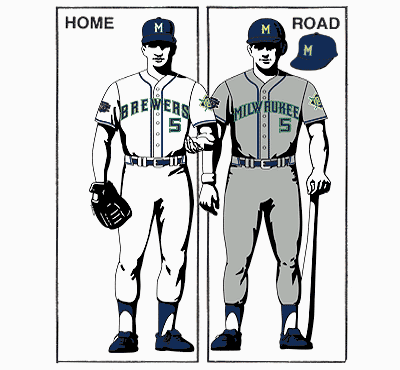
I should probably start by saying that, unless you’re a New Era cap collector or a Brewers fan, you might not remember this cap. It’s ok, not very many people in Milwaukee even remember this cap existing, but even crazier is that it’s next to impossible to track down. Much like the Brewers cap I wrote about on April 9th, it falls under the category of “What the f--- were they thinking?” but not because of the uniforms. To be honest, I actually really like this cap. I just hate the history surrounding it. See, back in 1994 is when it all started when the Brewers introduced these uniforms


Bring an end to arguably one of the greatest uniform sets and caps in Major League Baseball history. But that’s not all. 1994 was the year that MLB decided to expand their playoff format by adding the Wild Card series to the mix. Some of you are probably thinking, “Now Ben, the Wild Card wasn’t added until 1995.” This is true; however, it was supposed to be used in 1994 but the players strike kind of put a halt on things until the end of April the following year. In order to make the Wild Card system work MLB broke up the original two divisions (East and West) and added a third (Central) to each side, moving the Brewers out of the East and into the Central and in turn giving the West four teams each between the American and National Leagues. Originally this should not have worked out, but luckily the Florida Marlins and Colorado Rockies were added in 1993 to balance the leagues out. So, everything is perfect, right? Nope! MLB had other plans which entailed even more expansion despite the fact that the strike was still in effect in March of 1995. Back then two new franchises (Arizona Diamondbacks and Tampa Bay Devil Rays) were awarded by MLB to begin play in 1998. It was decided to add one new team to each league. At the time, however, MLB did not want to have an odd number of teams per league because they would either have to give teams many more off-days than in the past, or interleague play would have to be extended year-round, or both (14 years later however, another realignment would cause there to be an odd number of teams in each league with year round interleague play). In order for MLB officials to continue the existing schedule, where teams play almost every day and where interleague play is limited to a few days per year, both leagues would need to carry an even number of teams. The decision was made to have one existing club switch leagues. This is the moment when MLB went full-retard. The problem that MLB had put them selves in was as a result of their poor planning when they allowed the Marlins and Rockies into the Majors in an attempt to even everything out. The real problem of their addition of the Diamondbacks and Devil Rays is that they made the mistake of adding one too many teams to the wrong division (Devil Rays to the AL East.) How did this happen? MLB made the mistake of keeping the Detroit Tigers in the AL East when the new divisions were set up in 1994. So now there were going to be 15 teams in each league with the NL having five teams per division while in the AL there was one division with four teams and another with six.

It’s funny to look at all of this now because even a group of third graders could have figured out the problem much faster than the owners and executives were able to. In my opinion (which would have been the correct move) MLB should have moved the Kansas City Royals out of their new place in the AL Central and BACK to the AL West where they have had all of their success including a World Series title in 1985. This move would have given each division five teams apiece and an even 15 teams per league. Yes, I understand that MLB was afraid of an odd number of teams in each league; however, look at what we’re dealing with today and how long it took for everyone to realize that 15 teams per league in even divisions is actually a blessing. More important, the shit that actually went down would have never put a dent in baseball’s legacy: REALIGNMENT.

That’s right; one team had to be moved from one league to another to form a balance, something that had NEVER occurred in MLB history. Teams had obviously moved from state-to-state or city-to-city, but nothing like this. The realignment was widely considered to have great financial benefit to the club moving; however, to avoid the appearance of a conflict of interest, Commissioner (then-Brewers owner) Bud Selig decided another team should have the first chance to switch leagues. The Royals were asked first, but they decided against it. The choice then fell to the Brewers, who, on November 6, 1997, elected to move to the NL Central Division. At the same time, the Tigers agreed to move from the AL East to the AL Central (to replace Milwaukee). The Devil Rays joined the AL East and the Diamondbacks joined the NL West. Had the Brewers elected not to move to the NL, the Minnesota Twins would have been offered the opportunity next. Even reading my own words absolutely blows my mind that this happened. But what does any of this have to do with the cap? Well…

’97: The Brewers got a lot of flack for the uniforms they introduced in 1994 and wore through the end of the 1996 season. So they decided to correct their mistake and come up with something more appealing to the fans. In the offseason the Brewers introduced these uniforms to be worn for the 1997 season.


From then until the end of the 1999 season the Brewers wore this cap for all of their home game and a similar model with a gold “M” (which I can’t find for sale anywhere) for all of their road games. It is still the only time in MLB history that a cap/uniform has been used in multiple leagues. The cap on my head was purchased while the team was still a member of the AL and in my mind the team will always be an AL team. When time came for realignment once again at the end of the 2012 season MLB could have done the smart thing and looked at my original proposal by moving the Royals to the AL West and moving the Brewers back to the AL Central to even things out, but they once again decided that going full-retard was the most fiscally sound option by moving the Houston Astros to the AL West. Because trying to fix the past is just silly and make too many people happy.


These are obviously not new stories. I’ve touched base on a few of these issues before, but they still drive me crazy. How it’s possible for an old man like Selig to take “something he loves” (baseball) and completely blow it off kilter and be satisfied with himself is beyond me. It’s shit like this why I made the conscious decision to have Bernie Brewer added to the AL side of my body. I figured one baseball-loving person had to have some sense.


As to who the girl is, that’s a gem for another post.


#5: If there was ever a player over the last 25 years or so who made a quiet, yet definite impact for the throughout his entire career, it has to be Geoff Jenkins. Jenkins was a three-sport varsity athlete at Cordova High School in Rancho Cucamonga, California, but elected to pursue baseball full-time after receiving a scholarship from USC. From 1993-1995 he played ball for the Trojans. In his final season, he batted .399 with 78 RBI and a .748 slugging percentage in 70 games, also scoring 75 runs to tie the school record held by Rich Dauer and Mark McGwire; his 23 home runs and 193 total bases ranked second in school history behind McGwire's 1984 totals of 32 and 216. He led the Trojans to the College World Series, where they reached the championship game; Jenkins was named to the all-CWS team, and also earned team co-MVP honors and was named a consensus All-American. In 1996, the year of the CWS' 50th tournament, Jenkins was named to the all-decade team for the 1990s. He finished his USC career with a .369 batting average, 45 home runs (second only to McGwire's 54), a .652 slugging percentage, 180 runs, and school records for runs batted in (175) and total bases (444). Yah, he was kind of a big deal, but he fell to the Brewers in the ninth round of the 1995 amateur draft and didn’t make his MLB debut until 1998.

 Not pictured- Brett Favre

Jenkins played 10 years with the Brewers at the MLB level and was consistently the team’s best player. Twice he led the team in batting average, the first of which came in 1999 when he hit .313 with 21 home runs and 82 RBI. In 2000, he was the Brewers' team MVP. He led the Brewers in batting average (.303) and home runs (34). His 2002 season was cut short when on June 17 in a game against the Astros he suffered a horrific-looking dislocated ankle when sliding into third base feet first during a game. He was safe on the play. He was selected to the NL All-Star team in 2003 via the MLB's All-Star Final Vote contest where a player is selected from both leagues by fans to join their respective team after the initial roster is announced.

Jenkins hit a bit streak of offensive woes starting in the 2006 season and was eventually replaced in his spot in the outfield for Corey Hart. At the end of the 2007 season Jenkins was not re-signed, thus ending his Brewer career with a .275 average, 221 home runs and 733 RBI. But, his baseball career wasn’t over. On December 20, 2007, he signed a two-year, $13 million deal with a vesting option for 2010 with the Philadelphia Phillies. Jenkins returned to Miller Park in a Phillies uniform on April 23, 2008, to a crowd of just over 30,000. He was welcomed back with a tribute video, highlighting his ten-year career with the Brewers, and the standing ovation that followed. He received a second ovation while leading off the second inning. Philadelphia would go on to lose the game, 5-4. He went 0 for 3, with a walk and a stolen base. In the postseason, his only hit came on a leadoff double in the bottom of the 6th in Game 5 of the World Series. His hit set the tone for the finale of the World Series as the Phillies won the World Series and earned Jenkins his first World Series ring of his 10 year career. The Phillies ultimately released him at the end of Spring Training in 2009 and in July he was signed by the Brewers on a one-day contract so he could officially retire with the team.


#20: Jeromy Burnitz played his collegiate ball at Oklahoma State University and played minor league ball with the Welsh Waves and the Buffalo Bisons. He batted left-handed and threw right-handed. He first came up with the New York Mets and exhibited both power and speed, but was traded by them to the Cleveland Indians. Burnitz never really cracked the Cleveland lineup and it was only after his trade to Milwaukee in 1996 that he emerged as an everyday player.

From 1996-2001 Burnitz was an absolute stud for the Brewers. In his first full season, 1997, Burnitz hit .281 with 27 home runs, 85 RBI and even stole 20 bases. His efforts gave him a top-30 finish for the AL MVP. The next season he hit a modest .263 but pounded a career-high 38 home runs and a career-high 125 RBI which ultimately improved his stock with a top-20 finish for the NL MVP. Clearly hitting in the NL improved his power game in just one season. In 1999 he made his first All-Star Game and even started in place of the injured Tony Gwynn, thus becoming the first Brewer to start an All-Star Game since Paul Molitor. In the six years he played in Milwaukee he hit .258 with 165 home runs and 525 RBI.

Burnitz played until the end of the 2006 season with the Mets for a second time (2002-2003), the Los Angeles Dodgers (2003), the Rockies (2004), the Chicago Cubs (2005) and then finally with Pittsburgh Pirates (2006).

Monday, September 9, 2013

July 16- 2013 National League All-Star


Depending on who your team is, the 2013 Major League Baseball All-Star Game could be considered a rousing success or an absolute failure. The American League team relied upon small ball and tough pitching to notch a 3-0 victory over the National League team and won the rights to home field advantage in the World Series. Even though the win for the AL side made me incredibly happy for the sake of being an Oakland Athletics fan, I will admit the game was pretty boring. Actually, to be honest, this year’s mid-summer classic was the first one I haven’t watched since the NL beat the AL 2-0 at the All-Star Game hosted at the Coliseum back in 1987. For 25-straight years I had tuned in to watch the best in the game slug it out every summer until finally it came to an end du to the fact that I had to work. The All-Star game has always been my personal Super Bowl if you will, a one day test to see whose league was the most dominant. Prior to the 2003 All-Star Game there was never really much incentive for winning, but it was still fun to watch. The one thing that has always separated the MLB’s All-Star game format to the other major sports is that the players can’t play half-ass. I suppose if a pitcher really wanted to throw 90 MPH fastball right down the middle to allow home runs he could, but I highly doubt you’ll ever see it, or I doubt you’ll ever hear a pitcher admit it.

Baseball has always been my most consistent love. Whether I play it, watch it or just enjoy a comforting chat with somebody about it, baseball has always been there for me. Prior to this post I never wanted to admit that I had become some sort of a celebrity last season. Being the guy who has all of the team logos and mascots tattooed all over him may be a comforting label to some, but to me it has always been just a small part of who I am. Being featured in articles by Deadspin, Yahoo! Sports, Bleacher Report, etc. were just small steps that I had to endure to reach, what I thought was the top of the heap, the MLB Fan Cave; however, my experience left me somewhat jaded as I was eliminated before I was able to fulfill the one selfish request I had on my journey, going to the All-Star Game.

From the time I was first interviewed for any of the articles I was featured in my goal was clear, I wanted to share my love of baseball with the masses and bring in the next generation of fans. Years of watching games, studying the stats, but more important keeping an eye on media trends helped me come to the realization that the Fan Cave would have been a perfect platform to lead this mission. As my quest for the Fan Cave built momentum I continued to relay my mission statement over and over and over again to whomever would listen and to whomever asked. These moments included my interview process in Phoenix, Arizona during the top-30. Entertaining and educating others about the game of baseball was all I wanted, and still want to do. I know I’m being redundant, but I really need to continue to emphasize my mission. When finally asked by the executives of what I wanted for myself, the only thing that I have ever wanted for myself is to go to the All-Star Game. When asked why I stated, “I’ve always wanted to be an environment where fans of all teams come together to put rivalries aside and just enjoy the game of baseball with one another.” I also added that it would be a thrill of a lifetime to take a photo with all of the mascots in one venue, which ended up being the only thing that anyone really listened to. This was actually also a point that was brought up during our first day meeting at the Office of the Commissioner of Major League Baseball back in March not too long after the nine of us who were lucky enough to be Cave Dwellers arrived in New York. Clearly the marketing team had been plotting to take me to the All-Star Game for the same mascot-related reason. So when it came to be that I was being sent home I was a little bit pissed off and heart-broken about what I would be missing. 


7/10/12- I was at my parent’s house in Bakersfield, California at the time of the 2012 All-Star Game. I had missed the Home Run Derby the previous night as I had instead decided to go to a Bakersfield Blaze game with my friend Toni (@condorsfan06) instead. In between the innings if the Blaze game I flipped through the Facebook pages of Ricardo Marquez, Shaun Kippins, Ricky Mast and Ashley Chavez to see how their trip to Kansas City was going. All of us were still on really good speaking terms at that time, but things were creeping ever-so-close to the edge as my anger and jealousy was starting to take over.

Prior to that night I had spoken to Ricardo over the phone once or twice since I had been eliminated. No one else really gave me the time, but we did converse through tweets and texting. I had pretty much given Kyle Thompson the finger for spreading lies about during my time in New York which ultimately got me on notice with the executives; however, I have since been told that it was actually Ashley who caused all of this in conjunction with Gordon Mack. Either way, I'm still not happy about the deception. Ricardo and had been trying to relay whatever bits of information he could to me as talk of a TV show staring me had entered the picture. Having not heard a single word from anyone but Ricardo on this matter I thought it was BS, and have still yet to get any solid evidence to prove otherwise. But even at that, we still chatted. The moment in which everything went to Hell was when I scanned through Ricardo’s Facebook page to see him surrounded by all of the mascots.

A few days prior I had let loose on Ricardo after he and Gordon had stolen one of my video concepts and made it their own. The concept was an Unsolved Mysteries video in which Adam Dunn had rediscovered his swing after a poor first year with the Chicago White Sox. The only problem was that nobody else wanted to help me make it, so it died. When voting started for the All-Star Game final vote Gordon and Ricardo teamed up to make a video on Los Angeles Angels’ pitcher Ernesto Frieri… in the style of Unsolved Mysteries. After dealing with that and now the mascot photo I had all I could take.

Not wanting to see or hear anything more about their trip to the All-Star Game I had decided to not watch it. I made an announcement about it on Twitter as well which saddened a lot more people than I had expected. I think I smoked nearly a full pack of cigarettes leading up to the game when I finally decided to not let my emotions get the better of me. I hadn’t missed an All-Star Game in 24 years, I wasn’t about to kill the streak then.

For those of you who weren’t following me then it’s probably for the better, especially if you’re a Texas Rangers fan. At times I have been a bit too outrageous on Twitter, but on this particular day it was a no holds barred war of words. During my American League All-Star cap post from yesterday I discussed how the Oakland Athletics haven’t had a position player make an All-Star team since Ramon Hernandez in 2003. This particular fact was something that I had worked my ass off to change when I made a campaign video for Josh Reddick. But alas, it didn’t happen. But some really cool stuff did result from the video. My beef for his absence was fueled even more by the fact that then-AL manager Ron Washington had stacked his team with his own players who really didn’t have the stats to be there in the first place. So, needless to say, I made Washington my target for when things went wrong, which didn’t take very long.

In a ridiculous bit of foreshadowing, San Francisco Giants third baseman Pablo Sandoval rocked a bases-clearing triple off of Detroit Tigers pitcher Justin Verlander after Milwaukee Brewer Ryan Braun’s RBI-double to give the NL a 4-0 lead. After Atlanta Braves’ second baseman Dan Uggla knocked in Sandoval with the next at-bat the score jumped to 5-0. I had been tweeting up a storm prior to the game, but the one thing I had noticed was that none of the other Cave Dwellers had said a thing. Actually, the last Cave Dweller tweet was by Kyle who had taken a photo during the National Anthem. Around the fourth inning I had finally tagged Ashley in a tweet about taking a trip down the Home Run Slide after Giants’ outfielder Melky Cabrera went yard. Still no response, not even a personal tweet on her end. The game continued with the NL pounding the AL and by this time my direct message inbox, as well as my mentions, had been flooded from people asking me why none of the other Cave Dwellers were talking. I responded as quickly as I could but the questions were still coming in. I had no clue why. What I ended up doing next was meant to have neutral intentions; however, what came out was taken as rude. My tweet basically said, “Why is it that I’m talking but all of the @MLBFanCave Dwellers are silent?” It wouldn’t be until after the game that my question was finally answered with Ashley, Ricky, Ricardo and Gordon unfollowing me and Ricardo giving an explanation to everyone saying that he wanted to put the phone down and just enjoy the game. At which I texted him a “well played, I know that was directed at me.” To which he sent me a massive text saying how wrong I was to do that, how he had always had my back, stuck up for me, etc.

I felt bad for what I had done. It’s not in my nature to attack people and I sent him a long apology afterward, and then about five or six more apologies after that from July 2012 through December 2012, none of which have had anything to follow. Even on the day when I survived a mall shooting and asked to talk to him to make amends I still got nothing. As time wore on I questioned why I even bothered to apologize to him.

I guess the reality is that I hate grudges. I realize how weird that sounds considering where I stand with Kyle; however, if he was willing to actually man up and reach out to me I would be willing to listen. You know, look a good Christian ought to, but I’m Mormon, we don’t need a reason, we just do it. Shaun and I have always been fine as he actually understood what I was getting at. Ricky and I made amends not too long after the shooting and I apologized to Lindsay Guentzel about everything I may have done to her in August of last year.

The reason I marked up this cap with that particular date is to always remind me of a few things:

1. The most important- watch what you say publicly.

2. Keep your ideas to yourself (still struggling with that one)

3. Be true to yourself

On the last day that I got to hang out with Ashley, Ricardo, Ricky and Shaun in New York I made a few simple (drunken) requests that, if anything, I wanted carried out for me; none of which was too demanding. All I asked was that they have the same amount of fun as I did and to share the experience with everyone the same way that I had. Being silent during the one day when all fans and teams come together was not exactly what I had in mind. But hey, I guess that's why I'm still looking for a job in baseball.

Hopefully that last little bit helps give a little bit more insight to why things happened they way they did last year and why I will always be there for the fans. Everyone I interact with matters.

As far as why I chose the National League All-Star Game cap to air all of this out; it seemed fitting that my first All-Star Game and the last one I watched during the streak were both won by the NL. In the case of 2012 the NL won by a final score of 8-0. Both games were shutouts.

Tuesday, August 13, 2013

July 4- USA Olympic/World Baseball Classic


Happy Independence Day everyone!!! Time to drop some knowledge!

When I originally thought about doing this post I was going to focus primarily upon the United States of America’s baseball team; however, upon doing a thorough amount of research I found that “one cannot simply talk about USA Baseball” in a few paragraphs. The main reason for this is because the USA Baseball team has evolved for nearly a century. That’s right, for roughly 101 years there has been some form of a US national team in place. So I’ll do my best to keep all of this succinct and with a point, rather than just constant babbling.

If I didn’t all ready blow your mind with the 101 years part, things are going to get a bit crazy for the next page or so for you then. According to the USA Baseball Web site and Wikipedia (for the sake of argument) the US National team was formed in 1978 and has been the National Governing Body (NGB) for amateur baseball. It represents the sport in the United States as a member of the U.S. Olympic Committee (USOC) and internationally as a member federation of the International Baseball Federation (IBAF). This is not entirely true. A lot of it is dependent upon wordage used and when other top-tier organizations complied to recognize baseball on an international level. This includes (as stated above): the IBAF, USOC, NGB, International Olympic Committee (previously), the Pan-American Games, etc. Like I said, there is a lot to cover but I’ll leave most of you to your own research as to not bore you with bureaucracy. Anyway, my whole point of the “not entirely true” dates back to 1912, the first time baseball was displayed as a demonstration sport at the Olympic Games in Stockholm, Sweden.

For those of you who don’t know, the definition of a “demonstration sport” is a game or event which is displayed for promotional purposes as an attempt to encourage interest in other countries. Baseball made its first appearance in the Olympics in 1912 in Sweden as an exhibition sport. A game was played between the US, the nation where the game was developed, and the host nation. The game was held on Monday, 15 July 1912 and started at 10 a.m. on the Ostermalm Athletic Grounds in Stockholm.

The Americans were represented by various members of the American Olympic track & field athletics delegation, while the Swedish team was the VesterĂ¥s Baseball Club, which had been formed in 1910 as the first baseball club in Sweden. Four of the Americans played for Sweden, as the Swedish pitchers and catchers were inexperienced. One Swede eventually relieved Adams and Nelson, the American pitchers. Six innings were played, with the Americans not batting in the sixth and allowing the Swedes to have six outs in their half of the inning. The game was umpired by George Wright, a retired American National League baseball player who also happened to be the brother of Harry Wright, the guy who pretty much invented professional sports in the US. One could argue that his Cincinnati Red Stockings of 1871 were the first professional athletes in the world, but that would be an untrue statement. Some dude named Gaius Appuleius Diocles in Rome in 146 A.D. can disprove that.

In 1936 baseball was once again displayed as a demonstration sport, but only two teams actually took the field; the US Olympic team and the World Champion team. Both teams were comprised of all members from the US. But even at that, the US kicked ass in front of Adolf Hitler. The person who pushed for baseball in Olympics was a pro ballplayer named Leslie Mann; no, not the actress whose married to Judd Apatow. Rather, the guy who played for the Boston Braves, Chicago Cubs, St. Louis Cardinals, Chicago Whales (Federal league), Cincinnati Reds and New York Giants for 16 seasons. Originally Mann had organized a 20-game exhibition in Japan the year before the Olympics. In fact, a team from Japan was supposed to play in the Olympics in Germany, but backed out last minute. Mann later went on to found the International Baseball Federation which played its first international championship in 1938 in England. The English team, composed mainly of Canadian college players, won 4 out of 5 games against an amateur American team. He also organized subsequent championships in Cuba in 1939 and Puerto Rico in 1941. World War II brought Mann's efforts to an end.

Baseball was played at the 1952 Olympics in Helsinki, Finland, but not the kind you’re thinking of.

Traditional baseball wouldn’t rear its head in Olympic competition again until 1956 when the games were held in Melbourne, Australia. What’s interesting about these games is that baseball was considered THE “foreign” demonstration sport of the games; however, baseball had been played throughout the country since 1889 and the Australian team was the first to actually field a legitimate team against the US… with the exception that their top cricket players were not allowed to play due to the fact that they were professionals. At the time, according to IOC rules professionals were not allowed to participate in said competitions. Due to the field being set up between the running tracks, right field was only 225 feet so special ground rules were put in place, stating that a ball hit over the running track on the full will be declared a home run, where one that bounces or rolls on or over the track, shall be declared a ground rule double. This rule was put in place to stop baseball cleats damaging the track for the events after the baseball. The game was played on December 1st (remember, Australian seasons are the opposite of ours) from 12:30pm. As the visiting team, the Americans batted first, scoring 2 runs off 3 hits. Australia did not strike back until the bottom of the 2nd inning, when Chalky White of South Australia hit a solo home run off Vane Sutton. Sutton made up for his error in the top half on the 3rd, with a grand slam to send the score out to a commanding 6-1. The Americans again put the pressure on Australia in the fifth inning as two errors led to another 2 runs to the US, putting them in a comfortable position. The game was eventually called at 2:40pm, after six completed innings and a final score 11-5, with the US batting first. Very few fans were present at the start of the game, but according to record 114,000 had arrived by the sixth inning. This was due to the finals for the 1500 meters, 4x400 meters relay and finish of the men's marathon.

The Olympics were held in Tokyo, Japan in 1964 and once again only one game would be played between the Japanese and the US national team led by former USC head coach Rod Dedeaux, the greatest college baseball coach in history. Members of the team included pitchers Alan Closter, Dick Joyce, and Chuck Dobson; catchers Jim Hibbs and Ken Suarez; outfielder Shaun Fitzmaurice; first baseman Mike Epstein; and second baseman Gary Sutherland. Fitzmaurice hit a home run on the first pitch of the game and the US won 6-2 in front of 50,000 fans.

Baseball at the 1984 Summer Olympics was a demonstration sport, and the first Olympics in which the USA Baseball Team played as an internationally recognized program since the US boycotted the 1980 Olympics in Moscow, Soviet Union. Although single exhibition games had been played in conjunction with five previous Olympics, it was the first time that the sport was officially included in the program, and also the first time that the sport was played in Olympics held in the United States. Eight teams competed in Los Angeles, California in the tournament. Games were held at Dodger Stadium. Cuba, after winning the gold medal at the 1983 Pan American Games, was to participate, but did not as a result of the Soviet-led boycott (Payback). The US made it all the way to the final game where they lost to the Japanese team by the score of 6-3. Notable names from the ’84 team include Mark McGwire, Will Clark, Cory Snyder, Barry Larkin, Bobby Whitt, B.J. Surhoff and Bill Swift. The Dominican Republicteam that year featured a relatively unknown fastballer named Ramon Martinez. Due to the fact that baseball was a demonstration sport, no actual medal was awarded to the winners.

In 1988 in Seoul, South Korea, the final year as a demonstration sport, the US took home the gold (literally) as the beat Japan in the final game rematch. What’s most unusual about this final game is that actual medals were given out; however, they were not recognized by the IOC. It’s all dumb. Notable players on that year’s team include Andy Benes, Jim Abbott, Charles Nagy, Mike Fiore, Tino Martinez, Robin Ventura, Ed Sprague and Mickey Morandini.

Finally, in 1992 baseball made its debut as an official sport at the Olympics in Barcelona, Spain, which is oddly enough one of the only Olympic cities to actually turn a profit off of the games. The US finished a respectable fourth, having bean beaten by Japan and Cuba in the round robin stage and once again by Cuba in the semi-finals. If it makes you feel any better Cuba won the whole thing. But from 1992-2008 baseball served as an official Olympic event in which the US took home one bronze (1996 in Atlanta, Georgia), one silver (2008 in Beijing, China) and one gold (Sydney, Australia).

I don’t know a terrible amount about the Pan-Am Games, but what I can tell you is that the US have won five bronze medals, seven silver medals and one gold medal. I didn’t go into too much research in the Baseball World Cup either as most people don’t know much about it. However, there is the IBAF-recognized World Baseball Classic which wrapped up its third year in 2013… with the US team failing to medal in all three years.  Not to be one to end things on a downer, I saved the best for last, but first… the hat.

This particular cap was first introduced during the 2000 Olympics in Sydney. Prior to those games all headwear consisted of “USA” being stitched across the front panels like this.
Jason Giambi
Kris Benson

So whomever designed the current “US” with a red-outlined silver star logo back in 2000 certainly did a fantastic job as it has been used prevalently ever since in all international baseball games. While the cap has appeared in other bill and panel color schemes, the classic all-nave blue has lasted all 14 years of competition, with the addition of the flag of the USA added to the side in 2006 during the first World Baseball Classic tournament.
Now, despite 101 years to focus on I was able to whittle my marks down to two numbers for one year.

#28- Drafted by the Milwaukee Brewers in the first round (10th overall) of the 1999 draft, Ben Sheets made his professional debut with the Ogden Raptors of the Pioneer League. In August, against the Idaho Falls Chukars, Sheets struck out eight batters while allowing just one hit through five innings. Later in the month, he was promoted to advanced-A Stockton of the California League. In his seven minor league starts that year, Sheets averaged a strikeout ratio of 10.09 batters per nine innings.

In 2000, Sheets was on the US national team for the 2000 Summer Olympics in Sydney. One of the most important things to note from this year’s Olympics is that it was the first time professionals were allowed to be on the team. Granted, none of the talent had made it to the Major League level, but they were still paid players in the minor leagues and no longer technically amateurs. Sheets pitched 22 innings, struck out 11 batters, walked one, and gave up 11 hits during the tournament, and faced off against Cuban ace Pedro Luis Lazo in the gold medal game, giving up three singles and advancing just one runner to second base for the entire game. Sheets gave up no walks and struck out five in a 4–0 complete game shutout. It is still considered one of the finest pitching performances in US international competition.

After helping the US win their first and only gold medal in Olympic competition, Sheets headed back to the minors in 2001 but quickly worked through the ranks of the Brewer farm system until making his Major League debut on April 5th. In eight seasons with the Brewers, the last few which were hampered by injury, Sheets went 86-83 with a respectable 3.72 ERA and 1325 strikeouts. All four of his All-Star Game appearances were made with the Brewers in 2001, 2004, 2007 and 2008. His best statistical season came in 2004 when he went 12-14 with a 2.70 ERA and 264 strikeouts, which were good enough for an eighth place finish for the National League Cy Young award that season. At the end of the 2008 season Sheets and the Brewers went their separate ways.

Sheets wouldn’t pitch again in the Majors until 2010 when the Oakland Athletics agreed to a one year, $10 million with an additional $2 million in incentives, contract with the Oakland Athletics. Sheets got the Opening Day start, going five innings allowing three runs (two earned) on four hits while striking out 3 and walking 4, receiving a 'no-decision'. The Athletics lost the game in the bottom of the 9th. On July 29, 2010, the Athletics announced Sheets would miss the remainder of the season due to a torn flexor in his right elbow. His season ended with Sheets going 4-9 in 20 starts.

On July 1, 2012, the Atlanta Braves announced that Sheets had signed a minor league contract with the organization in order to attempt a comeback to the major leagues. He made his first minor league start with the Mississippi Braves on July 4, 2012. On July 12, the Braves announced that they had called Sheets up from the minors. Sheets made his first start in nearly two years on July 15th against the New York Mets. He pitched six scoreless innings, giving up two hits and striking out five to earn the win. After his second start also resulted in no runs given up by Sheets, who pitched six innings of five-hit, six-strikeout ball, he stated, "If you asked me if I'm surprised I haven't given up a run, yeah I am. But I'm not surprised I'm getting people out. I wouldn't have come back if I didn't think I could get people out." Sheets made the final start of his career Wednesday, October 3, 2012 against the Pittsburgh Pirates.

#16- Doug Mientkiewicz attended Westminster Christian School in Palmetto Bay, Florida, where he was a teammate of Alex Rodriguez. Upon graduation, he was drafted by the Toronto Blue Jays in the twelfth round of the 1992 Major League Baseball Draft, but chose instead to play at Florida State University. In his third season with the Seminoles, Mientkiewicz led the team with a .371 batting average, 19 home runs and 80 RBI. Florida State earned their first ACC Championship, and Mientkiewicz was named ACC Atlantic I Regional MVP. After the season, Mientkiewicz was drafted by the Minnesota Twins in the fifth round of the 1995 Major League Baseball Draft.

In 1998, he batted .323, with a .432 OBP and .508 slugging percentage in 509 at-bats for the New Britain Rock Cats to earn Eastern League (AA) All-Star honors, and a September call-up to the Twins. He batted .200 with two RBIs in 25 at-bats for the Twins. Mientkiewicz earned a roster spot with the Twins the following spring without having previously played in Triple-A, and batted .229 with two home runs and 32 RBIs sharing playing time with Ron Coomer at first base in 1999. After a full season in the majors, Mientkiewicz spent the 2000 season with the Twins' AAA affiliate, the Salt Lake Buzz. He was the Triple-A All-Star first baseman, and Pacific Coast League All-Star designated hitter. He batted .334, with a .446 OBP and .524 slugging percentage, in 485 at-bats for Salt Lake, while both scoring and driving in 96 runs.

After the season wrapped up Mientkiewicz was named to the US team and served as the starting first baseman. Mientkiewicz was counted upon for his leadership as the oldest member of the team. He is best known for his walkoff home run against the South Korean team in the semifinals which helped carry the momentum into the gold medal game against Cuba.

In 2001 Mientkiewicz became the Twins’ full-time first baseman, posting the best numbers of his career on both sides of the ball. He won his first and only Gold Glove of his career that season and finished in 14th place for the American League MVP award after going .306/15/74 under then-manager Tom Kelly. Mientkiewicz had another solid year with the Twins in 2003, but was traded to the Boston Red Sox near the trading deadline in 2004 where he joined a former Twins teammate David Ortiz as they shattered the “Curse of the Bambino” that season after the Red Sox won their first World Series title since 1918. Not wanting to make the same defensive gaff as in the case of Bill Buckner in Game 6 of the 1986 World Series, Mientkiewicz was put in a first base and recorded the final out of the Series.

Since then, Mientkiewicz became a bit of a journeyman, playing a season each with the New York Mets (2005), Kansas City Royals (2006), New York Yankees (2007), Pittsburgh Pirates (2008) and Los Angeles Dodgers (2009). He currently serves as the manager for the Fort Myers Miracle, an advanced-A affiliate of the Twins in the Florida League.