Showing posts with label All-Star. Show all posts

Saturday, January 3, 2015

New York Yankees- Derek Jeter Side Patch (2014)


Where did the time go? As crazy as it sounds, it’s been 381 days since my last blog post, and to be honest, I feel like I’ve cheated a lot of you for it. Over the last year my life took some incredible turns, all of which were certainly for the better. For starters, I’m back where I belong in Oakland, California. The last time I had been fortunate enough to call this city (area) home was when back in 1985 at the ripe age of two-years-old. And as unbelievable as this may sound, I still remember the mornings waking up to the sound of traffic rolling by on I-580 and the cool crispness of the air wafting through the open window of my bedroom. Anytime I came back to visit my grandparents, roll through on a family vacation or even just drove down on a random weekend while I was attending the University of Oregon, a feeling of unexplainable joy always washed over me as if I had just returned home from a long journey. To those of you who I have become closer friends with over the last year, I am truly grateful. You have all made Angie and my important decision to truly start our lives together the best we could have made. And for that, this is probably the biggest reason why I needed to restart my blog. Thank you.

As candid as I was throughout the first 225 or so posts speckled throughout 2013, I feel this is as good of any time to be perfectly frank and explain why it’s taken me so long to get back to this thing that I love to do so much. I guess for starters I should point out what I actually accomplished in 2013 with my blog and the articles I compiled for eDraft Sports. First the blog. I know I’ve pointed this out in a few of my posts, but my overall mission was to form a habit of writing every single day. When I had started my posts they were roughly 2-3 pages long and they primarily comprised of just the history of the hat and the numbers I marked them up with. As time wore on I felt more and more comfortable opening up and telling a bit of my own personal history of my relationship with baseball and the caps and players I was paying tribute to. As soon as that kicked in my stories became 8-10 page biopics. Therefore, if you break down he numbers to, let’s say, seven pages per post times 225 posts you’ll get 1,575 pages. Now, let’s say that the average book is about 275-300 pages and then divide that into what I wrote and you can essentially say that I wrote the equivalent of a little over five books. Crazy, right!? But we’re not done yet. Like I said, I also write for eDraft, which came out to be 125 articles at roughly 2-3 pages in length. So, do the math again, three pages times 125 articles equals 375 pages, or another book to boot. The fact of the matter is that I burned out. I’m willing to bet that I had written more in that year than in all of my other years combined. As selfish as it was for me to take a break, I really needed it.

One thing that I should also point out is that around the time when I stopped writing a post every single day (June 13, 2013), I had a bit of an “oh shit!” moment when I realized that I didn’t have neatly enough hats to complete the year. Even though I was doing my best to increase my numbers with what little money I had, I knew there wasn’t going to be any possible way for me to hit that mark unless I elected to start blowing dudes on the streets of Portland for the cash. This was not going to be my legacy. Instead, I tried pacing and spacing my stories out a bit more until life became a bit too crazy and I need to focus more on the move and finding a stable job. Long story short (too late), I have three great jobs, two of which are with my favorite baseball team, the Oakland Athletics, the other is with one of my favorite hat retailers, Hat Club; and most importantly, I’m in the city I love with all of my friends and the woman I’m going to spend the rest of my life with. And now, you get to read more about all the crazy shit that led up to this moment and every adventure that comes next. Y’all are in for treat.

It was a bit of a struggle to figure out which hat I was going to write about, as I obviously have a pretty decent score of stories and caps to shuffle through now. However, there is one problem that arose a few months ago which my affect things a bit. The phone that I had won in the MLB Fan Cave and toured around the country with, taking every photo over the last two years, died and I can’t quite figure out how to get the photos off. So, until I can find/hire someone with the appropriate nerdery levels, we’re all a bit screwed on that one. So, I decided to roll with one of my most recent cap purchases which also carries along one of my favorite moments of the 2014 season. At this moment I don’t even know why I threw in a bit of build up, you obviously knew which cap I was going to write about based on the photo and title above. Gaaaaahhhhh!!!

Anyway, back on September 7, 2014 the New York Yankees debuted this cap during the final day of a three-game series against the eventual American League champion Kansas City Royals, a contest the team would lose 0-2 with Jeter going 1-3 with a walk. Not exactly the best of days; however, the real victory on the day was the cap itself. For those who don’t remember, September 22, 2013 was the first time a patch commemorating the career of a player had been worn on a New Era Cap, and that honor was bestowed upon Yankee closer, and future Hall of Famer, Mariano Rivera. 


Back then the Yankees wore this patch for the final four games of their home stand against the San Francisco Giants and the Tampa Bay Rays. Being the ardent oppositionist of side patches (at the time), I declined to purchase this cap, and believe me, it’s been biting me in the ass ever since. The one downside of this occasion was that the Yankees never maintained a lead for Rivera to get one final save with this on his head. Instead, the Yankees brought him out of the bullpen in the seventh inning of their final home game (September 26th) with one out and let him go 1 1/3 before Jeter and Andy Pettitte came in to take him out of the game, one the finer moments in the history of the organization. 


So presumably, not wanting to face the same issue as with Rivera, the Yankees elected to use the Jeter patch for their final home games of the season.

From a business aspect I really can’t blame the Yankees or New Era for doing this. As simple of a tribute as it is, it’s also an incredibly ingenious marketing campaign for die hard Yankees fans, cap collectors or even casual baseball fans. Hell, I broke down and bought it, and it wasn’t exactly easy. For starters, Hat Club started carrying it in the middle of September, so I of course requested one for myself and a few of my co-workers. The one thing I didn’t really expect was that so many of the customers (non-Yankees fans) would come in asking for one. Being the good guy that I am I offered the one I had on hold to anyone who came in looking for that size, something I do for any cap that I put on hold. There are two reasons that I do this: it’s good for business and it’s the right thing to do, both have the same end result in that I can easily get another one. What I wasn’t expecting when I sold it is that I would have to wait an additional two months for the store to get more in. But, here we are.

Now, there are two stories that I need to tell with this, one of which I already did back on June 16, 2014 for eDraft. As much as I feel it would be more appropriate for my blog to just hammer something out, the reality is that I am incredibly proud of what I already wrote. I rarely take pride in my own work, but this once was especially important to me to do a great job at. The second story is about the marking I put on the cap, something I will never forget for as long as I continue to follow this amazing game.

 It almost seems fitting to start with this moment as it took place 25 years and two-and-a-half weeks ago. It was May 29, 1989; a six-year-old boy from California watched one of his baseball heroes sobbingly announce his retirement from the game he loved during a press conference in San Diego. That player was Philadelphia Phillies’ Hall of Fame third baseman Mike Schmidt, a player who I had grown a great affinity for through my older brother Adam who had been following and idolizing Schmidt since before I was born. I didn’t really know it or understand it at the time, but that was the first moment I can pinpoint when I witnessed one of the game’s greatest players call it quits. As the years wore on and my love for baseball grew, I saw more of my heroes (Gary Carter, Eddie Murray, Nolan Ryan, Robin Yount, Paul Molitor, etc.) lose the magic they once exemplified as their time to walk away from the game came to fruition. Looking back on all of those names and dates, it almost feels like a dream as the majority of these guys had their best years long before I was old enough to comprehend what I was watching or before I was even a thought in my parents’ minds. For the time that I was lucky enough to be given, even to see most of the greats in their broken down years, I am truly grateful to say that some time somewhere, I saw them play.

1995 was an especially trying year for baseball fans. An overwhelming majority felt jilted by the players, owners, the powers that be for Major League Baseball and especially former executive director of the MLB Player’s Association Donald Fehr after the player’s strike of 1994 cancelled the remaining two months of that season as well as the playoffs which potentially could have pitted the lowly and now defunct Montreal Expos against the New York Yankees for what could have been longtime Bronx favorite Don Mattingly’s first trip to the postseason. As disheartening as it was to most fans to finally feel and see the dollar sign pressed into their faces, there were a few memorable moments to take away from the ’95 season: Cal Ripken, Jr. broke Yankee legend Lou Gehrig’s consecutive games played record on September 6th, the Atlanta Braves won their only World Series title with the likes of soon-to-be Hall of Famers Greg Maddux, Tom Glavine and Chipper Jones, and on May 29th, six years to the date after Schmidt gave his tearful goodbye to the game he loved, a 20-year-old kid from Kalamazoo, Michigan donned the Yankee pinstripes for his first game in the Majors.

##Derek Jeter## was born in Pequannock Township, New Jersey but was later moved to Michigan where he played his high school ball at Kalamazoo Central High School. Between his sophomore and senior years Jeter hit .524. During his senior year he clubbed four home runs, drove in 23 runs, swiped 12 bags in 12 attempts and only struck out once. The folks at the University of Michigan didn’t hesitate to offer Jeter a full ride scholarship. Nor should they have. That season (1992) Jeter went on to win the Kalamazoo Area B'nai B'rith Award for Scholar Athlete, the 1992 High School Player of the Year Award from the American Baseball Coaches Association, the 1992 Gatorade High School Player of the Year award, and USA Today's High School Player of the Year. The only thing keeping Jeter from moving on to the college ranks was the lure of making big bucks in the Majors, something two teams, the Yankees and the Houston Astros, were willing to shell out if they were able to draft and sign him.

As a scout for the Houston Astros, Hal Newhouser, a Hall of Famer in 1992 and Michigan native, evaluated Jeter extensively prior to the 1992 Draft. The Astros held the first overall pick and Newhouser, convinced that Jeter would anchor a winning team, lobbied team management to select Jeter. However, the Astros feared that Jeter would insist on a salary bonus of at least $1 million to forgo his college scholarship for a professional contract. Consequently, the Astros passed on him in the draft, instead choosing Cal-State Fullerton outfielder Phil Nevin, who signed with Houston for $700,000. Newhouser felt so strongly about Jeter's potential that he quit his job with the Astros in protest after they ignored his drafting advice. The Yankees, who selected sixth, also rated Jeter highly. Yankees scout Dick Groch, assigned to scout in the Midwest, watched Jeter participate in an all-star camp held at Western Michigan University. Though Yankees officials were concerned that Jeter would attend college and forgo the opportunity to sign a professional contract, Groch convinced them to select him. Regarding the possibility that Jeter would attend Michigan, Groch said "the only place Derek Jeter's going is to Cooperstown.” The second through fifth picks were Paul Shuey, B. J. Wallace (who never played in the majors), Jeffrey Hammonds, and Chad Mottola (125 career MLB at-bats and over 5,000 at-bats at AAA); those five would combine for a grand total of 2 All-Star Game appearances (Nevin and Hammonds). The Yankees drafted Jeter, who chose to turn professional, signing for $800,000. And the rest, as they say is history. Well, there’s a little more to it than that.

When Jeter made his debut in 1995 he only played in a total of 15 games as an occasional replacement for Tony Fernandez. Despite hitting .250 (12 hits in 48 at-bats) and knocking in seven runs, the Yankees left him off of their postseason roster. The three things to note from the Yankees making the playoffs this year with their 79-65 record are these: the Yankees were the first American League team to win a Wild Card spot, this was Mattingly’s first and only trip to the playoffs and the Yankees upended by the Seattle Mariners in Game Five which is still considered one of the most memorable playoff games in MLB history. But what happened for the Yankees after the American League Division Series ended is truly what makes Jeter… well, Jeter and the Yankees the most hated team in North American sports.

In 1996 the Yankees stopped “fooling around” by firing then-manager Buck Showalter and replacing him with Joe Torre. George “The Boss” Steinbrenner and his General Manager Bob Watson began making key signings to the likes of eventual Hall of Famer Wade Boggs and Cecil Fielder, but most important they made sure Jeter stayed up at the top level. That season Jeter easily won the AL Rookie of the Year Award with a .314 average, 183 total hits, 78 RBI, 10 home runs and 104 runs scored. And then of course that was that whole winning the World Series thing, the team’s first since 1978, but that really wasn’t that big of a deal. What was a big deal was when Jeter and the Yankees went on to win the Series every year from 1998-2000, becoming the first three-peat champions since the Oakland Athletics (1972-1974). Unfortunately for Jeter and the Yankees, the new millennium wasn’t as prosperous as the previous as they would only go on to win one World Series title (2009) in the three trips they made (2001, 2003 and 2009). Regardless, a five-ringed Jeter in his 20 years of service is still pretty remarkable, and I haven’t even really scratched the surface of the individual feats he accomplished.

In 20 seasons, including his 15 games in 1995, Jeter’s lifetime average currently sits at .312, which based on the math and at-bats means that the only way he’ll finish with a sub-.300 average is if he goes hitless in his next 430 at-bats. Do you have any idea how hard that would be for a player of his caliber? Moving on; from 2004-2010 Jeter won five Gold Glove Awards. It could have been more had it not been for the likes of Omar Vizquel owning the 1990s when it came to superb infield defense. As of now Jeter has been an All-Star 13 times, but it is more than likely that he will make his 14th appearance this next month in Minnesota. As trivial as the All-Star Game may seem in regard to stats, Jeter actually has/had a distinctive mark in the record books. Even though the All-Star Game has been played since the 1933 season, the MVP Award didn’t become a thing until 1962. Even stranger, until Jeter won the MVP Award at the 2000 All-Star Game behind his three hits and two RBI, no Yankee had won the award previously. On top of that, no player had won the All-Star Game MVP and the World Series MVP in the same season until Jeter did it that season, and no player has done it since. But I think the most remarkable accolade that Jeter has not yet gotten his mitts on has to be his lack of a season MVP Award, the closest of which he came in 2006 with a career-high .343 average, 214 total hits, 118 runs scored, 14 home runs, 39 doubles and 97 RBI. Who did he lose to? Justin Morneau, by the thinnest of margins (three first place votes). Jeter also holds the Yankee record for most games played at 2,661 as of June 15, 2014, which is 260 games more than the next closest, Mickey Mantle.

You know, in all of this Jeter talk I feel like I’m forgetting something… Oh yah!.. that whole 3,000-hit thing. I saved this for last on purpose because it carries a lot more weight than most fans realize. In the history of Major League Baseball there have been only 28 players of the scores who have played the game to reach this milestone. Of the 28, only four remain out of the Hall of Fame: Jeter, Peter Rose (of course), Rafael Palmeiro (a self-inflicted tragedy) and Craig Biggio (which makes absolutely no sense). Of those 28 players only Boggs and Jeter have notched their 3,000th hit on a home run. Of the 28, I’ve been lucky enough to watch 12 of them hit number 3,000. Of the 28, Jeter is the only member of the Yankees to accomplish this feat. This stat in particular is truly the most mind-boggling especially when you look back on all of the great hitters who have donned the pinstripes since they were first added to the uniform in 1912. The next closest Yankee, and when I say this I mean they played their entire career with the Yankees, is Gehrig at 2,721. Even though ##Ichiro Suzuki## is only 219 hits away from 3,000 himself, his number would not count in the Yankee record books in the same light of what Jeter has accomplished and is still adding to.

Despite all of the awards, the accomplishments and the fruit baskets he’s dished out over the years, the one thing (maybe two) that comes to mind when one has to think of a defining moment throughout his career that future generations can get a rough understanding of his greatness came on the night of October 13, 2001 in the bottom of the seventh inning of Game Three of the ALDS. At this point I’d really like to break the fourth wall and establish something that is very important to what has been read and what will continue to be read: I’m and Athletics fans, just in case you didn’t know that already. I bring this up because up until this point I feel I’ve done a fair job of capturing and presenting an unbiased retrospect on Jeter’s career. Had a Yankee fan written this, there may be a bit more embellishment. Had a Boston Red Sox fan written this you’d probably see a lot more blathering; however, the one thing that is FOR CERTAIN is that with the exception of the Baltimore Orioles, there is not a single fan base that has a legitimate reason to hate Jeter, let alone the Yankees, as much as Athletics fans do. Red Sox fans, you have three World Series title in the last ten years, shut it. Orioles fans, your real beef should be with Jeffery Maier and the shoddy right field umpiring work of Richie Garcia. But for this moment, the moment that defines Jeter as “The Captain,” Athletics fans will always have a sour taste in their mouths. “The flip,” as it’s come to be known occurred with two outs in the bottom of the seventh inning with Jeremy Giambi on first base, Terrence Long at bat and the Yankees holding on to a 1-0 lead which came via solo home run by Jorge Posada in the top of the fifth inning. The other important thing to know is that the Athletics were up 2-0 in the best of five series having beaten the Yankees in New York. Anyway, with a 2-2 count Long ripped a sure double down the right field line and Giambi did what he could to peddle around the bases. Off of a whim, then-third base coach Ron Washington decided to send Giambi home. Then-right fielder Shane Spencer tossed the ball from deep-right field into the infield, which barely made it beyond first base. At some point Jeter took quick note that the ball wasn’t going to make it home to Posada so he took action into his own hands by running over to the first base line to retrieve it and flip it to Posada. Giambi, for whatever reason, opted to keep running as opposed to sliding. In the end, Posada got the ball from Jeter, made a swipe tag and home plate umpire Kerwin Danley made the punch out call. Most Athletics fans you talk to are still convinced Posada didn’t apply the tag. Regardless, the out call was made, the Yankees won that game 1-0 and eventually came back to win the series in five games. The aftermath was then made into a book and eventual film called Moneyball, you may have heard of them. From that moment on, like a lot of my fellows Athletics fans, I hated Jeter (as a player).

As a now employee of the Athletics I am lucky enough to have access to certain facilities and section of the Oakland Coliseum. While I cannot and will not discuss what my actual job is, the one thing I can tell you is that I found myself face-to-face with Jeter before his final game in Oakland. It’s been almost 13 years since that damn play and I have long since gotten over it, but that doesn’t mean that I don’t still think about it. After he took some swings in the batting cage my co-worker and I were fortunate enough to be able to say a few words with him before he headed out into the field. The only thing that I could muster out; really, the only thing that mattered was to tell him, “thank you for a brilliant career.” In response, he looked me in the eye with those deep-blue, lady killing eyes, shook my hand and said, “I truly appreciate that.”

I can honestly say that it’s going to be a sad day when the final day comes for Jeter, much like the highly emotional goodbye that I witnessed of Schmidt’s 25 years ago. There are very few who have played the game with the determination, leadership and class that Jeter has displayed for almost a quarter century. In this age of speculation and vendettas I am truly happy to look back on the 27 years of being a baseball fan and be able to say, “I saw a legend from beginning to end.” I can only hope the next generation of fans will be so lucky to say the same thing.

Clearly there are a few stats that need to be updated: Jeter ended up playing in his 14th All-Star Game, at which he probably should have won the MVP Award for, his 3,465 career hits are not only still the most in Yankees history, but he is now sixth all-time for career hits in MLB history, just 49 away from Hall of Famer Tris Speaker. Realistically, if Jeter played one more full season he could easily surpass Speaker. Pretty wild to think about.


9/25/14: This was a pretty easy decision. Despite all the accomplishments Jeter racked up throughout his career, his final game at Yankee Stadium was too amazing of a night to pass up and not say anything about. To be honest, I really didn’t have any intention of watching the game and I really can’t think of what I was flipping back-and-forth to in between Jeter’s at-bats, but what I really remember started when he took the field in the first inning.

In some way Jeter had always come off as a bit robotic to me, in that his mind was always in the game. Whether he made an amazing catch, turned a great double play or even biffed a ball off of his glove, Jeter went immediately back into the zone, awaiting the next play. At the moment when all the fans started chanting his name over and over and over, the reality clearly set in upon Jeter’s face. You could clearly tell that he was fighting back some serious emotions, and of course, like with a lot of you, a tear or two welled up in my eyes. But Jeter, tough as nails, fought through it and put on a display that truly defined his character.

Every at-bat the man saw was spectacular, knocking in Brett Gardner is his first plate appearance of the game to give the Yankees a 1-0 lead over the Orioles, and even the seventh inning bases loaded two-run error he forced. However, it was his final curtain call in the bottom of the ninth inning with the game now tied up at five each thanks to David Robertson’s blown save at the top of the inning which made the baseball world explode. Hell, my words can’t even do it justice, just watch it.

As I mentioned in my eDraft article, it’s kind of weird to think that this generation and those that follow may never experience a player of Jeter’s caliber accumulate a Hall of Fame career having played for the same team who drafted them. Only time and money will tell, I suppose.


Tuesday, December 17, 2013

August 15- San Francisco Giants


This post pertains to the specific date posted above. Enjoy.


My parents had separated for only a few months when my other decided to take my brothers Matt and Adam and myself to Livermore, California to visit our grandmother for a weekend in August in 1989. We had left on Friday the 11th, but we returned to our home in Bakersfield on Wednesday the 16th after missing a few too many days of school. It wasn’t like my mom to have us miss class, but I think she needed some extra time to spend with our grandmother to really grasp everything that had come to her and my father splitting up. From what I can recall the eventual divorce hit my oldest brother Matt the hardest as he was about to turn 11 in November, and at that age the sense of “I did something to cause this” was starting to settle into his mind. My brother Adam, who would be turning 10 the same month, took a protector role as I was too young to really understand what was going on. As the years pressed on these roles shifted slightly; Matt hated my mother for almost two decades as he eventually blamed her for their split, and Adam flip-flopped a bit on things as he became way more rebellious and sometimes took his frustration out on me. I merely sat back and observed, occasionally taking the role of the leader as I became way more methodical about the situation as I got older. As I loom back on the way things have panned out, it almost feels like a dream. No child should ever be put in that situation. I fully understand that marriage isn’t a for sure thing, even in a Mormon household that I grew up in. Everyone will be changed in some way, but it’s how we react to that adversity is what truly defines our character. I did my best to rise above the pain and frustration, as did my brothers, mother and father, but that’s not to say we didn’t slip from time to time. Today we’re all a bit happier. My mother and father don’t speak to one another, but my brothers and I don’t hold the grudges against either of them, nor do we bicker and fight like we used to anymore. I’m not entirely sure how my brothers got over it, but for me, I was always sought sports for my comfort.


1989 was an especially weird year, and the divorce made things especially odd when the World Series came around that October. Adam and my father had both grown up huge San Francisco Giants fans while Matt and I favored the Oakland Athletics. Obviously we all know how that series panned out. Matt and I were more than jubilant while Adam and my dad had the bitter taste of defeat in their mouth. My mother was indifferent due to her Boston Red Sox loyalty, but from what I recall, it was the last time I remember us all being collectively involved and happy in the wake of the madness that would slowly tear us all apart for the majority of 20 years.

There’s a reason I brought all of this to the table and most of it has to do with that weekend in August. While I remember small bits and pieces of my brothers and me running around the neighborhood of my grandmother’s house on Drake Way, I only partially remember my mother crying and her mother trying to console as I looked on in confusion. As the days passed I did my best to entertain myself by watching movies and baseball to kind of tune everything out since no one was making an effort to fill me in on everything that was happening. That weekend the Athletics had taken two out of three from the California Angels and beat the Cleveland Indians on Tuesday by the final score of 5-2. As for the Giants, they had lost two of three from their longtime rival the Los Angeles Dodgers and had begun a three game series on Tuesday in Montreal against the Expos. The Athletics game wasn’t on, but the Giants game was being broadcast on KTVU, so my brothers and I ended up watching it that evening. There’s a reason why I remember all these little bits and details even though most adults shouldn’t more than 24 years later. This was the night that I, and every Giants and Expos fan who happened to be watching that game, saw Dave Dravecky pitch for the last time.


8/15/89: It would be a few years before I fully understood what I was watching. I had heard the name Dravecky a few times in the three years that I had been following baseball, but it didn’t really stick until he took the mound against the Expos. He had started the game for the Giants, only his second appearance/start of the season after he underwent surgery in October of 1988, in which doctors removed half of the deltoid muscle in his pitching arm and froze the humerus bone in an effort to eliminate all of the cancerous cells that had been spreading throughout his left arm; his pitching arm. He had returned to the mound after an extensive rehab run in the minors on August 10th against the Cincinnati Reds, a game in which he would thrown eight innings while only allowing three earned runs on four hits and a walk on the road to the win. 


Against the Expos Dravecky had started out on fire, throwing a no-hitter through three innings before giving up a single to Andres Galarraga with one out in the top of the fourth. Dravecky went on to retire the next two batters. The Giants tacked on a run in the top of the fifth inning to give them a 1-0 lead. Dravecky had a some trouble in the bottom half of the inning, but managed to get through it after allowing back-to-back singles by Tim Wallach and Mike Fitzgerald before retiring the next three batters. Dravecky recalled a tingling sensation in his arm throughout the inning, but persevered. In the top of the sixth Will Clark led off with a single before Matt Williams cranked a two-run blast off of Bryn Smith to give the Giants a 3-0 lead going into the bottom of the inning. With a lead in tact and the minimum amount of innings to get a decision in the books, Dravecky took to the mound to face second baseman Damaso Garcia. Dravecky’s first pitch was a ball, but his second pitch was right down Garcia’s wheelhouse as he blasted it to deep left field (3-1 Giants). The next batter was Galarraga. Dravecky started off a little shaky as his arm was started to bother him more intently. He got Galarraga up to a 2-2 count but eventually beaned him on the sixth pitch. A few Expos fans booed, but it’s pretty obvious that Dravecky didn’t mean to retaliate over the home run, especially after getting the next batter to a 2-2 count. With Galarraga on first base, up to the plate came the ever-dangerous Tim Raines who had gone 0-1 with a walk in his previous two plate appearance. After a brief cool down Dravecky got into his wind-up and fired a shot that went high and to the left into the net behind home plate. Before anyone could grasp what had happened, Dravecky dropped to the ground in writhing pain. The shoulder on his pitching arm, in the same area where the surgeons had removed the cancerous tumors, had snapped. It’s not often that one sees a grown man in such pain on live TV, but the gravity of the situation never leaves your mind. There are a few videos on the web that show what happened, but I’m not in favor of posting it. Fictional violence in film is one thing, but showing something horrific happen to another human being is where I draw the line. The news broke later that night of what had actually happened, but I didn’t find out until the next day. After a few more surgeries and staph infection broke out in Dravecky’s arm, he made the decision to have it amputated.

I’ve brought this up in a few of my other blog posts, in that I really didn’t come into my writing skills until I was 13-years-old. The moment it all became apparent was in Mr. Fowler’s American History class at Fruitvale Jr. High School in Bakersfield when we were given a major presentation assignment under the topic of “Triumph and Tragedy” or “Tragedy and Triumph.” There really was no wrong way of doing it just as long as the essence of perseverance was conveyed through our report. I chose Dravecky’s story through his book Comeback. One of the other reference items I had to aid me in my report was one of my favorite videos that I miraculously came across on Ebay back in 2008 on VHS called “Champions by the Bay,” an essential collectors piece for any Giants or Athletics fan. Due to the fact that the internet was really just getting dropped on the world at the time, all of my research came from these two resources and a scatter of magazine and newspaper clippings that I could come across. At the time, I didn’t know a whole lot about Dravecky other than his years with the Giants, what I later came to realize is that he was way more of a polarizing in baseball than most remember.

Born in Youngstown, Ohio Dravecky attended his hometown college, Youngstown State, where he was drafted by the Pittsburgh Pirates in the 21st round of the 1978 amateur draft. He spent his first three years in the minors with the Class-A Charleston Pirates (1978) before getting promoted to the AA Buffalo Bisons, where he spent two seasons (1979-1980) going 6-7 in his first year and 13-7 with a 3.35 ERA in his second. When 1981 came around he was traded to the San Diego Padres where he went 15-5 with a 2.67 ERA and 141 strikeouts with the AA Amarillo Gold Sox. It was in this season that he became a devout Christian. 1982 with the AAA Hawaii Islanders started off just as prosperous, 4-1 with a 2.48 ERA and 26 strikeouts in 16 appearances (15 in relief), when he was called up to the Majors and made his debut on June 15th of that year. From then until the middle of 1987 Dravecky made 199 appearances (119 starts) and finished with a 53-50 record, a 3.12 ERA, 456 strikeouts, one All-Star Game appearance in 1982 and one appearance in the World Series in 1984 against the Detroit Tigers, which they lost in five games. Dravecky pitched 10 2/3 innings in the playoff that season and didn’t allow a single run while striking out 10 batters. 


In the middle of the 1987 season the Padres traded Dravecky along with Craig Lefferts and Kevin Mitchell to the Giants in exchange for Chris Brown, Keith Comstock (who will appear in a future post), Mark Davis and Mark Grant. If you know anything about 1980s baseball, you know that the Giants totally owned the Padres on this deal. For the rest of the 1987 season Dravecky went 7-5 in 18 starts with a 3.20 ERA and 78 strikeouts as well as an appearance in the National League Championship Series against the St. Louis Cardinals, which they lost in seven games. Dravecky made two starts and went 1-1 despite pitching 15 innings while only allowing one run seven hits and four walks while striking out 14 batters. Seriously, he was lights out, but the Giants couldn’t give him any run support after Cardinals’ right fielder Jose Oquendo lobbed a sacrifice fly in the second inning of Game Six.

In 1988 Dravecky started off the season well, but was shut down after his start on May 28th when the cancerous desmoid tumor was discovered. 


He had pitched in seven games, going 2-2 with a 3.16 ERA and 19 strikeouts. When he made his return at Candlestick Park on August 10th he was met by a standing ovation from the sold out crowd of 34,810 fans. 


As I mentioned above, he pitched beautifully. His comeback merited the Hutch Award at the end of the season which is given to the player who "best exemplifies the fighting spirit and competitive desire" of Fred Hutchinson, by persevering through adversity. The award was created in 1965 in honor of Hutchinson, the former MLB pitcher and manager, who died of lung cancer the previous year. When Dravecky’s pitching career ended on that unfortunate day on August 15th, one detail from that game ended up being an intriguing moment down the road. Garcia, the player who had hit the home run off of Dravecky in the top of the sixth inning, saw his playing career come to an end less than month later in September 12th. The home run he hit would turn out to be the last in his 11-year career. Even eerier, a year after he retired, Garcia started to have double vision and was diagnosed with a malignant brain tumor. In 1991, Garcia had the tumor removed, and was told that he only has six months to live. The effects of the tumor left him with limited speech and certain movement. He recovered enough to throw out the first pitch of a Toronto Blue Jays playoff game in 1992, the team he had been with for the majority of his career (1980-1986). His oldest son suffers from hemophilia which prompted Garcia to run a baseball camp for hemophiliac children in the Dominican Republic. As for Dravecky, he found himself at an unusual crossroad after the additional surgeries, the staph infection and the eventual amputation of June 18, 1991. After his recovery Dravecky looked at his life and analyzed his relationship with God and realized that baseball was merely a stepping stone to reach the next step. He began touring as a motivational speaker he wrote two books about his battles with cancer and his comeback attempt: Comeback, published in 1990 and written with Tim Stafford, and When You Can't Come Back, co-authored with wife Jan and Ken Gire and published in 1992. He has also written a Christian motivational book titled Called Up which was published in 2004.

I don’t speak much of religion in my posts unless it is pertinent to the topic at hand. As I mentioned above, and in a few other instances, I was raised Mormon. Most of what I have done in life may not reflect that of the typical Latter-Day Saint lifestyle (alcohol consumption, tattoos, smoking, etc.), but the one thing that has stayed within my life from those days is my faith in God. I’m a firm believer in the philosophy of “everything happens for a reason,” but that part that I differ on from most religions is that I don’t feel that God is necessarily controlling those moments. To me, God is merely watching over us, working more as a conscience when it comes to moments of right or wrong and taking the next step. It’s really more of a comfort, kind of like the way our parents are always by our sides, reminding us that they gave us the tools to succeed and now it’s up to us to choose the right path as they look on. Nothing about what I believe is meant to persuade anyone. You are all free to believe what you want and do what you want, but this is merely look into how I became the man I am today as I reflect upon the moments from my childhood that somehow became involved with the day that Dravecky took the mound for the last time. Much like Dravecky, an injury while I was playing baseball is inevitably what ended my possible opportunity to play professional baseball. Obviously mine wasn’t as horrendous, but the end result was the same: Baseball is merely a platform for us to see what our greater purpose is. For Dravecky, it’s sharing his story and sharing his testimony and relationship with God. For me, it’s sharing stories through my writing and baseball in the attempt to become a better person and help others along the way. While my drive isn’t a religiously charged as Dravecky’s, the mission is still the same.

Originally I was going to save this post until I could track down a Giants 1989 World Series cap since he was a part of the team that year, but I have something else planned for that. Instead, I chose this cap that the team used as their game cap from 1983 until the end of the 1993 season. Even though there were a lot of stories to tell during that time frame, nothing really embodied the good spirit of those teams quite like Dravecky in the two-and-a-half-years he was on the field. When I laid out my design plan for my mascot and logos tattoos I did it with the intention that every single piece had a greater story behind it. For the Giants, I got rather subtly creative.


Originally I was going to add the old Crazy Crab that everyone used to hate, and I may still add that down the road, but ultimately I chose Lou Seal. More specifically, I found a picture of Lou Seal from a kids MLB coloring book which featured a picture of him giving the thumbs up. Now, being an Athletics fan I of course had to put my tweak on it by giving it a thumbs down on top of the old school green underbrim on the cap; however, there is one aspect that I was very specific about that very few ever notice. If you look above you’ll notice that Lou Seal isn’t exactly all in frame. Yes, his legs are being boxed out by Chief Noc-a-Homa below, but the left arm was purposely covered up/removed as my tribute to Dravecky. Also, and this will blow your mind even more, if you look at the full tattoo below you’ll see that the two team mascots to his left (the Reds and Expos) are the last two teams he faced, and the last two teams he notched wins against as the Giants still won the game on August 15th as they preserved a 3-2 lead to end the game. 


I may not see eye-to-eye with Giants fans most of the time, but I do respect their history and quite a few of their players. Until the day comes when I am dispatched from this life, I am happy to have Dravecky always be a part of it.

Tuesday, November 19, 2013

August 12- Toronto Blue Jays


I think the first thing that I need to point out is that it’s obviously not August 12, 2013. I’m not even sure why I’ve continued to keep up with the charade that I’ll be able to get back on pace of doing one blog post per day. When I started this mission back on January 1st it seemed like it was going to be an easy thing to do. After all, the first month-and-a-half consisted of posts that were barely two pages long. Don’t get me wrong, I love researching, learning, writing and educating, and I am not throwing in the towel anytime soon. I didn’t feel I was doing you (the reader) or myself any favors by half-assing my posts. I’ve always been more of the longwinded type of writer, cramming in as much information that can possibly be conceived for the sake of not leaving anyone in the dark on even the smallest detail. My journalism professors at the University of Oregon can back me up in that assertion too.

When I started expanding my stories, adding in my personal details and stopped worrying about if it was too long I started to notice that I was enjoying myself more and connecting with a larger audience. What I didn’t expect was that after four-and-a-half months of doing that every single day I would break physically and mentally. I can pinpoint the exact moment too, it was right after I post my June 15th story about LaTroy Hawkins that I quickly started to unravel. My follow-up post was a San Francisco Giants post on June 16th for Father’s Day, a story that dealt with the hardships my dad and I went through for well over a decade, my bouts with depression and thoughts of suicide and then the resolution of the two of us patching things up in the summer of 2012. The hard part wasn’t really writing it as much as it was the personal struggle of whether or not I should post it. After all, something that raw could potentially be a red flag for employers. But, like a lot of my posts after the middle of February, it was met with a lot of positive feedback, the kind of stuff that motivates me to keep going and keep improving upon what I do.

I don’t feel that I’ve thank you all enough for taking the time to read these posts that I care about so much. Even though I’m well over 100 days behind, I will be surpassing 100,000 total views on my blog within the next two days. I find that kind of funny because I thought writing every single day was going to be the key to achieving anything close to that. Turns out that re-posting at the right times was a huge factor, but also spacing things out, allowing people to fully-appreciate each post instead of cramming them down your throats every single day. It’s all a learning process I suppose. Most importantly though in the thanking department, I haven’t thanked you all enough for the experiences that you’ve shared with me. I love sharing New Era Cap stories, baseball stories and just stories about life with all of you. I’ve always been kind of a social butterfly, but I don’t really know how to show it sometimes. I love to laugh and joke, but sometimes I don’t know how to share my feelings unless I write it out. All of your relatable stories and appreciation for what I do is the best reward I take from my blog. Without all of you, this would be nothing. From the bottom of my heart I thank you all for sharing this journey with me. I promise to quit being a blubbery bitch now.

One person who has been a wonderful treat to meet and get to know is my friend and fellow #CrewEra13 New Era enthusiast and die hard Toronto Blue Jays fan Andrew Mitchell-Baker (@AMitchell_416). 


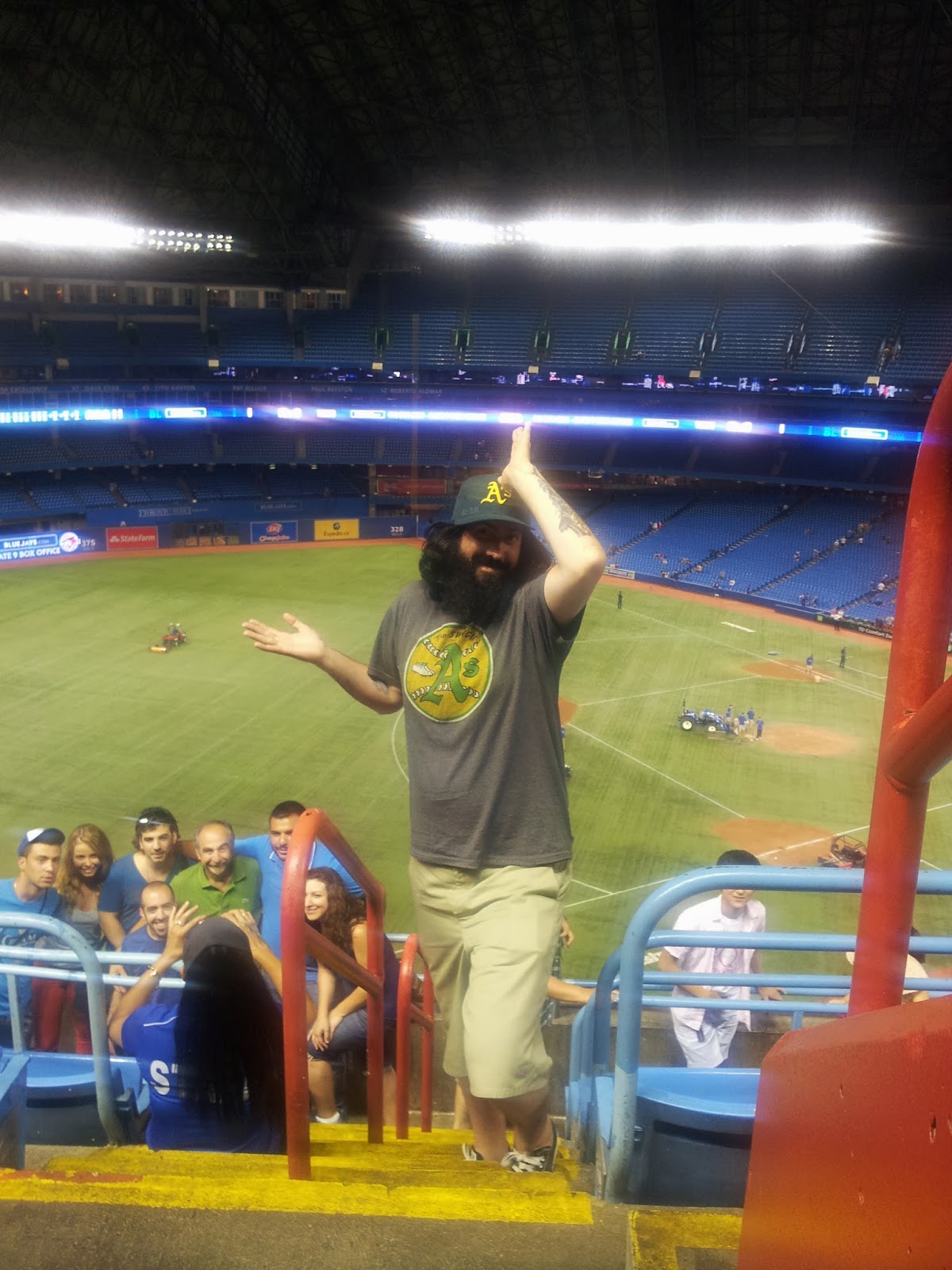
Andrew was born and raised in Toronto and has been an avid visitor of the Sky Dome/Rogers Centre since he was old enough to walk. He’s one of the few people I had the luxury of meeting during my trip to New Ere headquarters in Buffalo, New York. Like the rest of the gang, we met in the lobby of the hotel we were staying at, but we didn’t really hit off until we took the first leg of our trip to Niagara Falls. Andrew had been to the falls before, but only on the Canadian side, so it was a pretty cool new adventure for him. One of the first comments that Andrew bestowed upon me was that I look a lot like RA Dickey, something that I will leave up to y’all to decide with the photo above and below as your frame of reference. 


He is also not the first, nor the last person to make this assertion. On the inverse though, I said he looks a lot like Tim Duncan. You be the judge.


As we toured around the Falls we swapped stories about how we came up with our respective baseball teams. His story was a little bit more intriguing as he was there in the early days of the Sky Dome and was going to games during the Blue Jays’ most dominant years. I was six-years-old when the Oakland Athletics won the World Series in 1989, but I was living four hours away in Bakersfield when it happened. Andrew was getting introduced to the game in full on the back of the back-to-back World Series wins in 1992 and 1993. From there, it was a birthright. For the past 15 seasons he’s been in house for every season opener and almost every series against the New York Yankees because, well… everyone has an enemy. His shining moment at a game came on June 2, 2001 when Chris Carpenter; yes, THE Chris Carpenter, gave up an absolute muderstroke to Manny Ramirez that hit the wall at the top of the upper deck. Oh, and when I say upper deck, I mean upper deck. Watch this. Just to give you a little perspective of how far away that is, here…

 Deeeeeeeeeeeeeep!!!

I’ve been to four games at the now-named Rogers Centre, but I know I’ll be back for more, shooting the breeze with my friend, and sipping on only the finest Alexander Keith’s they have to offer.

Today marks a crazy day in Major League Baseball history as one year ago today one of the biggest trades in the history of the game was finalized between the Toronto Blue Jays and the Miami Marlins. The deal technically took place on November 13, 2012, but it took until November 19th for MLB commissioner Bud Selig to approve it. The deal consisted of the Blue Jays acquiring shortstop Jose Reyes, pitchers Mark Buehrle and Josh Johnson, catcher John Buck, and infielder/outfielder Emilio Bonifacio from the Marlins in exchange for shortstop Yunel Escobar, pitcher Henderson Alvarez, catcher Jeff Mathis and four minor-league prospects including Adeiny Hechavarria. Cash was also sent to the Jays in the trade. Well, as you all know, the Blue Jays weren’t done yet. On November 16, 2012, they signed outfielder Melky Cabrera to a two-year, $16 million deal. On November 20, 2012, it was announced that the Blue Jays had re-hired former manager John Gibbons for the same position signing him to a two-year deal after the team had sent then-manager John Farrell to the Boston Red Sox along with pitcher David Carpenter for infielder Mike Aviles. Finally, on December 17th the Blue Jays acquired the 2012 National League Cy Young Award winner R.A. Dickey in a trade with the New York Mets that sent prospects Travis d'Arnaud, Noah Syndergaard, minor leaguer Wuilmer Becrra and catcher John Buck to New York. Toronto also received catcher Josh Thole and minor league catcher Mike Nickeas in the trade. As part of the transaction, the Blue Jays signed Dickey to an extension worth a total of $29 million over 3 years with a $12 million fourth year option. In short, things went batshit insane in Toronto in a very short period of time. The crazy part in all of this is that I had predicted it seven moths earlier.

Ok, maybe I didn’t predict the exact specifics of the deal, but the exchange between the two parties was on the money. See, back in the early days of my MLB Fan Cavery I had been involved in a discussion about where the league was going over the next two-to-three years. This of course was right after the Marlins had “spent” a boatload of cash on new talent, Ozzie Guillen as the manager and was getting ready to open the door to their new stadium in the heart of Little Havana. One of two things were going to happen in 2012: the Marlins were going be incredibly successful OR they were going to fall apart; and not just fall apart, but have one of the worst meltdowns in MLB history. During the interview process in Arizona for the Fan Cave a question about the Marlins had come up from one of the executives as they were curious how I thought they would finish. My close-to-exact words were, “Based on the history of the Marlins I can totally see them making a solid World Series run because every time they reload their roster they’ve won the World Series (1997 and 2003). But, if they don’t even make the playoffs this year, expect the team to abandon ship and deal as many players as they can to one team who needs the talent and has the money to afford the contracts; someone like the Blue Jays.” I know, it all sounds like bullshit in retrospect, but I have yet to lie to any of you in these posts, and I sure as hell am not about to start. The reality in all of this is that it was a lot easier to predict than you might imagine.

The Blue Jays haven’t made the playoffs since they last held the Commissioner’s Trophy above their heads at the end of their second World Series victory in a row in 1993. 18 years, the second longest drought next to the Pittsburgh Pirates who finally broke their streak after 20 years in 2013. The Blue Jays may not have the biggest payroll in MLB, but they do have quite a bit to spend, especially when you have to consider that they play in the American League Eastern Division with the Red Sox and New York Yankees. With the emergence of Jose Bautista, Edwin Encarnacion, Brett Lawrie, the Blue Jays were on the cusp of being able to assemble a star-studded team that would finally revive the glory days of the early 1990s. The only thing that had been missing was they key person to make such a deal a reality….


AA: Alex Anthopoulos, a native of Montreal, Quebec who is fluently bilingual in English and French, became interested in baseball in the early 1990s after seeing the Montreal Expos play at Olympic Stadium. He attended McMaster University in Hamilton, Ontario where he studied economics. After his father's passing, he realized that he wanted to do something that he loved for a living. He proceeded to call several Major League organizations, looking for a foot in the door. His chance came when he got a direct line to the Expos GM Jim Beattie's office in Florida. He offered to work for free doing something he loved, and he was given his chance. He worked in the media relations department with the Expos, and moved to their scouting department in 2001. In 2003, when the Expos' days in Montreal were numbered, he accepted a lower-paying job with Toronto in order to remain in Canada. The job was as the scouting coordinator.

Anthopoulos quickly climbed the ladder. By the end of 2005 he was promoted to the position of assistant General Manager by then GM J.P. Ricciardi, which was then complimented with the title of Vice-President of Baseball Operations following the 2006 season. In 2004 he was a major reason why the Greek National baseball team was assembled for the Olympics which took place in Athens, Greece. For three years Anthopoulos waited in the wings, keeping an eye on how to conduct himself with the hope that he would move all the way to the top, either with the Blue Jays or another team who showed interest. When October 3, 2009 came rolling around Anthopoulos found himself in an interesting position as his mentor, Ricciardi, was fired after the team went 75-87 in former World Series-winning manager Cito Gaston's first full year back as the manager. Anthopoulos was promoted to General Manager, and got to work immediately.

On December 15, 2009 Roy Halladay was traded from the Blue Jays to the Philadelphia Phillies for minor league prospects Travis d'Arnaud, Kyle Drabek, and Michael Taylor. Hell of a way to break into the new role. Needless to say, Blue Jays fans were pissed, but Anthopoulos was just getting started. Soon afterwards, he sent Michael Taylor to the Athletics for Brett Wallace, and in July 2010, traded Wallace to the Houston Astros for center field prospect Anthony “Space” Gose. On December 22, 2009, Anthopoulos traded reliever Brandon League and minor league outfielder Johermyn Chavez to acquire Brandon Morrow from the Seattle Mariners. The move brought in a little bit of faith, but the reality was that the team was now down their ace and closer. On July 14, 2010 Anthopoulos made a deal with the Atlanta Braves to acquire Yunel Escobar, and Jo-Jo Reyes in exchange for Alex Gonzalez, and two minor league prospects: Tim Collins, and Tyler Pastornicky. The end result, the Blue Jays went 85-77 in what would be Gaston’s final year as manager. Bautista launched a franchise-record 54 home runs, Encarnacion was looking solid and he pitching was coming around. Things were certainly looking bright, but once again, Anthopoulos wasn’t done yet.

On January 21, 2011, Anthopoulos completed a blockbuster trade, shipping another longtime face of the Blue Jays franchise Vernon Wells and the remaining $86 million over the next four years to the Los Angeles Angels for slugging catcher Mike Napoli and veteran outfielder Juan Rivera. He then sent Napoli to the Texas Rangers for pitcher Frank Francisco and Rivera to the Los Angeles Dodgers for cash considerations. On July 28, 2011, Anthopoulos made two successive trades to acquire center fielder Colby Rasmus from the St. Louis Cardinals. In the first, the Blue Jays traded pitching prospect Zach Stewart and veteran reliever Jason Frasor to the Chicago White Sox for starting pitcher Edwin Jackson and infielder Mark Teahen. Jackson was then traded with relief pitchers Marc Rzepczynski and Octavio Dotel, outfielder Corey Patterson, and cash or three players to be named later to the Cardinals for Rasmus and relief pitchers Brian Tallet, P.J. Walters and Trever Miller. This of course all went down in the-manager/current Red Sox manager Farrell’s first season at the helm. Oh, but Anthopoulos still had one more major deal to make. On August 23, 2011, Anthopoulos traded infielders Aaron Hill and John McDonald to the Arizona Diamondbacks for second baseman Kelly Johnson. Even with all of these players getting swapped the Blue Jays finished 81-81. Before the 2012 Major League Baseball season, he was known to make trades in order to acquire supplemental draft picks. The most prominent example was when he acquired Miguel Olivo, a Type B free agent, and declined his club option the next day making Olivo a free agent. The Blue Jays gained a supplemental first-round draft pick when Olivo signed with the Mariners.

With Anthopoulos, the wheels were always turning. His days with the Expos taught him how to be sharp as the team was slowly being picked apart and eventually relocated. Anthopoulos loved the Expos, and vowed to bring a winning team back to Canada. In 2012 the Blue Jays went 73-89, their worst finish since Ricciardi’s final season in 2009. With his back against the way, so to speak, Anthopoulos took the call from the Marlins, talked to the higher ups and approved the blockbuster trade on November 13, 2012 (finalized on November 19).

Now, some of you may still be a bit confused as to how I could possibly know these two parties, of all the other teams in the league, could make that deal happen. It all lies within the Expos, the team Loria had first bought a 24% stake in back in 1999 until becoming the principle owner prior to 2002, right before he sold the team to MLB. So, for those of you playing at home, Anthopoulos worked for Loria for 2 ½ seasons. I’m not sure how strong their relationship is, but in the baseball world relationships like that are deep. Based on their history and Anthopoulos’s willingness to make the Blue Jays a winner, it was the only deal that ever made sense if it were to happen. Needless to say, when it did, I felt like a God damn genius… but I still don’t have a job working for ESPN or MLB. Drat!

’13: I had marked up the cap the day the deal was finalized and couldn’t think of anything better to capture the craziness that was my prediction and the season to come for the restored faithful Blue Jays fans. This cap especially is a memento of where the Blue Jays and their fans have gone in the last 19 years, a fixed mistake that never should have been altered in the first place. When this cap was introduced in 2012 it brought back a lot of warm feelings for die hard Blue Jays fans like Andrew and my other good friend and 2012 Fan Cave hopeful Dave Barclay. As Dave said, “It was like starting over again, getting back to the winning ways of the former Jays. Would you like a hot dog?” Those were his exact words. 


I still have quite a few Blue Jays posts to go, and if you learn anything from these posts, as I always mention in the Blue Jays posts, if you’re a team on the bottom and y’all decide to change the uniforms, be sure to expect good things. When you’re on top, expect some dark years. The Blue Jays finished the 2013 with a record of 74-88, only a one win improvement. Perhaps good things will be in store for Anthopoulos and the Blue Jays in 2014. Hopefully. 

As for the Marlins, they made out like bandits, but not because they made a ton of money on the deal. They only finished seven games worse than they did in 2012, but they got stellar showing from the players that the Blue Jays had dealt them. Hechavarria played in 148 games, hitting .227 with three home runs and 42 RBI and boasts a dandy glove. As for Alvarez, he went 5-6 with a 3.59 ERA and 57 strikeouts in 17 starts. He also had one shutout and one complete game, which both came on the final day of the season when he no-hit the Detroit Tigers. I don't want to elaborate too much on that story though. Patience.

Wednesday, November 13, 2013

August 11- New York Mets


The New York Mets have been an on-going joke in the New York metropolitan area as well as on social media for the better part of the last 20 years or so. It’s come in the form of subway signs


television shows


and even if the form of logos created by the team which resemble that of Domino’s Pizza.


Nonetheless, a lot of it comes in the form of good fun while other times it appears to be a cyclical internal habit by the Mets themselves. One moment in particular I wrote about on May 4th with now infamous “ice cream” uniforms. At the end of the day though, the Mets should be given a lot more credit. After all, they did win two World Series titles in 1969 and 1986 and they’ve also drafted, brought up, traded for and signed a lot of talent over the years.

And of course there’s also that time Bobby Bonilla became the smartest man to ever sign a Major League contract.


I for one will admit that I haven’t been the most pleasant person to critique the Mets and financial decisions, but I assure you that none of it is done with malice as the intent. The Mets will always have a soft spot in my heart because of Gary Carter and their title run in 1986, my first conscious memory of watching a Major League Baseball game on television. For me, it’s hard to watch a team with so much money and talent come up short every year, even if it is a New York team. Hell, for the last 20 years of my life I’ve had to deal with heartbreak coming from a team who has no money and a vast crop of talent every season, only to see it broken down and rebuilt year after year. That team of course is the Oakland Athletics. The Mets are different though. There are elements of their decisions that are reminiscent of the Athletics teams of the late 1980s and early 1990s in that they have a lot of money, but work with a lot of homegrown talent on top of a few key signings. Unfortunately for the Mets, most of their signings haven’t really panned out. But there is a more specific reason why the current Mets team reminds me so much my beloved A’s teams, their general manager Sandy Alderson. Only time will tell if Alderson can right the slowly sinking ship in Flushing, but his first few major moves are definitely an indication that he’s in it to win.

One deal in particular that is a reflection of the Mets’ willingness to win took place on December 5, 2012 when the team re-signed their 2001 draft pick and multiple All-Star spot-winning third baseman David Wright for an additional eight years on top of his then-current contract. The most interesting aspect of this announcement, for me at least, came during the winter meetings when the Mets took the opportunity to unveil their new All-Star Game uniform patches, a few new jerseys and lastly, this cap.


When I first saw it I didn’t now what to make of it. I either had missed the formal announcement and the unveiling of the cap or the Mets didn’t say anything at all as Wright sat up on the stage to field questions while it sat on his head. The 2013 batting practice cap photos hadn’t been released yet so I just assumed that’s what he was wearing. Not at all. The new Mets hat that Wright was sporting is in fact the Sunday/special event alternate cap that the team has been rocking all season long, and to be honest, I actually dig it.

I was super bummed that the Mets decided to retire their road cap at the end of the 2011 season, but they certainly made a strong effort to make up for it with this cap. The color combo is kind of interesting as it has the same appearance as the Citi Field logo up above, but that’s not exactly a bad thing. Orange is an odd color to work with, especially when it comes to the bill, but it works swimmingly against the royal blue crown. Also, the addition of the orange over the white on the “NY” logo helps keep the focus off of one specific area. Even though it didn’t get much play in 2013 it was still one of the better additions for any team over the last six or seven years.

I’ve written many times about how uniform changes can make or break a team and unfortunately for the Mets this was one of those times where it broke them. They finished with the same record as they did in 2012 under Terry Collins (74-88), but they got a lot of performances out of Wright and a few other up-and-coming stars. I did my best not to pick favorites, but the obvious choices were right in everyone’s face. 


#5- Wright was born in Norfolk, Virginia and raised in Chesapeake where he attended school at Hickory High School and worked extensively with Coach Gregory Friedman of Bellmore JFK. Wright was the 2001 Gatorade Virginia High School Player of the Year and earned All-State honors in 1999, 2000 and 2001. He was also named Virginia All-State Player of the Year in 2001. Over his four-year career at Hickory, Wright hit .438 with 13 home runs and 90 RBIs. Upon graduation Wright planned to attend Georgia Tech and major in engineering, but the opportunity to make the pros stepped into the light.

Wright was chosen 38th overall by the Mets in the 2001 amateur draft during the supplemental round as compensation for the Mets' loss of Mike Hampton to the Colorado Rockies in free agency. Wright was selected after future teammate Aaron Heilman who had been selected with the 18th overall pick. Wright progressed steadily in his first three years of minor league play, winning the Sterling award for best player on the class A St. Lucie Mets in 2003. In 2004, he quickly rose from the AA Binghamton Mets, to the AAA Norfolk Tides, to the Majors when he made his short-awaited debut on July 21st.

I’m still not sure why, but Wright somehow managed to not even receive a vote for the 2004 National League Rookie of the Year Award despite hitting .293, 14 home runs and 40 RBI in 69 games. Granted, the winner, Jason Bay, did have a great season for the Pittsburgh Pirates, but he also played in 120 games. Either way, over the next six years Wright flourished. He made the All-Star team five years in a row from 2005-2010, won back-to-back Gold Glove and Silver Slugger Awards in 2007 and 2008 and finished in the top-10 for the NL MVP three years in a row from 2006-2008.

Wright had a bit of a down year in 2011, mostly due to injury, but bounced back in 2012 with a sixth place finish for the NL MVP and another nod to the All-Star team. For his career Wright has a .301 average and could potentially be a member of the 3,000 hit club if he’s able to grind out a few 200+ hit seasons along the way. The most impressive thing about Wright is that he holds the franchise record for 11 offensive categories in only 10 seasons of work including hits (1558), runs (853), doubles (345), RBI (876), walks (671) and sacrifice flies (60). He is also a substantially wealthy individual, most of which didn’t come on the baseball field. See, back in 2007 Wright became a spokesman for Vitamin Water which was a product of the Queens, New York based company Glaceau. Rather than receive one paycheck, Wright negotiated a 0.5% ownership of the company. It may not seem like much until Coca-Cola bought Glaceau for $4.1 billion. Athletic AND business savvy!

#28- Just like Wright, Daniel Murphy is a homegrown talent who was plucked from the swamps of Jacksonville University in Florida in the 13th round of the 2006 amateur draft. Murphy’s time in the minors only lasted two years, the first of which was spent in St. Lucie where hit .285 with 11 home runs and 78 RBI in 135 games in 2007. The following season Murphy played at all three levels but made a jump to the Majors on August 2nd after an injury to Marlon Anderson made room for him as the most viable replacement. In his first major league at-bat, against three-time All-Star Roy Oswalt, Murphy hit a single. Later in the same game, he made a difficult catch against the left field wall, throwing out Hunter Pence at second base for a double play to end the inning. As of August 9, 2008, Murphy was only the 5th Mets rookie to record 10 hits in his first 20 at-bats. Murphy hit his first home run in the bottom of the 6th inning against the Florida Marlins at Shea Stadium on August 9. According to Major League Baseball rules, players are no longer considered a rookie if they have had more than 130 at-bats in a single season. Murphy had 131 at-bats for the Mets during the 2008 season, thus making 2008 his rookie season by a single at-bat. He finished the season batting .313, with 2 home runs and 17 RBI.

Murphy, a natural third baseman, moved around in the field, getting a few starts in left field and other in the infield. Since 2009 Murphy has been a regular fixture in the Mets lineup with the exception of 2010 when he missed the entire season due to a MCL tear while trying to turn a double play during a rehab game with the then-AAA affiliate the Buffalo Bisons. Murphy had hurt his knee during a Spring Training game. In 2011 Murphy’s season ended after 109 games after injuring the same MCL that had been repaired. In 2012 he came back at full-strength as the full-time second baseman. His .290 career average is one of the best on the team over the last few years including his 2011 campaign in which he was hitting .320 before his injury.

While I didn’t have the opportunity to meet Wright during my time in the MLB Fan Cave (missed it by two days), I was able to meet and have a few words with Murphy. That day in particular was kind of interesting because Murphy inadvertently violated one of the biggest rules of the Fan Cave: no clothing items from any of the other professional leagues allowed… ESPECIALLY THE NFL.


Even though I knew it would cause beef with the executives I just had to snap a photo, which I was told to never post on social media. In the mean time, one of the interns was sent downstairs immediately to grab a jersey for Murphy out of the “supply closet,” a room full of MLB gear including hats, shirts, autographed baseball and other cool trinkets. 

After that, the mood was a bit more relaxed. Murphy kicked it on the couch for a social media interview while we all waited for our second special guest, Arsenio Hall.


If there’s anyone who I have ever met that wasn’t built with an off switch, it’s definitely Arsenio, and I don’t mean that as an insult. With every question asked him he had a fantastic joke. He was genuine and polite with everyone who came up to talk to him, but he was honest and humble anytime someone asked him about coming up in the comedy game. The concept that the production crew had brought the two of them in for was a fishbowl Q&A, where basically there was a fishbowl filled with strip of paper with questions on them that the two asked one another. The responses were pretty natural, which made for a good segment. Unfortunately most of the best footage was left on the cutting room floor due to language and subject matter. Does that surprise you?