Showing posts with label Cy Young. Show all posts

Friday, November 8, 2013

August 8- Seattle Mariners


Back on March 4th I tackled the original trident cap that the Seattle Mariners wore from 1977-1980, but I purposely left out one particular detail as it pertains to the cap that I’m writing about today. The 1979 Major League Baseball All-Star Game was the 50th playing of the midsummer classic between the All-Star of the American League and National League and it took place at the four-year-old Kingdome in Seattle, Washington. The game is perhaps most remembered for the play of Dave Parker in the outfield, as he had two assists on putouts at third base and at the plate. With Parker receiving the MVP award for this game, and teammate Willie Stargell winning the NL MVP, NLCS MVP, and World Series MVP, all four possible MVP awards for the season were won by members of the Pittsburgh Pirates. The game was also notable for the play of Lee Mazzilli, the lone representative from the then-lowly New York Mets, providing the 7-6 margin of victory. In his only All Star appearance, Mazzilli tied the game in the eighth inning with a pinch hit home run off of Jim Kern of the Texas Rangers, and then put the NL ahead for good in the ninth, drawing a bases-loaded walk against Ron Guidry of the New York Yankees. This would be the only time the Kingdome would host the All-Star Game. When it returned to Seattle for a second time in 2001, the Mariners had moved to their new home at Safeco Field. The other important detail from this game is that the Mariners inadvertently created one of the most iconic logos in All-Star Game history which they would ultimately don as the primary logo for their caps and uniforms.


Since the All-Star Game was first played in Chicago at Comiskey Field in 1933 it had become customary for the host team to come up with some sort of a cool logo when advertising for the game. You’re probably thinking that my math is off based in the year of the first game played and how the 50th game took place in 1979. Well, from 1959-1961 the All-Star Game was played twice per year, typically one in June and the other in July. In 1961, the final double-dip, the second game, hosted at Fenway Park, ended in a tie. Now where have we seen that happen?


Anyway, the point I’m trying to make is that the logos created are usually only meant for their one-time use at the All-Star Game; however, the Mariners and their fans took quite a liking to the logo they had created for their midsummer classic and decided to make it their official logo for their game caps from 1981 through 1986. With the exception of a few of the teams who incorporated the cap logo into their All-Star Game logos, the Mariners are the only team to do it the other way around.

One of the unfortunate things about this cap is that not a whole lot happened for the Mariners while they wore it with the exception of the players strike which took place in 1981. I don’t know how many times I’ve said it or listed it, but changing uniforms does have a tendency to bring success for a lot of teams, but when it doesn’t, all Hell breaks loose. Besides the strike, this bit of bad fortune befell upon the Mariners: On April 25, 1981, Mariners' manager Maury Wills advised the Kingdome groundskeepers to enlarge the batter's box by a foot. A's manager Billy Martin noticed. Martin showed umpire Bill Kunkel that the batter's box was seven feet long instead of six feet. Martin felt that batters being able to move up a foot in the box could cut at pitches before a curveball broke. Wills was suspended for two games and fined $500. In May, while in Arlington, Texas to play the Texas Rangers, the Mariners' uniforms were stolen. 

On May 28th, this happened...

 
In the sixth inning, Amos Otis of the Kansas City Royals topped a ball down the third-base line. Lenny Randle, the Seattle third baseman, charged the ball, fell on his stomach and appeared to blow the ball into foul territory. Larry McCoy, the home plate umpire, ruled the ball foul, but manager Jim Frey protested. After a discussion, the umpires awarded Otis first base, ruling Randle had illegally altered the course of the ball. Two days later in a game against the Rangers, the Mariners wore their batting practice jerseys, Milwaukee Brewers' caps, and Rangers' batting helmets. The Mariners purchased the Brewers caps at the Rangers' souvenir-stand; the Rangers did not offer Seattle caps for sale.

The only other notable moment came in 1985. On July 9th, in a game between the Toronto Blue Jays and the Mariners at Seattle, Jays catcher Buck Martinez executed a double play by tagging out two runners at home plate. In the third inning, Phil Bradley was on second when Gorman Thomas singled. Bradley was tagged out at home, on a throw from Jesse Barfield to Buck Martinez. There was a collision between Bradley and Martinez; Martinez broke his ankle. Martinez was sitting on the ground in agony and threw the ball to third base in an attempt to tag out Gorman Thomas. The throw went into left field and Thomas ran towards home plate. Toronto left fielder George Bell threw the ball back to Martinez. He was still seated on the ground in pain but was able to tag Gorman Thomas for the second out.

Despite having stars such as Hall of Fame pitcher Gaylord Perry (nicknamed the "Ancient Mariner"), 1984 AL Rookie of the Year Alvin Davis, two-time All-Star and three-time Gold Glove winner Harold Reynolds, three-time American League strikeout leader Mark Langston, and shortstop and team captain Spike Owen on their rosters, the Mariners teams of the entirety of the 1980s were characterized by perennial non-achievement, gaining a reputation for poor performances, low attendance, and losing records. Moreover, the team's ownership again changed hands after the 1988 season, as then-owner George Argyros sold the club to a group headed by communications magnate Jeff Smulyan. However, the 1989 rookie season of center fielder Ken Griffey, Jr., acquired with the first overall pick of the 1987 amateur draft, gave fans hope that a change of fortunes might be on the horizon.

The Mariners since wore the caps for their Turn Back the Clock nights on June 25, 2010 against the Milwaukee Brewers and July 1, 2011 against the San Diego Padres. With all that in mind, it made my markings a bit of a challenge, but I’m pretty happy with my selections and their place in Mariners’ history.


#12- Born and raised in San Diego, California Mark Langston was a second round draft pick by the Mariners out of San Jose State in the 1981 amateur draft. From then until the end of the 1983 season he came up through the ranks of the Mariners’ minor league system, but bypassed AAA altogether when he made is MLB debut on April y, 1984. His most notable season in the minors came in 1982 when he was with the Class-A Bakersfield Mariners and went 12-7 with a 2.54 ERA and 161 strikeouts in 177 1/3 innings.


Langston served as the team’s ace his rookie season, going 17-10 with a 3.04 ERA and a league-leading 202 strikeouts. He ended up finishing in second place for the AL Rookie of the Year Award thanks in part by his jerk of a teammate Alvin Davis who had a great offensive showing. Either way, the important thing to note from the two finishing one-two for the Rookie of the Year Award is that they both beat out Kirby Puckett and Roger Clemens. 1982 proved to be a pretty rough sophomore season for Langston, but he picked his game back up in 1983 when he led the league in strikeouts again with 245. Unfortunately he also led the league in earned runs with 129 as well. Yikes!

In 1987, of course the first year not wearing this cap, Langston had his best year in Seattle, going 19-13 with a 3.84 ERA and once again leading the league in strikeouts with 262. He also made his first All-Star Game appearance and won the first of his back-to-back Gold Gloves. Langston would win seven for his career. But not to sell him short, Langston also finished fifth for the AL Cy Young Award, the highest finish he garner for his career.

Langston went 15-11 with 235 strikeouts in 1988, but got off to a mediocre 4-5 start in 1989 when he found himself on the trading block in July where he was sent to the Montreal Expos along with Mike Campbell for Gene Harris, Brian Holman and Randy Johnson. Langston pitched for 10 more seasons, eight of which came with the California Angels from 1990-1997 when they changed their name to the Anaheim Angels. In 1998 he was a member of the NL pennant-winning San Diego Padres. Noted for his pickoff move to first base, his 91 career pickoffs were, at the time of his retirement, the most in baseball history. Today, he has the fourth-most pickoffs in baseball history, behind only Kenny Rogers, Terry Mulholland and Andy Pettitte, all of them also left-handed pitchers. Currently, Langston serves as a radio color commentator for the Los Angeles Angels of Anaheim during Angels home games. Starting in 2013, Langston does radio color commentary for all games and is also a co-host of the Angels post-game call-in show Angel Talk on radio station KLAA. He also appeared as himself in an episode of “Sabrina, the Teenage Witch.”


#29- Speaking of players most of you have probably never heard of, Phil Bradley is arguably one of the greatest hitters in the history of the Mariners’ organization. Bradley played high school baseball in Macomb, Illinois for the Macomb High Bombers. Due to his success there, the Macomb High School baseball field was later dedicated in his name. Also a talented football player, he played college football at the University of Missouri in Columbia, Missouri and was their starting quarterback from 1978 through 1980. One of the most decorated athletes in Mizzou history, Bradley lettered in football from 1977-81, and in baseball in 1979-81. Bradley quarterbacked the Tigers to three bowl games. He was a three-time Big Eight Conference "Offensive Player of the Year" and set the conference total offense record at 6,459 yards which stood for 10 years. In baseball, he starred as an outfielder on Mizzou teams that won the Big Eight championship in 1980, and went to the NCAA Tournament in 1980 and 1981.


Bradley was selected in the third round of the 1981 amateur draft by the Mariners and made his Major League debut on September 2, 1983, as a pinch hitter against the New York Yankees. Bradley became Seattle's regular left fielder in 1984, batting .301 in 124 games. In 1985 he hit .300 with career-highs in home runs (26) and RBI (880 in 159 games and was selected to the AL All-Star team. He also finished 16th for the AL MVP that season. On April 29, 1986, Bradley was Roger Clemens' 20th and final strikeout as the pitcher set a major league record for strikeouts in a game. In December of 1987, the Mariners traded Bradley and Tim Fortugno to the Philadelphia Phillies in exchange for Mike Jackson, Glenn Wilson, and minor leaguer Dave Brundage.

Bradley hit a respectable .264 in his only season with the Phillies. Almost one year to the day since arriving from the Mariners, the Phillies, desperately in need of pitching help, dealt Bradley to the Baltimore Orioles for Gordon Dillard and Ken Howell. Back in the more familiar AL, Bradley's batting average rose to .277 in his first season in Baltimore. In mid-season 1990, he was traded to the Chicago White Sox for Ron Kittle. His final major league appearance came on September 29, 1990, as he drew two walks and scored a run in a 5-2 White Sox win over the Seattle Mariners. For the Mariners Bradley his .301 lifetime with 52 home runs, 234 RBI and even stole 107 bases.

Thursday, October 17, 2013

August 1- Minnesota Twins


One would think of all the hats in my collection this would have been one of the easier ones to track down. Nope! If my memory serves me correct it took me about three years of combing various Web sites, Ebay and Lids locations in order to find an authentic one. Now, over my ridiculously exhaustive search I did come across a few “Genuine Merchandise” versions (replicas), but this bad boy was a diamond in the rough that I somehow found at the Lids in Union Square in downtown Manhattan. Clearly all of the best caps are displayed there because I definitely picked up some gems every time I went there.

It was a bit of mystery to me as to why this cap would have been so hard to track down, but then again, I can be pretty picky at times. I for one have always preferred the Major League Baseball logo on the back of the hat, a token which was only added to caps starting in 1993. 


As in the case of this cap the logo wasn’t added until 2009 when the Minnesota Twins wore it as a home alternate cap. The Twins first used this for all of their home games from 1976-1986 where it and the all-navy “TC” cap that I wrote about on February 15th were replaced with the “M” logo cap that I wrote about on January 21st. The move proved to be one of those rare uniform changes that brings immediate success as the Twins hoisted their first World Series championship since 1924 when they were still the Washington Senators.

In my research I found a bit of a conflicting story about its first use. The vintage MLB clothing company Brand ’47 has the year 1973 marked on most of its franchise caps, as did a few other Web sites. The only problem with this is that in almost every photo I found, whether it was baseball cards, game photos or even the team photo, this cap wasn’t used. No, the first arrival of this cap via photo didn’t arrive until 1976 as I previously mentioned as shown in the photo below.


Now, I can see where in a black and white photo one might not be able to tell; however, it’s easy to notice how the shade of the cap matches with the “TWINS” emblem across the chest, which was red at the time and contradicts the navy blue shirts of the trainers and equipment managers. This trait becomes even clearly in the team photo from 2009.


Like I said, I looked deep into most photo archives and couldn’t find anything until I came across the Web site http://twinstrivia.com/year-by-year/ where they have all the team photos dating back to 1961, their first year as the Twins. Check the link if you don’t believe me as the team also wore the red caps from 1977-1982 and 1984-1986. I could be wrong about 1983, as it might also have to do with the lighting and it being in black and white, but it looks like a few guys are wearing red and other navy blue. Either way, red was the home color that year.

Keeping in the theme of the red cap I have elected to mark it up with numbers and a date from the original time from of when this cap was used. Nothing personal against the 2009 team who won their division on an extended day of the season (game 163) against the Detroit Tigers, but there’s just too much good stuff that happened within the other 11 years to pass up.


#14- To those familiar with the Twins legacy, this is an easy number to remember. But for those who only know about Hall of Fame legacies, this is a name you should learn. Ken Hrbek, a product of Bloomington, Minneapolis, was drafted in the 17th round of the 1978 draft. The interesting part about the timing is that, as a first baseman, he had some pretty big shoes to fill as Harmon Killebrew and Rod Carew were the only names were noting to have played the position in the team’s history. Carew was traded before the 1979 season, so Hrbek was one of two possible candidates being groomed for the position. Hrbek made his major league debut on August 24, 1981 at Yankee Stadium, hitting a game-winning home run in the 12th inning off New York reliever, and future Twin, George Frazier.

After his cup of coffee at the end of the '81 season, Hrbek would make the team out of spring training and come into his own in 1982, playing well for Twins manager Billy Gardner. That season Hrbek would etch his name into the Twins’ legacy as he finished the year with a .301 average, 23 home runs and 92 RBI. As great as his accomplishment were during his rookie season, he still only managed to finish in second place for the Rookie of the Year award one step ahead of Wade Boggs and one spot behind some washout named Cal Ripken, Jr. Not sure what happened to either of those guys. Hrbek also locked up a trip to the All-Star Game that year, the only appearance of his career.

1983 proved to be a stellar sophomore season for Hrbek, but it was in 1984 that he had the best of his career. In ’84 Hrbek finished the year with a career-high .311 average, 27 home runs, a career-high 174 hits and a career-high 107 RBI. Somehow Hrbek didn’t gain an invitation to the All-Star Game, not to mention he once again finished as the second fiddle when it came to the American League MVP vote. That year Detroit Tigers relief pitcher Willie Hernandez won the MVP as well as the Cy Young Awards outright. The Tigers ended up winning the World Series that year as well.

Hrbek started and finished his 14-year career right where he started, in his home state in front of the people who had cheered him on since his high school days. The most notable contribution Hrbek gave back to the Twins fins were the two World Series Championships they won in 1987 and 1991. One the first run Hrbek finished the season with a career-high 34 home runs, but his most memorable came during Game 6 when he hit a grand slam off of St. Louis Cardinals reliever Ken Dayley, which shifted the momentum in favor of Minnesota who would win the Series in seven games. In 1991 Hrbek’s bat isn’t what most remember from that World Series run, rather the now infamous first base clash he had with Atlanta Braves’ left fielder Ron Gant in Game 2. Here’s the play if you don’t remember. Hrbek was a hero in Minnesota and public enemy number one in Atlanta. The Twins would win the Series again in seven games thanks to great pitching from Jack Morris and clutch hitting from Kirby Puckett. Hrbek was one of seven Twins to be part of both World Series teams. The other six were Puckett, Randy Bush, Greg Gagne, Al Newman, Gene Larkin and Dan Gladden.

Frequently injured (though seldom seriously), Hrbek retired after the players strike in 1994, citing his nagging injury problems and desire to spend more time with his wife and daughter. Kent Hrbek's number 14 was retired by the Twins in 1995, becoming at the time only the fourth (along with Killebrew, Carew, and Tony Oliva) in franchise history. Hrbek was also inducted into the Minnesota Sports Hall of Fame in 1996. He was also one of few players then (which is even rarer today) who played out his entire career with only one team.


#28- It’s a rare quality for anyone to have a professional baseball career for more than seven years, but Bert Blyleven was able to hang onto a playing career for 22-strong. Born in the Netherlands, but raised in Garden Grove, California, his father moved the family to Melville, Saskatchewan, Canada when Blyleven was two years old, and then to Southern California when he was age 5. He became interested in baseball as a young boy watching Sandy Koufax pitch for the Los Angeles Dodgers and listening to Vin Scully and Jerry Doggett announce the Dodgers' radio broadcasts. Blyleven was quoted as saying, “My dad built me a mound in the backyard with a canvas backdrop over our horseshoe pits, and I would go back there and just throw and throw and throw until I developed it, and it became my curveball. And I could throw it over at any time, any count.” Blyleven starred on the Santiago High School baseball team, also running cross country to build up his stamina and leg strength. He was drafted straight out of high school by the Twins in the third round in 1969, where after only 21 minor league starts he found himself called up to the Majors at age 19 on June 2, 1970. In his first season, his sharp curveball helped him to ten victories and he was named AL Rookie Pitcher of the Year by The Sporting News.

For six-and-a-half years Blyleven was the ace the Twins needed; however, he was blamed by the fans for the team’s failures. Blyleven won at least 15 games every season from 1971-1975; unfortunately, he also lost at least 15 games every season from 1971-1974. What’s even more unusual is that Blyleven never posted an ERA above 3.00 from 1971 until the moment he was traded to the Texas Rangers in the middle of the 1976 season. In 1973 Blyleven went 20-17 with a 2.52 ERA, 258 strikeouts and nine shutouts. The wins, ERA, strikeouts and shutouts were all career bests, but they were only good enough to give Blyleven his first All-Star Game appearance, a seventh place finish for the AL Cy Young and a 26th place finish for the MVP. Yah, times were pretty crazy back in the 70s.

After Blyleven was traded to the Rangers in ’76. He pitched well with the Rangers, having a 2.76 ERA in his first season and throwing a no-hitter against the California Angels on September 22, 1977, just two weeks after being sidelined with a groin injury. His 2.74 career ERA with the Rangers remains the best in team history. He was traded to the Pittsburgh Pirates the following year as part of a four-team trade which is way to long to list the ins and outs. In short, Blyleven won his first World Series ring with the Buccos in 1979 behind a 12-5 record and a 3.60 ERA in 37 games started. Once again, the 70s were crazy time. At the end of the 1980 season Blyleven was traded again to the Cleveland Indians where he would have a stellar third place finish for the Cy Young in 1984 and an equally as noble 1985 season where he was traded back to the Twins and still finished with his second, and final All-Star Game appearance and another third place Cy Young finish behind a league-leading 206 strikeouts, league-leading 24 complete games, league-leading five shutouts and a league-leading 293 2/3 innings pitched. If you’ll learn anything by the end of this post it’s that pitchers these days have it pretty easy.

Blyleven would play three more years with the Twins all the way until the end of the 1987 season where he would earn his second World Series ring. At the end of the 1988 season, his worst statistical season, he was granted free agency by the Twins and was almost immediately picked up by the Angels. In his first year in Anaheim Blyleven had a bounce-back season going 17-5 with a 2.73 ERA, a league-leading five shutouts and 131 strikeouts. Blyleven finished the season in 13th place for the AL MVP and fourth place for the Cy Young. Blyleven would play two more seasons with the Angels before hanging it up at the end of the 1992 season.

After his first year of eligibility in 1998, Blyleven was widely considered to be the best eligible pitcher not yet in the Baseball Hall of Fame. According to Matt Welch of Reason Magazine, "there had long been a strong case that the Dutch-born curveballista was the most deserving player on the outside of Cooperstown looking in." Still, it was not until his 14th year of eligibility in 2011 that he was elected, with 79.7% of the vote. He currently ranks 5th all-time in Strikeouts, 9th all-time in Shutouts, and 27th all-time in Wins. At the time of his election he was the only eligible member of the 3000 strikeout club, and the only person with 50 or more shutouts, not in the Hall of Fame.

Blyleven received only 17.55% of the vote for Hall of Fame admission in 1998 (first year of eligibility), and his vote total dropped to 14.1% the following year. No player who had debuted on the ballot since 1970 had a vote total that low and later won election to the Hall. However, ESPN.com columnist Jayson Stark stated that "no player has ever — and again, that word is 'ever' — had his Hall of Fame candidacy helped more by the sabermetrics boom than Blyleven." Specifically, according to Welch, "the president and chief investment officer of Lederer & Associates Investment Counsel in Long Beach, California, a guy by the name of Rich Lederer, began spending some of his off-hours writing analysis on the Interwebs about Blyleven's overlooked case." Blyleven was finally inducted to the Hall of Fame in 2011 after receiving 79.7% of the vote on his 14th attempt. "It’s been 14 years of praying and waiting,” he said. "I thank the baseball writers of America for; I’m going to say, finally getting it right." Blyleven was the first Dutch-born player inducted, and his Hall of Fame plaque depicts him with a Twins cap.

In 1996, Blyleven became a color commentator for the Twins. Blyleven's commentary is occasionally risqué for a baseball broadcast, but provides interesting and friendly conversation between him and play-by-play announcer Dick Bremer. One of his trademarks is circling fans with the telestrator on screen. Fans, both at home and at road games, carry signs to the games saying "Circle me Bert." This has led to a fundraising campaign with the Parkinson's Foundation and a sponsorship with the Minnesota Lottery.


8/1/86: This is one of the more fascinating days in Twins history for a number of reasons. The Twins were at home hosting my beloved Oakland Athletics as the Twins were holding their 25th Anniversary celebration. That’s one reason. Blyleven was on the mound with 2,992 strikeouts under his belt, facing one of the better power hitting teams of that 1980s. In front of a crowd of a little more than 14,000 people Blyleven struck out Mike Davis for his 3,000 career strikeout and still had time to drop seven more batters on his way to a career-high 15 strikeouts in one game. Not to mention, Blyleven also got the complete game. Now, what would a game be without a little bit of offense? In order of his five at-bats Puckett hit a triple in his first, flew out in his second, hit a ground rule double in his third, a single in his fourth and a home run in his final at-bat to become the seventh player in Twins history to hit for the cycle.

What’s even crazier about this date, August 1st, is that it also marks another unusual time in Minnesota history. In 2007 the I-35W Mississippi River Bridge in Minneapolis. Due to how many people were at the game the Twins elected to play the game that night against the Kansas City Royals, but postponed the game the following night. What I wouldn’t find out until six years later is that my girlfriend, Angie, was in Minneapolis, visiting friends from Wisconsin, and happened to still be in town for when the Twins played the Indians two days later.

Friday, October 4, 2013

July 26- Seattle Mariners


2001 was an incredibly difficult year to be living in the Pacific Northwest as an Oakland Athletics fan, but somehow I managed. I was just at the tail end of my senior year at Columbia River High School in Vancouver, Washington and working at Just Sports (@JustSportsPDX) when it all began. First off, some of you may have heard of Columbia River recently, especially if you’re a big sports fan. Here’s a link to explain why. Yup, that was my high school, but that’s beside the point. No, my issues started in late November of 2000 when the Seattle Mariners purchased the contract of Ichiro Suzuki from the Orix Blue Wave of the Pacific League in Japan, sending Mariners fans into a feeding frenzy as they all needed to have a piece of the Ichiro sensation. As you could imagine, most of my days were filled with selling nothing but Mariners gear. On the outside this was good; more money for the store meant more money to pay my wage as more hours were available. However, on the inside I was a pot of hot water about to boil over. The Mariners had only been successful one year in my life, 1995, something that I covered in two posts on January 31st and May 27th. My Athletics had edged the Mariners by half a game in 2000 and all I wanted to do was rub it in the faces of the people who I felt were jumping onto the bandwagon of one of the biggest sporting fads of the last decade. After all, I grew up in Southern California when Hideo Nomo was brought over to the United States by the Los Angeles Dodgers and I also saw his career go from instant Hall of Famer to role player in a very short time. I thought the 2001 Mariners were going to be the 1995 Dodgers all over again. Boy, was I wrong.

Things immediately started off the exact opposite of how I thought they would. Within the first nine games of the season the Athletics and Mariners played each other six times with the Athletics biting it hard to the tune of 1-5. To make matters worse the Mariners finished the first month of the season with a 20-5 record while my Athletics finished 8-17. Needless to say, panic had set in. And of course to make matters worse, the store was doing so well in selling Mariners gear that we opened a separate kiosk at the opposite end of the mall which only carried Mariners gear. Guess who got stuck working at most of the time, yours truly. The Baseball Gods sung their praises and boasted the Mariners into the limelight, something that most had felt would take years to recover after the loss of Ken Griffey, Jr. Nope! It only took one full season with out him to reach a higher plateau than anyone could have imagined. From May 23rd through June 8th the Mariners went on a 15-game winning streak, a feat that would be bested by my Athletics the following season with a hard 20. But none of that mattered. Once the Mariners lost a game, two games in a row if a team was lucky, they would start another streak right back up.

The worst moments of the season (for the Mariners) came on August 5th and September 20th through September 23rd. August 5th, as some of you may remember, is a game that is routinely played on ESPN Classic, is probably the worst result in Mariners history and is by far one of the greatest games in Major League Baseball history. This is the night when the Mariners got out to a 12-0 lead against the Cleveland Indians at Jacobs Field and ended up losing in the 11th inning by the score of 15-14 thanks in part to a miraculous comeback in the seventh through ninth innings and a walk-off RBI single by Jolbert Cabrera. As for the games in September, those four games account for the longest losing streak the Mariners suffered the entire season, three of which came at the hands of the Athletics, which ended up being key victories as the Athletics managed to finish the season with 102 wins and 60 losses despite the absolutely horrific start. The Mariners, on the other hand, tied the Major League record with 116 wins which was originally set by the 1906 Chicago Cubs. Most of the Mariners season consisted of one to two run victories; however, you can’t help by look back on these five games and easily say that any one of them could have, should have been a victory for the Mariners, especially their game against the Indians. To make matters worse, the Mariners were only able to notch one victory against the defending World Series champion New York Yankees in the American League Championship Series. And like the 1906 Cubs, the Mariners ended their season with a record, but not a championship trophy.

For 10 of the last 12 years I held the piece of history above the heads of every Mariners fan I know. After all, until the Anaheim Angels won the World Series in 2002 the Athletics owned the American League West, except for 1985 when the Kansas City Royals were still in division. But the more I look at things, the more I notice how many empty seats are in Safeco Field for every game, the more I see how the team has gone through seven managers after Lou Pinella and the more I see homegrown talent traded away for overhyped multi-millionaires, it all makes me realize how important a World Series title would have been for that team, the fans and the city. Who knows how different things would be? Lou Pinella might have just stepped down two to three years ago, Pat Gillick would still be putting World Series-caliber teams together and even Portland, Oregon might still have a AAA baseball team if not a Major League team in the works. People outside of the sport realm don’t really understand how a championship can change the economy of a city or its surrounding area, but I sure as shit do.

It’s sad. My selfishness and spoils got the better of me I guess. I’m not at all taking the blame for what happened, but it’s all so clear now how rivalries should never be taken to intense depths. Wins and losses come and go, but sometimes, the grand scheme of things, the thing that will hurt your pride the most is the most beneficial for you in the end. If the Mariners winning the World Series that year helped keep the interest and support in Portland, I would have been comfortable with that in a heartbeat. But, it didn’t. And like Mariners fans of today, all I can do is look back on the season that once was.

This cap is an interesting relic from the 2001 season. Most of you have probably seen it, but very few probably remember that it was only used for 14 games, only on Sunday home games throughout the 2001 season. The Mariners went 11-3 under this cap, losing to the Toronto Blue Jays on May 6th (11-3), the Indians on August 26th (4-3) and the Texas Rangers on October 7th, the last day of the regular season by the score of 4-3. Like I said earlier, a lot of one to two-run games. The silver material used for the bill is a metallic-looking thread which had only been used one other time on a baseball cap by the Houston Astros, a post I’ll get to in the not too distant future. The compass logo was first introduced in 1993 and has been a fixture on all the Mariners caps as it normally sits in the center of the “S” on the home and road caps. This particular cap for the first to use it as a primary cap logo and was subsequently used for all/most of the batting practice caps after the 2001 season.


#48- One of the most important figures for the 2001 team is somebody who has gotten very little credit over the last decade for his service, Paul Abbott. Abbott was a third round draft pick by the Minnesota Twins in the 1985 Draft out of Sunny Hills High School in Fullerton, California. He didn’t play a major role for them, but he was still a 3-1 winning relief pitcher for the Twins on the 1991 team which earned him his only World Series ring of his 11-year career. At the end if the 1993 season he was released by the Twins and signed by the Indians where made five stars, none of which were great, and was released at the end of the season. From then until January of 1997 he bounced between the Royals, Cubs and San Diego Padres, but never made it beyond the minors until the Mariners decided to give him a shot. Abbott had a decent 1998 and 1999 season with the Mariners, but still found himself getting released and re-signed by the Mariners twice during that time period. Finally in 2000 then-manager Pinella put Abbott in a starting role where he started 27, pitched in 35 and went 9-7 on the season with a 4.22 ERA and 100 strikeouts, the highest of his career. With a savvy, reliable veteran arm in tact, Abbott remained one of Pinella’s five starters going into the 2001 season.

Abbott was given the fourth spot behind Freddy Garcia, Aaron Sele and equally if not more grizzled veteran Jamie Moyer. The Mariners and their fans figured Abbott was nothing more than a 33-year-old arm to throw the ball until they got something better, they were wrong. Despite carrying a 4.25 ERA throughout the season, Abbott managed to score the best win percentages in the franchise’s history, 81%. Abbott mustered everything he had that season and posted a record of 17-4, as well as a new career-high in strikeouts with 118. All of this came in 27 starts once again. He wasn’t at all in the running for any awards like his teammates were, nor did he make the All-Star team that year, nor any year of his career.

Abbott pitched one more season with the Mariners, the worst of his tenure, and he was released at the end of the season. Abbott was picked up by the Arizona Diamondbacks soon after and traded to the Royals in August of 2003 where he would make his only MLB appearances of that season. He was then signed by the Tampa Bay Devil Rays in late 2003, made a few appearances in 2004, was released shortly after and picked up by the Philadelphia Phillies before the season ended. After that his MLB career was over.

#50- Jamie Moyer is hands down one of the greatest human being to every put on a Mariners uniform, let alone any MLB uniform. Moyer has received numerous awards for philanthropy and community service, including the 2003 Roberto Clemente Award, the 2003 Lou Gehrig Memorial Award, the 2003 Hutch Award, and the 2004 Branch Rickey Award, and there was even this one time he almost fell of the second tier of Century Link Field while he was waiving the 12th Man flag during a Seattle Seahawks playoff game against the Washington Redskins because he was so fired up. But, the one thing most people will remember him for is that he is one of only 29 players in baseball history to have appeared in Major League games in four decades.

Moyer’s career began when he was drafted in the sixth round of the 1984 amateur draft by the Cubs out of St. Joseph’s University in Philadelphia, Pennsylvania. To put things into a wild perspective, he was drafted the year before Rafael Palmiero (also drafted by the Cubs) and made his MLB debut on June 16, 1986, two months before Palmiero. From 1986-1996 Moyer had modest success, but jumped around to a lot of teams until ending up on the Mariners via trade by the Boston Red Sox for Darren Bragg. In Seattle he started 11 games and went 6–2. His record of 13–3 led the majors in winning percentage at .813.

In 1997, Moyer was fifth in the AL with 17 wins. His 17–5 record gave him the second-highest winning percentage (.773) in the league. Moyer made his first postseason start against his former club Baltimore, but was forced out with a strained elbow in the fifth inning. In 1998, Moyer went 15–9 with a 3.53 ERA. He was third in innings pitched with 234.1. He registered his 100th career win against the Indians on August 27, as well as his 1000th career strikeout with a sixth inning strikeout of David Bell. He was named Seattle's Pitcher of the Year by the Seattle chapter of the BBWAA. He walked two or fewer batters in 29 of his 32 starts. He ranked fourth in the American League averaging just 1.9 walks per nine innings. Moyer was also third among the league in innings pitched and seventh winning percentage. He matched his career-best seven-game winning streak from May 11 to July 7. He started the Inaugural Game at Safeco Field on July 15 against the San Diego Padres, throwing a called strike to San Diego's Quilvio Veras for the first pitch and getting a no-decision in Seattle's 3–2 loss after leaving with a 2–1 lead after eight innings. He defeated Baltimore for the ninth straight time on July 31; he did not lose to the Orioles in the 1990s. Moyer's only loss at Safeco came on August 5 against the Yankees. He recorded three complete games in the final month of the season, tossing back-to-back complete games on September 14 and 19. His 2.30 ERA after the All-Star break was the second-lowest among AL starters, behind only Pedro Martínez with his 2.01 ERA. He pitched 4 complete games for the second straight season, tying his career best. In 1999, Moyer went 14–8 with a 3.87 ERA and was voted to The Sporting News AL All-Star team. He again won the Seattle Pitcher of the Year award and finished sixth for the AL Cy Young award.

2000 saw Moyer rebound from an early shoulder injury to tally 13 wins, giving him at least 13 in each of his past five seasons. He made his first Opening Day start for Seattle, but lost to the Boston Red Sox 2–0 on April 4. His shoulder problems led his ERA to balloon to 5.49. A knee injury suffered on the last pitch of a simulated game caused him to miss Seattle's trip to the ALCS against the eventual World Series champion New York Yankees. Moyer lost five consecutive starts from August 4–24. He allowed a career-high and a club-record 11 earned runs in a 19–3 loss on August 9 against the Chicago White Sox. He allowed 11 runs, 6 earned, in a 14–4 loss on August 14 against the Detroit Tigers, joining the Astros' José Lima as the first two pitchers since 1950 to allow ten or more runs in consecutive starts. Moyer allowed a career-high seven walks in a no-decision on August 29 against the Yankees. The Mariners' 7–2 win on September 9 against the Minnesota Twins snapped a six-game losing streak. Moyer lasted just one and two-thirds innings in his final start, getting a no-decision September 28 against the Rangers. Moyer suffered a hairline fracture of left kneecap while pitching a simulated game on October 7.

In 2001 Moyer rebounded hard, winning 20 games, ranked tied for second in the AL, and his 3.43 ERA was sixth in the AL. He earned his 150th career win against the Rangers on September 24. He became only the second Mariner in history to win 20 games on October 5, former teammate Randy Johnson being the other. Moyer went 3–0 with a 1.89 ERA in the postseason. He won Games 2 and 5 for the Mariners against the Indians and also carried Game 3 against the New York Yankees before Seattle lost in Game 5. Moyer would finish in fourth place for the AL Cy Young that season.

Moyer continued to thrive with a successful campaign in 2003 wile becoming the first player 40 years or older to win at least 20 games. He went 21-7 that season and posted a career-low 3.27 ERA and 129 strikeouts. He was selected to the first and only All-Star Game of his career and finished fifth for the AL Cy Young that season. It would be the last time he would be on a Cy Young finishing ballot.

Moyer’s career with the Mariners came to a sad end on August 19, 2006 when he was traded to the Phillies for minor league pitchers Andrew Barb and Andrew Baldwin. The only important thing to take of note from this time period is that Moyer earned the elusive World Series ring in 2008 as the Phillies won for the first time since 1980. Most important about this is that Moyer was able to win it in his home city.

His career continued on until the end of the 2012 season. He is the oldest pitcher to record a win on April 17th against the Padres as a member of the Colorado Rockies. He would subsequently break that record on May 16th against the Diamondbacks which would ultimately be the final victory of his career.

Moyer brought me many years of absolute frustration as an Athletics fan, but in the end, I had the utmost respect for him. The one thing that I think really personified his career was a commercial the Mariners put together in 2006 about him which, in my opinion, is still one of the greatest team commercials ever released.

Wednesday, October 2, 2013

July 24- Atlanta Braves


I realize that this is a bit late, but according to my post date, July 24th, it’s right on time. Happy birthday to my friend and fellow MLB Fan Cave Dweller Shaun Kippins!


Of all the caps the Atlanta Braves currently have in their wardrobe, this one has to be my favorite. I realize that there is a great deal of kinship that follows the classic red-billed caps the Braves have been rocking since 1987; however, very few newer Braves fans are aware of the fact that this all-navy blue cap is a throwback to the old days when the Braves were still getting their footing in Atlanta. While the Braves’ first season in Atlanta took place in 1966, the team first introduced the well-known red-billed cap through the end of the 1967 season. That season proved to be their first losing season since 1952. Like a lot of teams, even simple uniform changes can prove to be a morale booster. It sounds weird, but it has been a successful transition multiple times in the past. The best, most recent example of this came in 2008 when the Tampa Bay Devil Rays dropped the “Devil” and changed their team colors to become the Rays. They ended up making it to the World Series, losing to the Philadelphia Phillies in five games. From 1968 through the end of the 1971 season the Braves fared decent success, only having one sub-.500 season in 1970 and one incredible season in 1969 where they went 93-69 in which they lost to the New York “Miracle” Mets in the National League Championship Series under then-manager Lum Harris. The current Braves organization brought it back in 2009 to serve as the team’s road cap and it too has brought moderate success in the form of two postseason appearances, but two first round exists under both Bobby Cox and Fredi Gonzalez.

This is one of the many caps I ended up picking up at the New Era Flagship Store that sat across the street from the MLB Fan Cave, but not necessarily because I needed it for my collection. From day one when I started this blog I’ve talked about my personal experiences with these caps and the impact that the history behind them has had on me. Only once have I strayed off course to talk about two people who have had a profound impact on me, and coincidentally it came with another Braves post on June 26th. This is another one of those posts about fellow Fan Cave Dweller Shaun Kippins (@Skippins).


SK- I first found out about Shaun during the Top-50 campaign for the Fan Cave when I watched his audition video on the Fan Cave Web site. I needed to get a better understanding of who my competition was going to be so I figured, “What the hell?” The thing I liked most about Shaun’s video is that it was a lot like mine, straight to the point. He talked about himself, the history of the game and the impact it had on him, most specifically about Hank Aaron and the Braves. Shaun grew up in upstate New York and began his fellowship with the Braves organization the same way a lot of kids did back in the day, on TBS: The Superstation. Shaun could have gone with his home state heroes, the New York Yankees and Mets, but the glory years of Javy Lopez, Tom Glavine, John Smoltz, Greg Maddux, Sid Bream, Otis Nixon, David Justice and Fred “Crime Dog” McGriff were too much to resist. I didn’t hear much of Shaun during the publicity portion of the Top-50 push, but I was happy to see him in Phoenix, Arizona as we had both moved on to the Top-30.

The one thing I can say about the competition, let alone people running the show, is that it wasn’t diversely strong. Yah there were a few female competitors and employees, but only three African-Americans (one employee), two Mexican and one Asian contestant. The other black competitor was my friend Nick Hamilton, the Los Angeles Dodgers representative. Out of the entire whole of people present, I felt this to be a bit weird, but tried not to think about it too much. Shaun and I met around the pool in the mid afternoon when everyone was still getting settled. He struck me as a shy at first, but as I got to know him a bit more throughout the auditions, I was dead wrong.


Shaun attended Marist College in Poughkeepsie, New York along with 2012 Top-30 hopeful/2013 Cave Dweller Travis Miller, although the two didn’t know each other during their time there. Most of the time that I was around Shaun came at the hotel when we had breaks as we were always in separate groups during the challenges. The only time we ever competed against one another was during the “MLB IQ” challenge hosted by Matt Vasgersian and Eric Byrnes. And if you want to see how it all went down, here’s the video. Shaun was on Team Triple Threat and I was on the aptly named Uni-Lovers as Vasgersian had called me Unabomber numerous times. Due to the fact that we had three members on our teams each, our teams were the last to go against one another in the first round. While the video is cut up in kind of a weird way the one thing I can say is that it was pretty much a dog fight between Shaun and Jay Tuohey (@TheRoar_24) versus Dave Barclay (@DaveBarc) and myself. The question about how many postseason games took place in 2011 was literally the last question asked and served as the tiebreaker. We had guessed 37 while Team Triple Threat had guessed 36. Not exactly the way I wanted to win the first round, but we pulled it off and ended up winning the whole thing. The one thing I did learn from that experience is that Shaun’s knowledge was much deeper than most had originally given him credit for.

In the two days that we were in Arizona I only saw Shaun without this Braves cap once, but it wasn’t at any point when I was around. I only found out about it a few days after I had gotten back home to Eugene, Oregon. Most of you who are reading this may or may not remember who Shaun is; however, you will after you see this video. Shaun was the "unlucky" person selected to be the prank victim of Colorado Rockies shortstop Troy Tulowitzki in probably one of the most simplistic, yet clever pranks I’ve seen pulled in quite some time. Everyone played their parts to perfection, especially Shaun who was the unfortunate victim.

When the time came to head to New York I was pleased with most of the selections they made for the Top-nine, and Shaun’s name definitely came up on the good list. The only part that I was a bit confused about was why they had chosen two Braves fans in the top-nine, but after having gotten to know both Shaun and Ricky Mast (@RickyMast) in Arizona it totally made sense. Unfortunately for some of the other Top-50, Top-30 and random followers, they didn’t agree. I’m not going to call out names, but one of the biggest reasons why I disassociated myself with a lot of people before and after the Fan Cave was because of their feelings on Shaun and his skin color. A lot felt that his presence was based on the executives trying to find a cultural balance, a point that I didn’t agree with at all nor did I even want to hear coming out of the mouths of people who I called “friends.” Back on April 13th I had written about my views on skin color during Hank Aaron’s early years in baseball, and if there’s one thing I hate seeing or hearing about it's racism... unless it's a really good joke, I'll be honest about that, but it's still wrong.


Shaun and I shared an apartment together along with Phillies Cave Dweller Gordon Mack, but none of it came down to our choice. By this I mean that all of the apartments available were first come first serve and the three of us were the odd ones out as the other six had chosen to take the solo apartments and pair the three of us up. It was kind of a dick move, but I got over it in about 15 seconds. Every morning Shaun and I alternated on waking the other person up as we were always staying up late and needed to get up early in order to give ourselves enough time to shower and head down to the Fan Cave for filming. We had cable in the apartment so Shaun and I would occasionally watch “Mad Men” and “Shameless” as they were both shows that he enjoyed but I had never watched. We talked about the journalism industry a lot as we were both seeking work within our respective fields; him on the production, video side and me on the written side. Shaun also had a bevvy of hats with him, almost all of which were Braves, but most of the time he rocked this cap.


When we had our first day meeting at the Office of the Commissioner of Major League Baseball I did my best to make him laugh as there was a photographer trying to catch candid shots of us smiling and Shaun was having a difficult time of making it “look real,” That into itself made me crack up, but the best way I knew to make Shaun laugh was to call him a “broke ass Juan Pierre-looking motherf---er.” Everyone within in earshot of that comment had dying and Shaun was doing his best to hold his head up straight as he was about to fall over with laughter. It sounds gay, but I wish I had a copy of that photo. It was an awesome moment, especially after we hugged it out. Yah, kind of gay.

Other moments came and went, but we always did our best to make the other person laugh. One moment in particular came when we had been driven home after a late night and I was left in the front seat to sign for the voucher. Our driver had a thick mustache and Shaun, as he exited the car, made sure to say, “Thanks for the lift Mr. Belvedere,” which sent me into a fit of hysterics as I tried to sign my name. That’s still one of the funniest things anyone has ever done. Shaun, the person who I thought was extremely polite and shy was pulling a rouse on all of us, in a good way.

During the first week of the 2012 regular season I found myself at a going away party for one of the graphic artists of the Fan Cave as I was invited by her and later forced to go by one of the security guards after the first big party the Fan Cave had hosted. What I wasn’t expecting when I got there were three of the top level executives to be there as well. I think I touched on all of this is an earlier post, can’t remember which one though. Anyway, they were all a bit sauced but happy to see me and bought me a few rounds. Throughout the night they asked me questions about each of the other Cave Dwellers. When it came to Shaun they seemed to listen a bit more intently, as if I had some deep insight to him. All I said is that he is “purposefully” quiet, and by far the funniest person in the group. Nothing more really needed to be said beyond that. Shaun, as I learned, will open himself up when he needs to, something I found out in the weirdest ways a few weeks before I got eliminated.

One thing that only a select group of people were fortunate enough to witness came when Milwaukee Brewers catcher Jonathan Lucroy visited the Fan Cave. The sketch that we ended up filming was a form of speed dating in which we quickly jumped in, asked Lucroy a question and then bolted. This concept has been since used multiple times without much success. The sad part of this experience is that Shaun's an my portions ended up on the cutting room floor as they didn't air it until we had both been eliminated. I won't go into detail about my run until a later post, but what Shaun did halted production for a solid three minutes afterward. I don't remember what Shaun's question was going to be, but we he had cooked up in his head was that he was going to knock over the Lucroy bobblehead sitting in front of him and ask the question police interrogation -style. When Shaun stepped up to the table he stared Lucroy down and knocked it over. When Shaun had intended was that the bobblehead would just tip over; instead, the bobblehead took a tumble off the table and down to the floor, breaking the right hand off. Shaun then went into panic mode, picked up the bobblehead, took a step to leave, forgot that he left the hand, picked that up, placed it on the table next to the bobblehead and split. Three minutes of laughter erupted throughout the basement where we were filming. It was like watching a live action cartoon, and Shaun played it out to perfection. He didn't say a word. He didn't need to.

I didn’t sleep much while I was in New York, but every few days or so I dedicated my time to trying to get a full nights rest, even for just one night. This night in particular happened to be when a few of the others decided to go out and close a few of the bars down. At some point somebody had texted me, but I slept right through it. Some time a little after four in the morning I heard the front door open, foot steps, my light switch turn on and then I received a flying elbow drop from Shaun to really wake me up. I’m not one to get upset about these sorts of things, and in this case I was startled and laughing at the same time. Shaun kept going over and over about how I should have gone out with everyone and that they had “the best time.” I couldn’t muddle any words out, I couldn’t stop laughing. I don’t remember how we transitioned but it soon became “drunken confession” time. Nothing bad came out, but hearing Shaun tell me how good of a friend I’ve been, how I’ve always supported him and his work really clung to my heart. He then said he might barf, but I made sure to help him get into bed to prevent it. I slept pretty well the rest of the night. The next day though, Shaun was still in a bit of a haze, but at least we had a long break in between games so he good take a nap.

My version of the “drunken confession” came with the same consequences of elbow drops and late night wakeups, but the message was the same. I never forged a stronger bond with anyone in New York other than Shaun. He was and still is the only person who has been straight with me, has had my back and never judged me when things got crazy after my exile. I let him borrow my Jeff Francoeur Braves jersey when he came to the Fan Cave


and he was always the one who would crank his ITunes up when we got home, blasting some Talking Heads, Grateful Dead, Phish or The Band. It was Shaun who inspired me to get this cap. I wish I had more friends like him in my life.


#12- Most people know Dusty Baker because of his managerial stints with the San Francisco Giants, Chicago Cubs and Cincinnati Reds, but few remember how accomplished he was as a player from 1968-1986. Baker was drafted in the 26th round of the 1967 draft by the Braves out of American River College in Sacramento, California and made his MLB debut on September 7, 1968. From then until the end of the 1971 season Baker bounced back and forth from the Majors to the minors with the AAA Richmond Braves. In 1972 he received his first full-time spot in the lineup playing centerfield where he went on to hit .321 with 17 home runs and 76 RBI, good enough for a 22nd place finish for the NL MVP. Baker played with the Braves until the end of the 1975 season, batting .278 with 77 home runs and 324 RBI during his tenure before being traded to the Dodgers at the end of the season.

In LA Baker continued to play stellar defense and he received the name “Bakersfield” after the oil town which say 95 miles north and is also the place I spent most of my childhood. From 1976-1983 Baker made two All-Star Game appearances (1981 and 1982), won a Gold Glove in 1981, won two Silver Slugger Awards (1980 and 1981), finished in the top-seven twice for the NL MVP (1980 and 1981) and won one World Series title in 1981.

In 1984 he was signed by the Giants and played with them for one season before getting traded to the Oakland Athletics for his final two seasons as a player. For his career Baker hit .278, hit 242 home runs and knocked in 1013 RBI. His first year as a manager in the Majors came in 1993 after then-Giants manager Roger Craig (not the football player) stepped down. Baker has only been to the World Series once as a manager in 2002 with the Giants, losing to the Los Angeles Angels in seven games. As of now he has a career 840-715 record. 


#35- Signed by scout Bill Maughn in 1958 for a mere $250, Phil Niekro pitched for 20 seasons (1964-1983 and 1987) for the Braves (two of those seasons when the team was still in Milwaukee). He was popular in the city of Atlanta for remaining loyal to a team that often had a losing record, as well as for his contributions to Atlanta charities. On August 5, 1973, Niekro threw a no-hitter against the San Diego Padres; the no-hitter was the first for the Braves after moving to Atlanta. He was often the only star on the Braves teams. In 1979, for example, Niekro tied his brother for the league lead with 21 wins while playing for a team that only won 66. During his tenure in Atlanta, Niekro was selected for five All-Star Teams (1969, 1975, 1978, 1982 and 1984 with the Yankees), won five Gold Gloves (1978-1980 and 1982-1983), led the league in victories twice (1974 and 1979) and ERA once (1967 with a 1.87) despite being a knuckleballer.

Niekro was also a key to the only two division titles Atlanta won before 1991. In 1969, he had a 23–13 season with a 2.56 ERA and finished second in Cy Young balloting to Mets sensation Tom Seaver. In the final days of the season, Niekro started three of seven games, going 3-0 as the Braves won the division. He lost his only appearance in the NLCS, as Atlanta was swept by the Mets. In 1982, at the age of 43, Niekro led the Braves' pitching staff with a 17–4 season. On October 1st, with the Braves clinging to a one-game lead over the Dodgers, Niekro beat the Padres almost single-handedly by throwing a complete game shutout and hitting a two run home run. Niekro started Game One of the subsequent NLCS against the St. Louis Cardinals and pitched well, but the game was called on account of rain just before it became official. He pitched six innings of Game Two and left with a 3–2 lead. However, the Cardinals scored 2 late runs after Niekro left the game and would eventually sweep the series.

The Braves released Niekro after the 1983 season and he signed with the Yankees and went on to win 16 games and make the last of his five All-Star appearances. It was while pitching for the Yankees that Niekro gained entry into the 300 win club with a shutout win over the Toronto Blue Jays on October 6, 1985. At 46 years, 188 days, Niekro became the oldest pitcher to pitch a shutout in the major leagues; this record stood for nearly 25 years before Jamie Moyer (47 years, 170 days) bested the feat in May 2010; for Niekro, this complete-game shutout would be his 300th win. He did not throw his trademark knuckleball until the final hitter, former American League MVP Jeff Burroughs. Prior to facing Burroughs, Niekro's teammate and brother Joe visited the mound in the role of "substitute pitching coach" and jokingly suggested that an intentional walk was in order. Instead, Niekro struck Burroughs out to end the game.

After two seasons in New York, Niekro pitched for the Cleveland Indians and the Blue Jays in 1986 and 1987. The Blue Jays released him after he pitched ineffectively, and the Braves brought him back for one last start to wrap up his career late in the 1987 season. At the age of 48, Niekro was the oldest player in major league history to play regularly until Julio Franco, and his 24 seasons in the major leagues without a World Series appearance is a major league record. His total of 5,404⅓ innings pitched is the most by any pitcher in the post-1920 live-ball era. He only appeared in the postseason twice, making a playoff start in 1969 and again in 1982, both for Braves teams that would go on to lose the series.

In 1997 the Baseball Writers Association of America Niekro into the National Baseball Hall of Fame with a 80.34% vote on his fifth ballot. In 1984, when Niekro’s first stint with the Braves came to an end, they retired his #35, which of course was worn again when he returned during the 1987 season. Niekro is also the 1979 Lou Gehrig Memorial Award recipient as well as the 1980 Roberto Clemente Award winner, both of which were for philanthropic work on and off the baseball field.

Tuesday, September 24, 2013

July 20- Cleveland Indians


I’m not even sure where to start with this cap, but I do know what I want to talk about when I look at it. Since 2007 there has been a rumor floating around that the Cleveland Indians have been trying to phase out the iconic, but racist logo that has been a staple of the team since 1947. The reason why I can only use the word theory is because there is no concrete evidence to support it, only speculation and conspiracy theories… or so we’re led to believe. Sportswriters have periodically alleged that the Cleveland Indians are gradually phasing out the logo. A sportswriter for the New York Times suggested this in 2007, noting that Chief Wahoo enjoyed a much-diminished presence in Cleveland's home stadium. Sportswriter Craig Calcaterra wrote about his suspicions of a phase-out when he observed that the team used an alternate logo on their scoreboard, and the Journal News of New York has alleged the team is "so embarrassed by their grinning Indian logo that they've all but banished it from Jacobs Field". Changes to the batting helmets in 2013 led to renewed speculation of a phase-out. Sportswriters have speculated that a slow phase-out allows the team to avoid a negative short-term reaction; however, Indians president Mark Shapiro and other team spokespeople have said there are no plans for a phase-out. No matter what your opinion of this matter is, here are a few facts which may persuade you that the phase out is all… well, I don’t know really.

One thing that I can attest for is that I am a huge fan of this logo from merely an artistic perspective. Yes, I will admit that it’s pretty racist; however, the connotations have a much more innocent background. Legend has it that the team honored Louis Sockalexis when it assumed its current name in 1915. Sockalexis, a Native American, had played in Cleveland 1897–99. Research indicates that this legend is mostly untrue, and that the new name was a play on the name of the Boston Braves, then known as the "Miracle Braves" after going from last place on July 4th to a sweep in the 1914 World Series. Proponents of the name acknowledged that the Cleveland Spiders of the National League had sometimes been informally called the "Indians" during Sockalexis' short career there, a fact which merely reinforced the new name. As time wore on the name just stuck. Changing it now would be a bit of an issue, kind of like with what happened when the Montreal Expos relocated to Washington, D.C. and became the Nationals. It’s just weird. But, for arguments sake, if I had a vote on choosing a team name I highly suggest going back to the Spiders. Because honestly, it’s an underutilized and badass mascot name.

So now that the history of the name has been established we have to go into detail about the logo. In 1947, Cleveland Indians owner Bill Veeck hired the J.F. Novak Company, designers of the patches worn by Cleveland’s police and firefighters, to create a new logo for his team. 17-year-old draftsman Walter Goldbach, an employee of the Novak Company, was asked to perform the job. Tasked with creating a mascot that "would convey a spirit of pure joy and unbridled enthusiasm", he created a smiling Indian face with yellow skin and a prominent nose. This one.

Goldbach has said that he had difficulty "figuring out how to make an Indian look like a cartoon", and that he was probably influenced by the cartoon style that was popular at the time. Sportswriters would eventually take to calling the unnamed character "Chief Wahoo". Goldbach has said that the logo's moniker is inaccurate. Quoting a child he met while talking at a school, Goldbach explained in a 2008 interview, "He’s not a chief, he’s a brave. He only has one feather. Chiefs have full headdresses.” A valid point.

In 1951, the mascot was redesigned with a smaller nose and red skin instead of yellow skin. This logo has remained in use ever since, with only minor changes to the design. In the 1950s, the logo had black outlines and red skin; today the logo has blue lines and red skin.

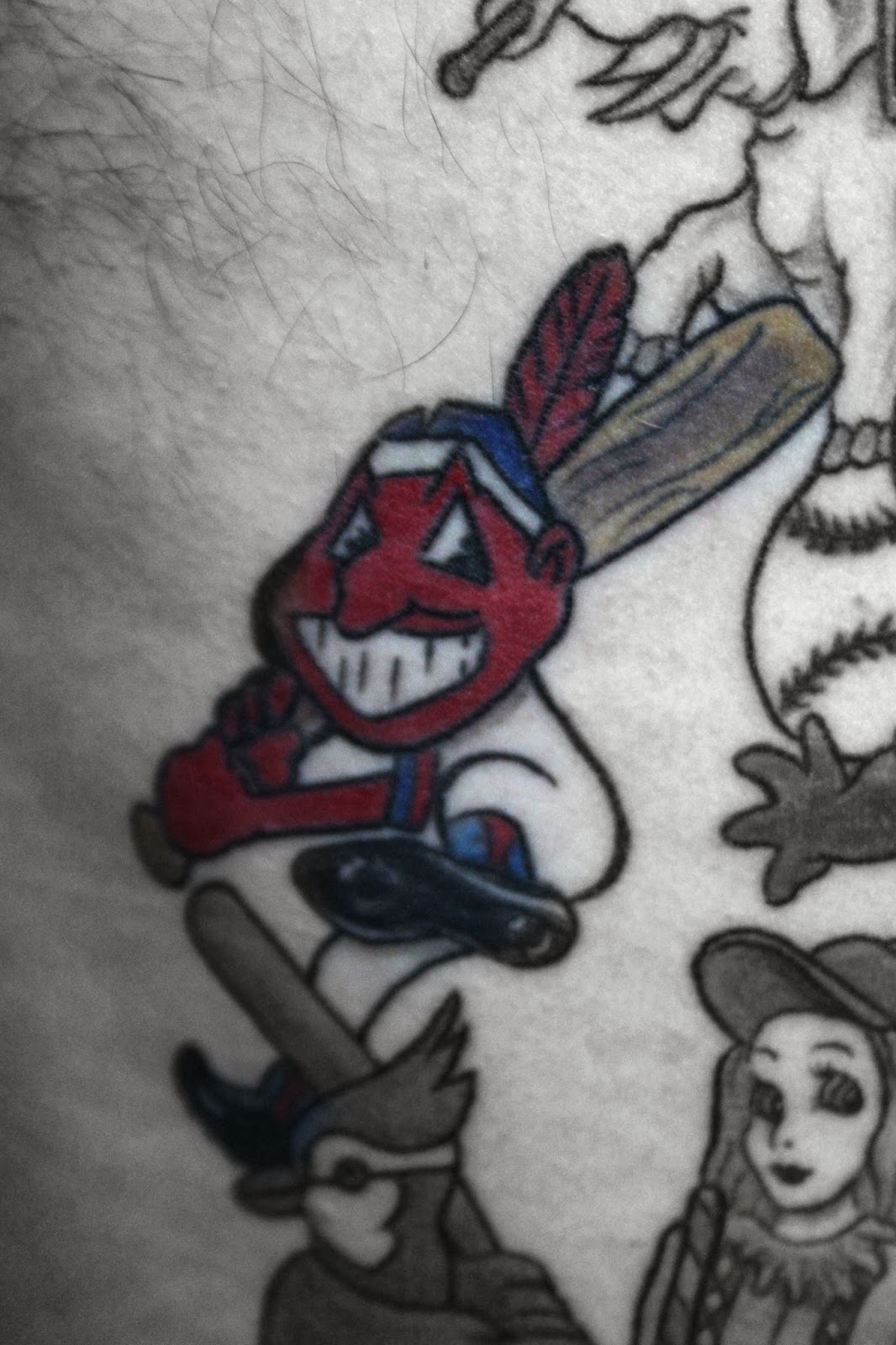
After its introduction, the face of the 1951 logo was incorporated into other, full-body depictions of the character, which is the style I decided to roll with for my tattoo.

Ohio sportswriter Terry Pluto has described comics of Chief Wahoo that would run on the front page of the Cleveland Plain Dealer in the 1950s, with the character's depiction signifying the outcome of yesterday's game. Wins were illustrated by Chief Wahoo holding a lantern in one hand and extending the index finger on his other. Losses were illustrated by a "battered" Chief Wahoo, complete with black eye, missing teeth, and crumpled feathers, because artists who do caricatures in sports and politics are borderline racist themselves. Kidding of course.

From then until the end of the 1985 season the Chief Wahoo logo was only featured on jerseys, memorabilia, jackets, posters and other novelties but it had yet to be put on a hat until the 1986 season. Prior to 1986 the caps all featured a variation of the “C” logo, but as soon as the Chief Wahoo logo was introduced as the cap logo, sales of the cap exploded. All throughout the late 1980s and into the early 2000s Indians caps were some of the best selling Major League Baseball caps on the market. Aside from them having a cool look it also helped that the Indians were World Series contenders for the majority of the stretch until the end of 2007, plus there was also that movie made about the Indians which people have come to know and love. Spaceballs?


But what happened in 2007 to cause the rumor about a phase out? In 2007, Shapiro signed veteran help for the bullpen and outfield in the offseason. Veterans Aaron Fultz, and Joe Borowski joined Rafael Betancourt in the Indians bullpen. The Indians improved significantly over the prior year and went into the All-Star break in second place. The team brought back Kenny Lofton for his third stint with the team in late July. The Indians finished with a 96–66 record tied with the Red Sox for best in baseball, their seventh Central Division title in 13 years and their first postseason trip since 2001.

The Indians began their playoff run by defeating the New York Yankees in the American League Division Series three games to one. This series will be most remembered for the swarm of bugs that overtook the field in the later innings of Game Two. They also jumped out to a three-games-to-one lead over the Red Sox in the American League Championship Series; however, the season ended in disappointment when Boston swept the final three games to advance to the 2007 World Series. Despite the loss, Cleveland players took home a number of awards. Grady Sizemore, who had a .995 fielding percentage and only two errors in 405 chances, won the Gold Glove award, Cleveland's first since 2001. Indians Pitcher CC Sabathia won the second Cy Young Award in team history with a 19–7 record, a 3.21 ERA and an MLB-leading 241 innings pitched. Eric Wedge was awarded the first Manager of the Year Award in team history. Shapiro was named to his second Executive of the Year in 2007. Now, I’m no fancy big city business tycoon, but from everything I just listed I would hardly say there’s any reason to shout conspiracy theories about a logo getting phased out, especially while a team is too busy winning. What is most interesting about the logo phase out theory are the hats that would introduced the following season, the one I’m wearing above.

I have yet to find or yet to hear any reasonable explanation as to why the Indians elected to shrink the size of the logo as dramatically as they did, but there is certainly one point chalked to the phase out theory. At the same time though, shrinking or making a slight modification to a log is also a really good way to boost merchandise sales. Take me, and other cap collectors for example. We all have the bigger logoed hats, so why not get the smaller logo as well? Some of you who aren’t keen on Indians caps might also not know that from 2003-2007 the Indians had brought out new caps in which the only change they made was a silver outline around the logo. I’m still looking for both of them.

I guess the only other thing to address is the theory that the Indians are using “alternate” logos on the scoreboard and around Progressive Field (The Jake!). Well, I was there last August, what do you think?

Even the employees still wear the Chief Wahoo logo on their shirts.

Can you spot me doing "The Shark?"

From everything I have researched, put together and seen in person I don’t see any evidence that the Indians are trying to phase it out. Yes, they certainly have introduced new hats which would also lead people to believe the theory, but they still use caps like this one as their road cap since 2008, and now as their alternate road cap since 2011. Wait a minute… alternate road cap!? They’re trying to phase it out! Damn you!!! ;)

In keeping with this oddity theme I am happy to say that I marked this cap up accordingly. Actually, prior to donning this cap in the photo I still had all of the stickers on it. Not even sure how I pulled that one off. Weird.


#48- Travis Hafner is one of the few people to make it to the big leagues having been born in the great state of North Dakota. Seriously, only 15 players, including Hafner, have come from The Flickertail State and the only other one you may have heard of is Rick Helling. Hafner attended college at Cowley County Community College in Arkansas City, Kansas (the town’s name doesn’t make sense to me either) where he was drafted by the Texas Rangers in the 31st round of the 1996 Major League Baseball Draft. He hit his first career home run August 11, 2002 while playing for the Rangers against the Indians. In addition to the home run, he had two doubles and a single in five at-bats, driving in three runs and scoring two. He nearly hit for the cycle in this game, but was thrown out at third base while attempting the triple. Greedy!

In the winter of 2002, the Rangers traded Hafner to the Indians along with Aaron Myette for catcher Einar Diaz and right-handed pitcher Ryan Drese. Hafner enjoyed moderate success with the Indians in 2003, splitting time between first base and designated hitter. On August 14, he hit for the cycle in Minnesota, the first Indian to accomplish the feat since Andre Thornton in 1978. In 2004, Hafner had a breakout offensive season. As the primary DH he finished the season in the top-10 in the league in on-base percentage (.410, 3rd), slugging percentage (.583, 4th), doubles (41, 6th), extra base hits (72, 7th), RBI (109, 9th) and batting average (.311, 10th). He also hit 28 home runs (16th in the AL) and scored 96 runs (20th in the AL). He topped the .300 mark in batting average each month of the season except August–when he hit a respectable .274–and was particularly hot in July, hitting .360 with 8 home runs and 28 RBI. He hit his first career grand slam in the Indians' home opener on April 12 against Kyle Lohse of the Minnesota Twins.

At the beginning of the 2005 season, the Indians signed Hafner to a three-year contract through 2007 with a club option for 2008. He responded by exceeding his offensive production of 2004. He was again among the league-leaders in on-base percentage (3rd, .408), slugging percentage (3rd, .595), doubles (5th, 42), walks (7th, 79), extra base hits (8th, 75), batting average (9th, .305), home runs (9th, 33) and RBI (9th, 108). He also scored 94 runs. The American League named him Player of the Month for June, when he posted a .345 batting average with 10 doubles, 8 home runs, and 29 RBI in 24 games.
In the first full week of July he was named Player of the Week after hitting .480 with 4 home runs and 12 RBI in 8 games. On July 16, he was hit in the face by a pitch thrown by the Chicago White Sox's Mark Buehrle and was placed on the 15-day disabled list on July 26. After returning from the DL on August 4, he hit .296 with 15 home runs and 45 RBI over the remaining 54 games of the season. To end the season, he hit home runs in six straight games from September 18–24, the second longest such streak in Cleveland history. After the season, the Cleveland chapter of the Baseball Writers Association of America (BBWAA) named him Indians Man of the Year and he finished fifth in the AL Most Valuable Player voting.

For the third straight season, in 2006, Hafner posted MVP-caliber numbers while anchoring the middle of one of the most potent offenses in baseball. On September 1, he was hit on the hand by Rangers’ pitcher C.J. Wilson. The Indians placed him on the disabled list for the rest of the season on September 9 after X-rays revealed a broken bone in his right hand. At the time of the injury, he led the league in slugging percentage (.659) and walks (100); was second in home runs (42), RBI (117), total bases (299), on-base percentage (.439) and extra-base hits (74); and was third in runs scored (100). He also batted over .300 (.308) for the third consecutive season. He finished 8th in the league MVP voting by the BBWAA.

On June 7, a section in the right field mezzanine at Jacobs Field was officially opened as "Pronkville." His nickname, "Pronk", was given to him by former teammate Bill Selby during spring training of 2001 when people sometimes referred to him as "The Project" and other times "Donkey" for the way he looked when running the bases. On July 7, Hafner became the first player in Major League history to hit five grand slams before the All-Star break and passed Al Rosen in the team's season record book when he homered off Kris Benson of the Baltimore Orioles. He joined Hall-of-Famer Ernie Banks of the 1955 Chicago Cubs, Jim Gentile of the 1961 Orioles and Don Mattingly of the 1987 Yankees as the only players to hit at least five grand slams in a season. A little more than a month later, on August 13, Hafner tied Mattingly's single-season record when he hit his sixth grand slam of the season off Luke Hudson of the Kansas City Royals. His league-leading 13 home runs and 30 RBI combined with his .361 average in the month of August earned him AL Player of the Month—the second time he has been honored as such in his career.

In 2007, Hafner had a down year as he batted .266 for the season, compared to .308 in 2006 and .305 in 2005. He hit 24 home runs and 100 runs batted in, his 4th straight season of 100+ RBI. Some critics point to Hafner's disappointing performance being due to unfinished contract negotiations, but Hafner denied this. The Indians signed Hafner to a four-year, $57 million contract extension during the All-Star break, keeping him in Cleveland through the 2012 season. Then the injuries came. From 2008-2012 Hafner played in 429 total games, only playing for over 100 games once in 2010 (118). He never hit for more than 16 home runs during this time, nor did he bat in more than 57 runs (2011). On April 5, 2012, Hafner became only the 12th player in Cleveland Indians history to make at least 10 starts on Opening Day in a Cleveland Indians uniform. On April 15, 2012, Hafner hit a home run off of Kansas City Royals starting pitcher Luis Mendoza that was estimated at 456 feet. It was the longest homer hit at Kauffman Stadium since 2001. When Hafner was placed on the injured list in May for surgery to repair an injured right knee, it was his sixth appearance on the list in the last five seasons. Against the Detroit Tigers on August 5, Hafner a solo home run in the 10th inning, his 200th home run of his career. He was again placed on the disabled list in August with lower back inflammation. On November 1, the Indians declined on his option, making him a free agent.

#55- Signed by the Indians as a free agent out of the Dominican Republic in 2000, Fausto Carmona was the original name given by Roberto Hernandez, a sinker specialist who spent seven years in the minor leagues before making his MLB debut on April 15, 2006. His first season was terrible, 1-10 with a 5.42 ERA; however, his sophomore season was Cy Young worthy. In 2007, his best year, Hernandez went 19-8 with a 3.06 ERA and 137 strikeouts which was good enough for a fourth place finish for the AL Cy Young and 23rd place for the AL MVP. His teammate Sabathia took home the AL Cy Young that season.

In the years to follow Hernandez posted mediocre, bad and then solid numbers. In 2010 Hernandez went 13-14 with a 3.77 ERA and 124 strikeouts. That season he made the only All-Star Game appearance of his career thus far. In January 2012, Dominican police arrested Hernandez after he left the U.S. Consulate, accusing him of using a false identity to obtain a visa. Police reported his real name as Roberto Heredia Hernandez, and that he is three years older than he reported. The Indians placed Hernandez on the restricted list. Officials in both countries received assistance in the case by a woman in the Dominican Republic who claimed she falsified a birth certificate for Hernandez in exchange for $26,000, but when Hernandez's father failed to pay her, she contacted the authorities. The Indians brought Hernandez back for the 2012 season in which he lasted on three games, going 0-3 with a 7.53 ERA.