Showing posts with label San Diego. Show all posts

Friday, September 6, 2013

July 14- San Diego Padres


It’s kind of crazy to think that in the 17 years that I lived in California (born and raised) I never went to San Diego until years after I moved away. Living in Bakersfield for the majority of my life this really doesn’t make much sense, especially since the two cities are less than four hour apart from one another. An even weirder thing to consider out of this is that from when I was 13-years-old until I was 19 I was a pretty avid surfer. The furthest south my board and I had ever gotten in California was down to San Clemente, which is still only about an hour north of “a whale’s vagina.” I don’t know. I can’t think of an reasonable explanation as to how I dodged it for so long, but I’m glad that I was finally able to make it out there this last year to catch a game with fellow MLB Fan Cave hopeful Andy Bishop.

Andy and I hit it off almost immediately when we first met in person in February of 2012 for the top-30 of the Fan Cave auditions. He and I have the same appreciation for weird, outlandish, off-the-wall comedy and we are both Mormon. Well, he’s a bit more adherent to the rules than I am; nonetheless, we were both raised with the same faith and struck a common accord during our time together. I thought he would have been a lock as one of the final nine from last season, but then again, I felt that way about a lot of the people that I met. Like Los Angeles Dodgers fan Nick Hamilton, Andy was one of the many people who I told that I would go south to visit him and take him to a San Diego Padres game no matter what the outcome of the Fan Cave experience would be. Just a few days after Independence Day 2012 I lived up to my word.

The timing of my visit technically couldn’t be any worse. Yes, Andy was around; however, Andy was also in the process of moving and didn’t really have a place for me to crash, but we did end up slitting a hotel room downtown. Aside from being an aspiring sports play-by-play announcer, Andy served as a tour guide at Petco Park on off days and before Padres games. Sadly, I never got to get the grand tour from the man, but he did show me around a bit before the game started and after we got to shoot the breeze with Cincinnati Reds second baseman Brandon Phillips. Andy took me to the warehouse in left field and we made our way to the sandbox in centerfield and the grass knoll-area which sat behind. The Padres were hosting a beer and wine tasting event at the time which was a really cool bonus for fans who don’t otherwise want to just sit in their seat waiting for the game to start. One thing I wanted to do was check out the Padres team store as I was in search of a Tucson Padres cap, the AAA-affiliate of the Padres, for my collection. As luck would have it they had a score in stock; however, the price on the caps was $50, and this was before tax. I passed without thinking twice about it.

The game itself was pretty rough. Even our rally caps couldn't thwart the Padres 0-6 loss, but we didn’t let that spoil our night. 
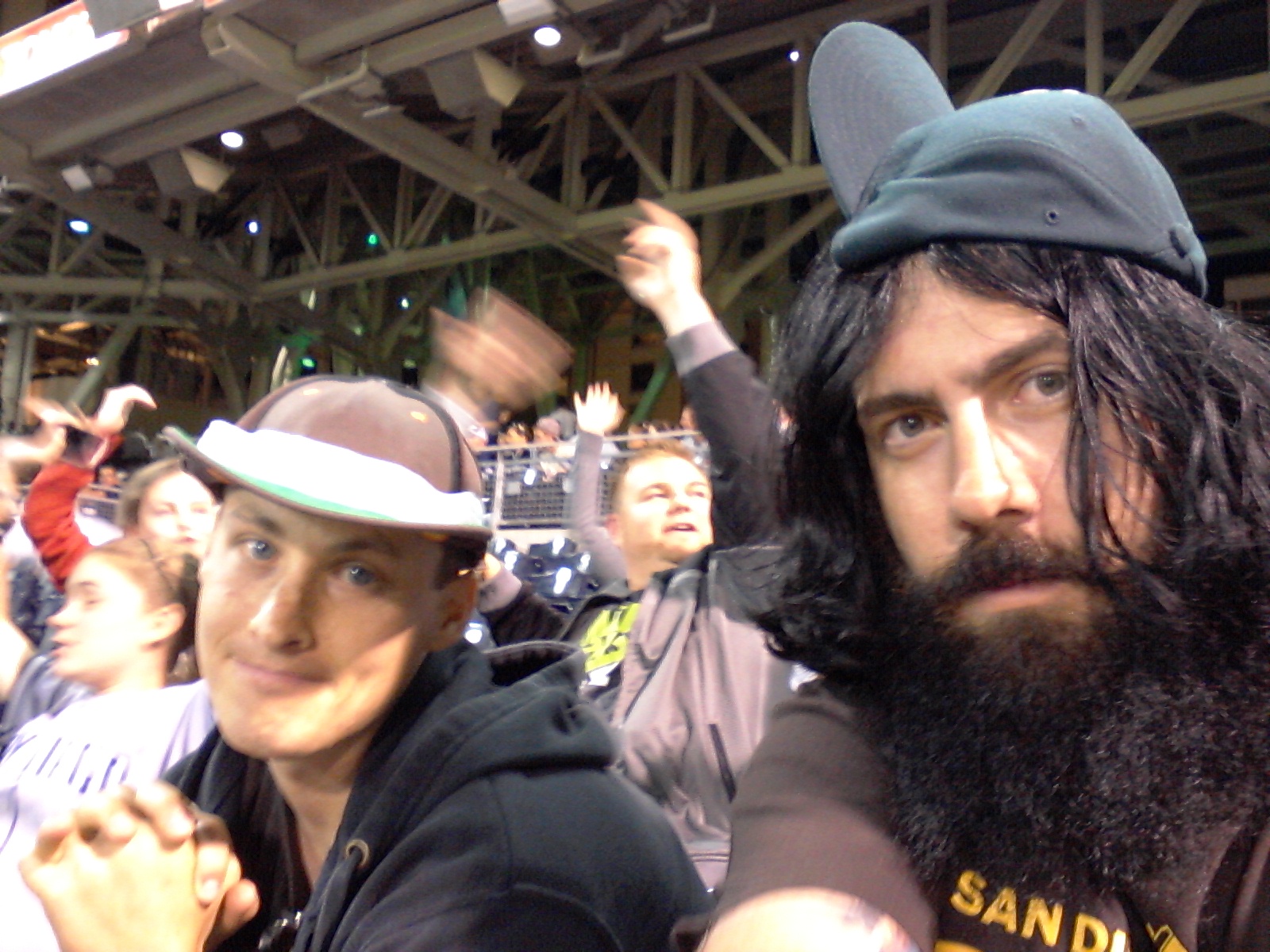

Andy and I retreated to a local ale house for a quick beverage, well, I did and we stayed there until the end of the Seattle Mariners versus the Oakland Athletics game that was in the bottom off the ninth inning. Andy and I spent most of the time chatting about what we’ve got going on over the next couple of days when the next thing I knew Chris Carter had just blasted a three-run home run off of Steve Delabar in the bottom of the 11th inning to give the A’s a 4-1 win over the Mariners. Worn out an both with busy days the next morning, we went to the hotel, turned on MLB Network and passed out. Andy had all ready paid for the hotel so I headed outside in the middle of the night to grab a smoke and run to an ATM to get money to pay him back. Of all the things that I will ever forget from that trip, the one that sticks out the most is how I left the cash sitting on the nightstand next to Andy’s bed. When I didn’t see Andy leave the next morning, but saw the money gone, I couldn’t help but laugh at that exchange being almost like I paid Andy for a date that night. I have a twisted sense of humor sometimes.

If you’re an avid follower of my blog you might have recognized the cap I’m wearing in the photos with Andy as the Padres Military Day cap I wrote about on April 12th. Seeing how I didn’t write about the game I went to with Andy I felt that this was a good enough platform to bring it up, especially considering the fact that Petco Park, and the numbers I have marked are all relevant to the cap that I’m writing about. The Padres introduced it, along with this cap, at the start of the 2004 season when they retired the white “S” with orange “D”-logoed cap at the end of the 2003 season; this cap. In the case of this sand-colored “SD” logo cap, the Padres wore it as their road and alternate cap and retired it at the end of the 2011 season. The all-navy blue with a white “SD” cap then took over as their regular game cap. I couldn’t believe that I had never worn this cap until I put it on today; the price tag was still on the bottom.

Picking players to mark this cap up was actually a pretty easy move. 


#44- Of all the players to move on from the Padres over the last decade, the hardest to swallow has to be Jake Peavy. I had actually written about Peavy back on February 12th for one of my Lake Elsinore pieces, but there’s so much that I left out as I focused primarily on his time with the Storm. 


Peavy grew up in Mobile, Alabama and cheered the Crimson Tide through and through. As a kid he followed the Atlanta Braves whose core of the 1990s was built around the brilliant pitching of Tom Glavine, John Smoltz and one of his sports heroes Greg Maddux. Jake’s father, Donny, was a skilled carpenter who made cabinets along with his father, Blanche, on their three-acre plot of land in the outskirt town of Semmes. Donny was an especially gifted and well-known ball player around town, as was Blanche. Jake was especially close to his grandfather who was still playing fast-pitch softball. He drove Jake to school in his old El Camino most mornings. After school, his grandfather would videotape Jake pitching, pop the tape in the VCR and analyze his motions. Despite all of this keen analysis, no one noticed that Jake was profoundly near sighted. After he got his first pair of glasses, he turned into an excellent hitter, too. One day, in 1994, Blanche turned on a fan in the shop and the unthinkable happened. The blade snapped and went through his eye and into his brain. He fell into a coma, and his family later agreed to let him go. Jake was devastated. From that day forward the loss motivated Jake as he gave it his all for his “Paw-Paw.”

When Jake was ready for high school, his parents sent him to St. Paul’s Episcopal in Mobile. The school had a reputation for its tremendous sports program, and his parents felt that this was a smart path for their son. St. Paul’s was a private school, so Debbie, his mother, had to take a job in the post office so they could afford the tuition. Money well spent.

As Jake grew into his burly 6-1 frame, he blossomed into an unbeatable pitcher. He had a hard fastball that he slung across his body, and a change up that was very advanced for a boy his age. In his first three varsity seasons, Jake went 31-1. He exhibited the kind of wildness one would expect in a live young arm, but after throwing an occasional pitch to the backstop, he was usually able to collect himself and get back down to business. The scouts who began showing up at his games took note of this quality. –JockBio.com

During Jakes senior season, 1999, he led the Saints to the state championship and never lost one of his 13 decisions on the mound. Of all the colleges who were interested in him, the University of Alabama was the one he wanted to attend the most. Upon hearing this Peavy was invited to Alabama’s campus in Tuscaloosa by then head coach Jim Wells for a tour and an offer… or so Peavy thought. Peavy though that Bama was going to roll out the red carpet for him, instead he was welcomed with little-to-no fanfare and the only offer he was given was Wells’ promise to pay for his books. Yup! The best high school pitcher in the state of Alabama was offered books. Dejected, Peavy took an audience with Auburn University head coach Hal Baird who offered him a full ride if he played for the Tigers. Peavy was at a cross road. He now had even more motivational fuel by playing for Auburn to stick it Alabama, or he could roll the dice and see where he ended up in the draft and make his decision from there. Peavy had all ready told most scouts that he would commit to Auburn if he wasn’t drafted in the first four rounds, which scared a lot of teams off… except one, the Padres. Padres’ scout, Mark Wasinger, had gotten to know Jake’s other grandfather, and was convinced that the kid had all the intangibles necessary to be a star. Wasinger called the Padres late in the draft and asked how high Jake had gone. When he was informed that his name was still on the board, he begged the club to take him. They did, in the 15th round. When the draft concluded Wasinger got Jake to agree that he would sign a contract if he was given fourth-round bonus money. Wasinger put his reputation on the line and convinced the Padres to offer six figures. Jake signed, making Hal Baird the unhappiest man in the state of Alabama.

Peavy made his Major League debut on June 22, 2002 and became an immediate fixture in the Padres rotation despite going 6-7 with a 4.52 ERA in his first year. From 2003-2006 Peavy would win at least 11 games per season, only having one losing year in 2006 where he went 11-14. His ERA was cut in half as he led the National League with a 2.27. In 2005 he made his first All-Star game as he lead the NL in strikeouts that season with 216. But all of these accomplishments were merely the warm-up to his phenomenal year in 2007.

Peavy’s final year in San Diego came in 2008, but it was his triple crown, second All-Star Game appearance, Cy Young-winning season in 2007 which will always make Peavy a legend in San Diego. That season he went 19-6 with a 2.54 ERA, 240 strikeouts and even a league-leading 1.061 WHIP to boot. Had the Padres made the playoffs that season Peavy may have won the NL MVP as well, but he finished in seventh place.

#30- If there is one player throughout my years whose name has come up at the most unusual times in my life; it has to be Ryan Klesko. Klesko was a fifth round draft pick by the Braves back in 1989 out of Westminster High School in Westminster, California. He made his Major League debut on September 12, 1992 and hung with the Braves all the way through their World Series run in 1995 and until the end of the season in 1999. In fact, Klesko is the only person in World Series history to knock a home run a three consecutive road games, which he did against the Cleveland Indians in ’95. At the end of the 1999 season he was traded to with Bret Boone and Jason Shiell to the Padres for Quilvio Veras, Reggie Sanders and Wally Joyner.

From 2000-2006 Klesko played first base and left field in San Diego where he made his one and only All-Star appearance in 2001 after hitting .286 with 30 home runs and a career-high 113 RBI. In 2002, he hit .300 with 29 HR and 95 RBI, and collected career-highs in hits (162) and doubles (39). In his career he has a .370 on base percentage with a .500 slugging average, for a .870 OPS. His .525 slugging percentage as a Brave ranks 4th all-time among the team's career leaders, ahead of Eddie Mathews. His .886 OPS as a Brave ranks him 5th among Braves' all-time leaders. Klesko hit .279 with 278 home runs and 987 for his career. He also had a really sweet mustache for most of his career.

My one story that has to do with him came in 2004 when I was interning at a newspaper in Salem, Oregon called The Statesman Journal. My first assignment was to interview a bunch of kids who were on a Little League team that was gearing up to make a solid run for Williamsport. One of the questions that I had to ask all of the kids was, “who is your favorite player?” One of the kids said his favorite player was “Brian Flesko.” I even had him write it down. Well, guess who got their ass chewed out for not correcting it to Ryan Klesko? It wasn’t that I didn’t know who the kid was talking about; I just knew that he was being a smartass so I decided not to change it, which is also why I made him write it down. Needless to say, I never let that happen again.


#3- Khalil Greene was one of my favorite players to come up through the Padres organization. A 2002 Baseball America All-American, Dick Hoswer Trophy winner, ACC Player of the Year, All-ACC first team, Rotary Smith Award winner, Golden Spikes Award winner (best college baseball player), sociology degree recipient out of Clemson University, Greene entered the MLB draft and was taken with the 13th overall pick by the Padres. Greene moved through the Padres farm system with ease in a year-and-a-half starting with the short season-A Eugene Emeralds on to the Lake Elsinore Storm on to the AA Mobile Bears and then for a brief time in 2003 with the Portland Beavers before making his MLB debut on September 3rd.

Greene became a regular fixture in the Padres lineup in 2004 and put up solid numbers in his first year, but finished second for the Rookie of the Year award behind Pittsburgh Pirates outfielder Jason Bay. Greene hit .273 with 15 home runs and 63 RBI on the season. Greene became a fan favorite overnight. He looked like Jeff Spicoli and played with reckless abandon.


Hell, he even won me over.


But Greene’s time with the Padres would be short-lived as he was traded to the St. Louis Cardinals during the 2008 Winter Meetings. What’s actually pretty crazy is that even though Greene only played in five full season with the Padres, he still holds the franchise record for most home runs hit by a shortstop with 84. Greene took several weeks off during May and June 2009, after it was revealed that he was possibly injuring himself in mental anguish (revealed to be social anxiety disorder) due to a slow start for the Cardinals, hitting .197 with only three home runs at the time. He returned to the Cards lineup on June 19 at the Kansas City Royals. Playing third base for the first time since college, he went 2-for-2 with a double, a solo home run and a walk, eventually being substituted after fouling a ball off his foot. Following a 1 for 17 stretch over five games, Greene was placed back on the disabled list with social anxiety disorder on June 29. Greene filed for free agency for the 2010 season, and signed with the Texas Rangers. He announced on February 22, 2010 that, suffering another episode of social anxiety disorder, he would not be reporting to Rangers spring training. On February 25, the Rangers voided Greene's contract. Greene’s final game in MLB was October 4, 2009.


#32- Sean Burroughs was born in Atlanta, Georgia but grew up in Long Beach, California and is regarded as one of the greatest Little League World Series stars. His father Jeff, former American League MVP with the Texas Rangers, was the Long Beach coach and led his son and company to the LLWS and won back-to-back championships in 1992 and 1993. Sean is also the only player to pitch back-to-back no-hitters in the LLWS. Before breaking into the Major Leagues Sean was also a somewhat accomplished writer as a piece of his was included as one of the freedom writers as his is diary entry #132.

Burroughs was selected with the ninth overall pick in the 1998 amateur draft by the Padres, bolstering solid numbers with the gold medal-winning 2000 USA Olympic team and the AAA Beavers in 2001 before getting called up and making his MLB debut on April 2, 2002. Burroughs’s career with the Padres had a lot of promise. His best season came in 2004 where he batted .298 with 156 hits, two home runs and 47 RBI, but after the 2005 season the Padres dealt him to the Tampa Bay Devil Rays for Dewon Brazelton. Burroughs only made it through August before the Devil Rays released him. After that, he faded into obscurity… or so people thought.

After getting released by the Seattle Mariners in June of 2007 Burroughs disappeared, literally. He ended up in Las Vegas, Nevada moving around from motel to motel, drinking up to eight Slurpees a day and eating cheeseburgers out of trashcans. Sounds unbelievable, right? It gets worse. During an interview with ESPN Burroughs admitted, "I was doing a lot of things that were morally not correct and physically not correct. I was knocking at death's door. I was flirting with going to jail and getting locked up someplace. It was scary. Some people kind of came to my rescue. It was pure insanity, but I got myself back together and I'm coming back out of the haze I was in for so many years.''

The former LLWS star, Olympic gold medalist and highly-touted prospect picked up the broken pieces of his life and got back into baseball in 2011 with the Arizona Diamondbacks and then the Minnesota Twins in 2012. In 2013 he was signed to a minor league deal by the Los Angeles Dodgers and played 57 games with the AA Chattanooga Lookouts.

Saturday, June 8, 2013

June 5- San Diego Padres


Tonight I have given myself an inadvertent challenge all because my friend Bryan Mapes (@IAmMapes) suggested that I write about the San Diego Padres tonight. The way this whole decision came about had to do with a lack of historical events in Major League Baseball history occurring on June 4th and June 5th. I’ve touched on this in prior posts, but I always do my best to stay up to date with “this day in baseball” Web sites in order to find truly interesting or forgotten stories of MLB’s past. Having found nothing of real note I decided to take my campaign to Twitter and ask for suggestions from my followers as to which team to write about next. Mapes gave me two teams: the Padres and the Kansas City Royals. My biggest issue with the Royals is that, outside of their Stars and Stripes and batting practice caps, they’ve only had four caps they’ve worn on the field throughout their history. Somehow I’ve managed to burn through three (February 4th, February 24th and March 26th) of the four all ready and we’re not even close to the All-Star break yet. Hell, I wrote about all three of those before the season even started. WHYYYYYYY!?!? So, rather than finish one team off for the rest of the year, I opted to go with the Padres.

Like the Royals, I’ve managed to write about three of the team’s caps thus far (February 1st, March 10th and April12th). Unlike the Royals, the Padres actually have quite the assortment of hats in their catalog, which is quite impressive considering the fact that they’ve only been around in the Majors since 1969. What I am still trying to track down; however, is their 1936 cap from their old Pacific Coast League days when Boston Red Sox great Ted Williams played for the team. This particular cap, as I said above, gave me a bit of a headache when trying to pinpoint an exact year in which it was first used. Because I’m a huge sucker for details, I always make sure to consult two specific Web sites before writing down any of the dates in stone on any of the caps I write about, because after all, some one may be doing the same research I’ve been conducting and the last thing I want to do is give someone shoddy information. The two sites I use are Sportslogos.net and BaseballHallOfFame.org. Oddly enough, they gave contradictory information about this cap, a huge problem I’ve been dealing with since I started on this mission. According to the National Baseball Hall of Fame’s Web site the Padres didn’t start using this cap until 2004 in which they have been using it as their home come through the present. According to Sportslogos.net this cap was first used in 1998 and then went through a slight color variation from 1999-2003 until becoming the cap the Padres where during all of their home games. So, for those of you playing at home, the cap is definitely the home cap and it for sure has been used since 2004 through the present. But what about the previous six years? This is where things get a pit tricky and I had to put on my detective cap to verify a few details.

The 1998 part is the most confusing of all because I remember vividly watching the Padres playing in and losing the World Series to the New York Yankees wear this cap...

the white and orange interlocking “SD” logo. I don’t really recall the white “SD” at all. Oh, and side note, the way Steve Finley looks in this card is ridiculously amazing. Even when combing through pages and pages of photos from ’98 I still couldn’t find anyone wearing it with the exception of former pitch Brian Boehringer who played with the Padres from 1998 until 2000.

My only beef with this card is that I came cross it when I looked under “1999 San Diego Padres cards.” So, 1998 still remains a mystery. The only thing I can come up with is that the Padres wore the caps and a specific uniform set during Spring Training; however, no matter which Web site I use there is nothing to provide this detail.

Moving on to 1999; yes, this cap was definitely used then as the Boehringer card obviously proves. The other note from 1999 is that it was the first year New Era started making specific batting practice caps, which happened to feature the white “SD,” which the Padres used until the end of the 2003 season where they replaced the “SD” for the white slanted “P” logo and changed the cap from a mesh 59/50 into the low profile 39/30. Upon my research I was able to find photographic evidence to prove that the cap was used on the field for home games from 2000-2003, one of which being the final game of the 2001 season which was a truly historic day as Tony Gwynn played his final home game of his career AND Rickey Henderson recorded his 3,000th career hit with a double off of Colorado Rockies pitch John Thomson.

Alas, the mystery has been solved, well, except for 1998, which I leave to any of you who read this post to try finding evidence so I can add it to the story and give you full credit for. That is, unless I find it first.

In retrospect of my research I probably should have waited until the end of the season to write about this cap in regard to the final day of the 2001 season. I mean, Gwynn retiring and Rickey getting #3000 are two pretty extraordinary events in MLB history. Not to mention the fact that during that season Rickey also broke Babe Ruth’s all-time walks record (2062*), Ty Cobb’s runs scored record (2246*) and Zack Wheat’s all-time record of games started in left field (2328*). However, I marked this cap up with a few guys who are still currently wearing this cap as I actually wrote the numbers I have back in March of 2012 while I was in the MLB Fan Cave. No worries though. I’m happy with the choices I made, but more important, now all of those facts I just listed will be more in the open, and that’s what’s most important.

*numbers listed indicate previous records.

#24- One of the few guys from the Padres organization I had the fortune of meeting in the Fan Cave, Cameron Maybin was the 10th overall pick in the 2005 amateur draft by the Detroit Tigers out of high school in North Carolina. Maybin played in 24 games with the Tigers in 2007, but was traded to the Florida Marlins during the offseason as part of a blockbuster trade in which the Marlins sent Dontrelle Willis and Miguel Cabrera to Detroit. Maybin played in 144 games for the Marlins from 2008 until the end of the 2010 season in which he hit .257/12/43 during his days playing at Joe Robbie Stadium, or whatever the hell it’s called.

AT the end of the 2010 season Maybin was traded once again, this time to the Padres for Ryan Webb and Edward Mujica. The benefit of Maybin going to the Padres was that he quickly became and every day guy. Maybin played in 137 games, batting .264 with nine home runs and 40 RBI. Maybin also stole 40 bases that season, becoming the ninth player in Padres history to do so. In 2012 Maybin had a little bit of a drop in his numbers, but he was still one of the best offensive producers on the team hitting .243 with eight home runs and 45 RBI, as well as 26 stolen bases.

When Maybin came to the Fan Cave last season he was all smiles. He and I talked about surfing a bit as I have still yet to surf at any beach south of Huntington Beach… which really isn’t that far from San Diego. Maybin didn’t come alone though, Yonder Alonso and current Oakland Athletic Andy Parrino dropped by as well. One of the more interesting moments came when MLB.com writer Mark Newman pulled me aside and asked me if I knew of anything of note off the top of my head about Maybin. Naturally I brought up the 40 stolen bases in 2011; something I thought was really weird of him not to research before he came in. Then again, most people sought my knowledge more times than you can imagine as opposed to looking it up themselves during my time there. During Newman’s interview with Maybin I made sure to pop “the shark” and photobomb him; however, those bits were edited out. But, the video still lives on, and if you look quick enough you can see the tail end of me teaching all three guys how to do it. Also, the link for the Eric Byrnes shark is right next to it.

#7- Another member of the 2005 amateur draft class, Chase Headley was selected by the Padres in the second round out of the University of Tennessee, but after transferring from the University of the Pacific in Stockton, California. Headley made his MLB debut on June 15, 2007 but only played for eight games as a fill-in for Kevin Kouzmanoff. Headley played for the Eugene Emeralds the year he was drafted, two years before I moved there. Rats!

In 2008, after playing batting .305 and playing in 65 games with the AAA Portland Beavers, Headley was brought back up to the Majors where he has been ever since, with the exception of a four-game rehab stint with the Lake Elsinore Storm this season. From 2008-2011 Headley put up decent numbers, but nothing extraordinary. His average hung around .271 those three seasons and he only hit 27 home runs and 166 RBI. Headley proved he had the potential throughout his Minor League days; however, something just wasn’t clicking for him in the Majors. But, if there’s one things hitters do, it’s stay patient and keep swinging away… which Headley did very well in 2012.

Something clicked around the All-Star break. At the end of the day on July 8th Headley was batting .267 with eight home runs and 42 RBI. For the rest of the season (75 games) Headley would boost his batting average to .286, but crank out 23 more home runs and 73 RBI, the most productive of any player in the National League during that stretch besides San Francisco Giants catcher Buster Posey. Headley’s surge would land him in fifth place for the NL MVP award as well as give him his first Silver Slugger award. Headley also played stellar defense last year as well, winning his first Gold Glove at third base.

Friday, April 12, 2013

April 12- San Diego Padres


I’ve developed a bit of a bad habit over the last two weeks to work on my New Era Cap blog posts after the final game had ended. I suppose I could justify my reasoning around the slight chance that something extraordinary might happen at which I could quickly switch up the hat I’m going to write about and center it around whatever event took place. Alas, this was not the case tonight as I had chosen to write about this particular San Diego Padres hat earlier in the day. What can I say? I’m just a huge sucker for Oakland Athletics games.

On March 10 I wrote about the Padres military appreciation day hat the team has been wearing every Sunday since 2011; however, it was not the first hat to be used for such occasion. In fact, Sunday wasn’t even the original day in which the team used it. The actual first day sates back to… well… April 12, today. On a Wednesday back in 2000 the Padres took to the field wearing dark green and khaki jerseys with the team name and numbers stitched on in white complimented with the hat being adorned on the top of my head, as well as Sterling Hitchcock’s below.

Believe it or not it took three hours to track down this photo, and I wasn’t even the one to find it. I got a lot of help from the Twitterverse, but it was Matthew Young (@mjoven1975) who tweeted me the photo. One would think that something so trivial might be easy to find. Well, I have news for you; it isn’t.

The biggest indicators, as far as trying to date this photo are concerned, lie within, not only the player, but the particular fonts and color schemes being used by the Padres at the time, as well as the surroundings. The first thing to note is that Hitchcock played for the Padres from 1997- halfway into the 2001 season and again in 2004, his final year. Nowhere in any of my research did I find anything about the team using camouflage jerseys prior to 2000. The next thing to look at is what’s behind him: a navy blue wall with orange horizontal strips. This would indicate that the team was playing at home at Qualcomm Stadium after looking at other photos. The Padres played at Qualcomm (a.k.a. San Diego Stadium/Jack Murphy Stadium) from 1969-2003; therefore, the 2004 season is scratched. The only other piece of evidence is the typeface in which the “Padres” and the number are written. That particular font was used from 1985-2003, which still leaves it up in the air whether this photo was taken from 2000 or 2001. Based on the intel I received from Matthew, I’m pretty positive all signs point to 2000. Another really interesting fact about this hat is that of all the caps the Padres wore on the field, this one had the longest shelf-life. Every other hat in the 44-year history of the team lasted roughly 5-7 years.

There’s a particular Web site (Sportslogos.net) that I frequent run by a Canadian gentleman names Chris Creamer, who catalogs all the logos, jerseys and hat styles worn by each teams throughout their existence. Whenever I get hung up about a particular year in which a hat is used I call upon it to verify my research. Unfortunately in this case, the Web site let me down. On his site it says that the Padres used this hat from 2006-2010. I suppose in some way that bit is true; they did use it during those years; however, the entire timeframe between 2000 and 2005 is missing. Another unfortunate wrong turn I was led down was by the National Baseball Hall of Fame and their uniform database. Once again, only at times when I need to verify something do I use this site, but once again I was shut down. The Hall of Fame’s database doesn’t even have this hat listed, along with a lot of other hats used by various teams throughout the last 25 years. Even Wikipedia was a complete was today as the team photo they had listed saying “Padres players in their first camouflage uniforms” is incorrect. See?

Upon first glance you might think I’m crazy as a lot of the usual suspects from the 2000 team including then manager Bruce Bochy are present; however, the one giveaway is the presence of David Wells who only played in San Diego in 2006. I think I’ve mentioned this several time before, especially during the American League umpires cap post I did on February 19; a lot of time, work and research go into these little posts I do every single day. Not because I want to prove of my intelligence, because I don’t want to let any of you down. I don’t want any of you to go down the same paths of seemingly wasted hours to find this information. I also do it because I love telling stories. While someone else telling a story of discovery might be boring to others, I try to pep it up a little bit. And honestly, I really want to do great by everyone who reads these because I sincerely do care and value your opinions.

I bought this cap on Ebay back in July of 2011 since I couldn’t find it in any stores... I’ve always been a huge fan of this shade of green and felt it would be an excellent addition to my collection, not to mention something really awesome to wear. Most importantly though, I bought it because of my best friend Ronnie Forrest, a naval vet stationed in San Diego, who went to several Padres games before he was killed shortly after deployment to Iraq during Operation: Iraqi Freedom back in 2003. I still miss him every single day.

There really wasn’t much a patter, from what I recall, when I marked this cap up. Mainly just player on the Padres during this era that I felt didn’t get enough credit for their careers.

#22- There’s an interesting little game that could be played here as I picked two every interesting, ambiguous numbers to roll with. Since this hat was used from 2000-2010 there were four guys who wore #22, but only two of them were for more than a season: Xavier Nady (2000-2005) and David Eckstein (2009-2010). As much as I love Eckstein and his abilities to win at life, I have a greater personal attachment to Nady.

Nady was a second round draft pick by the padres out of the University of California-Berkeley in the 2000 amateur draft. He is also one of the few guys to play in a Major League game in the same year he was drafted. On the second to last day of the season (September 30) Nady made his MLB debut as a pinch hitter for pitcher Todd Erdos against the Los Angeles Dodgers. With one swing of the bat Nady got a base hit, which he later turned into a run in the bottom of the seventh inning. Nady didn’t see another second of action in the Show until 2003; however, at the end of that day and season, his batting average, on-base percentage and slugging percentage were 1.000.

In 2001 and a bit of 2002 he started out with the Lake Elsinore Storm in the California League, batting .289 with 39 home runs and 137 RBI before moving up to the AAA affiliate, the Portland Beavers. From 2002-2004 I watched Nady and company for the few games he was with the team at PGE Park. Hands down those were some of the best summers I ever had in Portland just being able to relax with a cold beer in my hand, watching the future stars of tomorrow trying to make it to the big leagues. His best season in Portland was in 2004 when he hit .330 with 22 home runs and 70 RBI in 74 games. Amazing! I remember one game specifically when he hit a home run so hard and so far that it tagged the light rail train as it crept passed the stadium. His time in the majors has been a bit checkered, by which I mean he’s become a bit of a journeyman. Eight teams he’s played for in his 13 year career in baseball, the longest of which came with the Padres. During his time in the majors he hit .263/25/91 in 269 games.

#23- This is another one I bit the pickle on as two guys wore this number for pretty long stretched between 2000 and 2010. From 2006-2010 Adrian Gonzalez was a first base masher for the Padres before moving on to the Boston Red Sox and now the Dodgers. Currently Yonder Alonso wear #23, but he never played under this cap. Nope, the biggest name from 1999-2005 was Phil Nevin.

Most people don’t really recall Nevin’s playing career, even though he did have a decent 12-year career with seven different teams. No, most people remember his for being the first overall pick in the 1992 amateur draft by the Houston Astros out of Cal State Fullerton. Now, the best version of this story I’ve heard was by New York Yankees die-hard fan and fellow 2012 MLB Fan Cave Dweller Eddie Mata during our time in New York City. At the time I knew all the info behind this, but it was very entertaining to watch and listen to him tell it with his thick Brooklyn accent.

So, the story goes that there was a scout within the Astros system (Hall of Famer Hal Newhouser) who told then-general manager Bill Wood that the team HAS to take this kid out of Kalamazoo, Michigan with the first overall pick as he would “anchor a winning team.” Fearing that it would cost the Astros a cool $1 million signing bonus to sway this kid away from the University of Michigan, Wood passed and took Nevin instead. With the sixth overall pick in that year’s draft the Yankees took the kid, DEREK JETER, on the advice from scout Dick Groch who told the Yankees brass, after their concerns with Jeter going to college, “the only place Derek Jeter’s going is Cooperstown.” Plus, it only cost them $800,000. The best part of the story is how every year after Jeter and the Yankees won their first World Series in 1996, Newhouser would give them a call asking “how that Jeter kid is working out for the Yankees.” Poor Nevin. He did his best.

The only part of the story that’s a bit questionable is whether or not Newhouser actually made the calls beyond 1996. I only say this because he passed away in 1998.

Nevin’s time with the Padres was the longest of his career. He hit .288 with 156 home runs and 573 RBI. His best year came in 2001 when he made his one, and only All-Star Game appearance and finished 21st in the National League MVP vote going .306/41/126-every stat that year including runs (97), hits (167) and walks (71) was a career-high.

Nevin’s career ended with the Minnesota Twins at the end of the 2006 season, but he’ll sadly be remembered as the guy who got taken over Derek Jeter. Also, he’ll be known to you as the guy who first wore the Padres camouflage jersey back in 2000. See!

It all came back around again. Scott G (@JustBaseball25) found this 2000 Fleer Showcase card for me, thus ending the search. Excellent work Scott!

Sunday, March 10, 2013

March 10- San Diego Padres


I can honestly say that of all the 260 hats that I own, this is my least favorite. I feel like kind of a scumbag saying that considering the fact that the San Diego Padres have been wearing this hat every Sunday since the 2011 season as part of their “support the military” days. I really have nothing against the military, nor do I have anything against supporting the troops… I just really hate the color of this hat. Which is also why of all the regular game worn on-field caps from 2012, this was the last one I scooped up.

Over the years teams have reconstructed and introduced a variety of caps which have made me question how certain people are able to keep their jobs. While I completely understand the desert sand color on this hat matches with the color combination of the camouflage jerseys the Padres wear, I just feel that there are many ways the Padres could have been supportive of the military presence in San Diego with a bit more flair and style. Because honestly, it looks like somebody spilled a jar of butternut squash baby food all over it and called it a day.

*It’s at this moment I would like to point out that not every one of these blog posts are winners.

**I should also point out that sometimes when one critiques something on a daily basis, whether it be food, films, music, etc. some of the final products aren’t up to snuff.

Anyway, the concept behind why the Padres opted to roll with this is truly noble. San Diego houses a large portion of the United States military, primarily the Navy and Marines on account of the more than perfect weather conditions, but most importantly because of the location it provides for deployment, training and first line of defense for an east to westward attack (Yes, I know a lot more about the world than just baseball). From 2006-2010 the Padres had done a different color variation on this tribute, but I’ll get to that post later this year. The biggest difference between this uniform style, other than color, and the '06-'10 set is the use of the digital camouflage style similar to what was used in the Stars and Stripes hat released by all the teams for Memorial Day. Like this…

Since this hat was introduced in 2011 I figured it would be best to stick with that year when marking up my hat. Keeping with the Sunday theme I decided to roll with only key numbers from those “Military Day” games… and somehow, even as meticulous as I am, I still managed to screw it up. I blame the color of the hat.

#21- This part is accurate. In 2011 Heath Bell was probably the most redeeming quality of the Padres’ 71-91 season. The most home runs any one player had was 11 by Ryan Ludwick who also led the team in RBI with 64. Clearly things were not going well. Bell saved 43 games that season on top of a 3-4 record with a team leading 2.44 ERA for all pitchers who threw 60 or more innings; which means that Bell contributed to 65% of their wins. For his service Bell made his third straight All-Star appearance as the lone member of the Padres. You might remember his sprint out of the bullpen and slide into the pitchers mound. Classic!

16-10(7-5)- I totally blew it on this, but at the same time not really. If you couldn’t tell by the season record I posted above, the Padres had a less than optimal season in 2011. How bad you say? Well, they won the first game of the season on March 31, which meant that March was the only month in which the Padres finished with a win percentage for a month greater than .500. In May the Padres went 14-14 which was the only full month they finished with a .500 or better record; however, based on the season splits, Sunday proved to be a very successful day for them. Now, here is where I screwed up: when breaking down the day-by-day numbers I accounted for ALL of the Sunday matchups, in which they finished with a 16-10 record with a win percentage of .615; pretty good. I thought that was their Home record; you know, the days in which they wore this cap. Without double checking my numbers, which is not something that happens often, I pulled out my black Sharpie and marked it up. After about 25 minutes of shaking the stupid out of my brain, I finally realized my mistake and went back threw the numbers; hence the (7-5), their actual Home Sunday record. A .538 win percentage on that day is still pretty solid; however, Bell only accounted for two saves, one win and one loss in that stretch. What gives bro!?

Tuesday, February 12, 2013

February 12- Lake Elsinore Storm


I’m slightly rusty on when this hat came out, but I know for a fact that it was after the 2000 season. The reason for my confusion is that the only difference from the original hat and this one is that the bill is red on the original. To clarify even more; there’s a particular Web site that I sue from time-to-time that helps me date a few hats, but they only give a date range on the logo, not the actual hat itself. Sooooooo… since I can only see the logo and not the bill I’m in a bit of a state of confusion. Now, the reason why I know it’s post-2000 is because the Lake Elsinore Storm are a class-A California League club, and from 1999-2000 I saw their hats 10-12 times a season while doing my bat boy duties for the Bakersfield Blaze. For both of those years the team wore the red-billed caps, which I also own. Not to brag or anything.

Keeping with the theme I have decided to roll with the time frame of 2001-present, as that has been the time that the club has been the affiliate of the San Diego Padres; not to mention my post-bat boy days with the Blaze when they were still an affiliate of the Anaheim Angles.

I’ve been a huge fan of this hat since the first time I saw it in 1999. If you grew up in the 1990s you night remember a clothing brand called No Fear, which had a very similar logo. Like Stussy and Billabong, No Fear was pretty much the coolest thing you could wear outside of a “BO KNOWS” Nike t-shirt. But to be honest, I don’t really like to wear it that often. Nothing personal, it’s just an odd-looking hat when you put it on and look at yourself in the mirror. So, I wear it rarely and prefer the look of it on my wall with all of my other hats.

#15- You can pretty much chalk this one up under the “biggest mistakes in franchise history” list. Back in 2006 the Padres drafted a solid third baseman in the ninth round from the University of Alabama. In 2007 this kid made the 2007 All-Star team with the Storm and was the second ranked prospect in the Padres organization; however, he was traded to the St. Louis Cardinals before the 2008 in exchange for Jim Edmonds. Yes, David Freese suited up for the Storm for one season and did a pretty stellar job for them going .302/17/96 in 128 games. Needless to say, Freese jumped to AAA in 2008 and then made his MLB debut for the Cards in 2009. But before he was the 2011 World Series hero as he’s known as today, he was merely little Davey in Lake Elsinore, California. I made the “little Davey” part up.

#22- This cat was so awesome that the Storm retired his jersey at the start of the 2008 season, despite only playing one season for them in 2001. It’s kind of funny to compare Jake Peavy’s numbers in 2007 for the Padres with his numbers with the Storm back in ’01. 2007- Peavy won the NL Cy Young and the pitching Triple Crown with 19 wins, a 2.54 ERA and 240 strikeouts. He also led the League with a 1.061 WHIP. 2001- Peavy wasn’t even the best pitcher on the team by a long shot. He went 7-5 with a 3.08 ERA and 144 strikeouts. Pitchers Andy Shibilo and Chris Rojas both won 10 games for the Storm that season; however, both players never made it past AAA. It’s kind of amazing to look at. Both of those pitchers were ranked at least 40 places higher on the prospect chart than Peavy, but it just goes to show that some guys have the stuff while others don’t. I tip my cap to you Peavy… but I really hate seeing you with the White Sox. (Sad face)

Friday, February 1, 2013

February 1- San Diego Padres


For any baseball fan born before let’s saaaaaayyyy… 1988, clearly 1994 was by far the worst year we can recall. I put the marker at 1988 because who really cares about anything intently before the age of six? I was 11-years-old at the time, and while I wasn’t exactly the most savvy when it came to multi-million dollar negotiations and Collective Bargaining Agreements, I was at least old enough to understand that was happening to my favorite sport really sucked balls (11-year-old Benjamin talking). August 12 not only served as a dark day in my youth in regard to my favorite sport, it also served as a three weeks to go marker for when I had to go back to school. And even though I didn’t know it at the time, exactly one month later my mother would relinquish custody of my brothers and me and give my father full custody rights. Needless to say, it was a really shitty time in my youth (29-year-old Benjamin talking). Now, as an adult, the 1994 season doesn’t upset me as much as it leaves me, and other baseball fans, in a state of confusion and intense discussion. So many unanswered questions: Could the Montreal Expos have really won the World Series? Was Matt Williams going to break the single-season home run record? Would Michael Jordan really make it up to the Majors? But I think the most important and most forgotten question is: Could Tony Gwynn have been the first person to hit .400 on the season since Ted Williams in 1941?

Having been born and raised in the Bay Area my older brothers and I were taught to hate the Southern California teams at a very young age. This of course included the San Diego Padres. I never really bought too much into that as the late 1980s/early 1990s really confused my when I saw highlights of the Padres and San Francisco Giants and thought they were the same team. Go back and look at each team’s road uniforms and you’ll totally understand my previous sentence. But, there was always that one guy who played for the Padres that I just couldn’t have ill will toward; and no, it’s not Benito Santiago.

’94 - .394: (This is the first appearance of stats on my hat posts) Tony Gwynn played 20 brilliant seasons, all of which came as a loyal member of the Padres from 1982-2001. His career stats are .338/135/1138; however, the 3141 career hits (and of course batting average) were a dead lock for the Hall of Fame, but it was the 1994 season that gives me the most issue. Gwynn had missed on 6 of the 116 games that had been played, which put him 65 at-bats behind the season leader Dante Bichette. However, even with those missed games Gwynn still led the League in hits with 165. What’s even more impressive is that Gwynn was on the upswing with his .394 average. In what turned out to be the final six games of the season Gwynn went 12-27 and hit safely in all six. In two of those games Gwynn went 3-5. With only 42 games left in the season, who knows what could have happened? Even more of a cliffhanger, would that have affected the MVP voting that year? Gwynn finished in seventh place as Jeff Bagwell won the award with all 28 first place votes. I don’t blame him; dude pal went .368/39/116, but still!!! .400!? At least Gwynn has 15 All-Star appearance, 5 Gold Gloves and 7 Silver Slugger awards to keep him company. Oh! And that spot in the Hall of Fame.

Maybe next year Bagwell.

Thursday, January 10, 2013

January 10- Eugene Emeralds


The Eugene Emeralds unveiled this bad boy last season as a tribute the school they share their stadium with, the University of Oregon Ducks. I was on the road touring the country when the hat was released and was lucky enough to pick one up when I stopped off in Eugene for a few games.

I have to say, I was quite impress by it, but what I always thought was really funny is that this was not their normal game hat, nor colors. The traditional colors of navy and neon green for the Emeralds never really sat well with me. I mean take the team name for starters: Emeralds. I’m no PhD laureate geologist, but I’ve always knows emeralds to be green. Keeping with this, Seattle, to my knowledge, has been known as the Emerald City for quite some time. While one could contest that the Emeralds have similar colors to the Seattle Mariners, I could also argue that the Seattle Supersonics were the dominant sports powerhouse, getting flashy with their green and gold uniforms. And so with that, I’ve always felt that the combination of those colors would have suited the Emeralds well.

As for the numbers; I didn’t really feel the need to throw any on. Since it was only a temporary hat, and I missed the games in which they wore the colors, I didn’t have a frame of reference to really know who would have been a good fit. So, blank it is.

Sunday, January 6, 2013

January 5- Tucson Padres


Believe it or not this hat turned out to be one of the hardest hats to track down over the last year. Even more unusual was where I ended up buying it. The story really dates back to 2008, long before the Tucson Padres were even a glint in anyone’s eye. I was a regular attendee of the then Portland Beavers, the AAA franchise of the San Diego Padres, while at the same time I was a season ticket holder for the then-USL Portland Timbers. Having moved to Eugene the previous year to attend the University of Oregon full time, it became a bit difficult to make the trip north to a lot of games. Yes, I realize we’re talking about summer sports; however, I was taking summer classes, so in your face! 2008 proved to be the last year I attended either team’s games at a high frequency as the hit my wallet was taking due to gas prices was becoming a bit crazy. It was also around this time that the Timbers were being considered for a call-up to Major League Soccer, something I really didn’t think would have such a major impact on the baseball market in Portland.

The AAA All-Star game in 2009 was the last time I attended a game at, then-PGE Park. Something that big was pretty hard to resist. The most notable part of that game was that Oklahoma City RedHawks infielder Esteban German was named one of the “Top Stars” of the game. This was personally amusing to me as I had a brief encounter with him back in 2000 when he was playing for the Modesto A’s and I was the bat boy for the Bakersfield Blaze. (That story will come in another post.) The really interesting thing about the game being played in Portland; however, was that it was supposed to be THE large stepping stone to keep the team in Portland and prove how big of a baseball town Portland actually was. Well, a year after that, the team played its final season as the stadium was now going to be renovated to a soccer-specific park for the Timbers as their promotion was approved.

Since October 19, 2010 the Beavers/Padres have been in a weird state of limbo. The team was supposed to move to Escondido, CA in 2013, thus making their home in Tucson temporary; however, as of May 2011 the plans for said move were put on indefinite hold. On July 30, 2012, after a large legal battle, the team was purchased by a group in El Paso, Texas which will move the team there by the start of the 2014 season once a new stadium has been constructed.

Now, as far as acquiring and marking the hat: I was a bit stewed after the team was sold and moved out of Portland, but not terribly upset as I still had the Eugene Emeralds to visit anytime I wanted only 2 miles away from my house. One night toward the end of the 2011 season I combed through the assortment of Minor League caps that Lids had to offer and came across the Tucson Padres. Needless to say, I was impressed. I’ve always loved the swinging Padre logo, hence why I hat it tattooed on my body. Also, I the color scheme was quite impressive so I put it on my “to get list.” I had all ready placed a 6 hat order a few days earlier so I was in no rush to scoop it up. My size (7 3/8) was available to so I didn’t worry too much about it. About 2 weeks later when I was ready to final get it, my size was gone. Seeing how the season had just ended, I was a bit screwed in hoping that there would be a restock in the near future. So I waited…. an entire year!

Almost everyday I checked Lids’ inventory for a restock with no success. The only other time I came across one was when I went to San Diego to catch a Padres/Reds game with my fellow MLB Fan Cave Top 50 finalist and friend Andy Bishop, at which the stadium store was asking $45 for the hat. Hell no! Months would pass, and still no restock available. I kind of figured the hat would be popular, but not like this. It wasn’t until late August when I was traveling between Pittsburgh, PA, Cleveland, OH and Buffalo, NY that I finally came across it. Having met and made a few friends with New Era, I was invited to their home office in Buffalo for a tour by retail marketing coordinator Seth Ehrenberg and events marketing manager Jim Wannemacher. At the end of the tour I took a peek inside the Flagship store they had set up. I spent a good 20 minutes canvassing the joint when I finally came across the “holy grail.” I was especially shocked when they had my size in stock. I tried it on and quickly threw it up on the counter. There was no way I was letting that bad boy go.

I really didn’t have any plans on marking my Minor League caps as players come and go too quickly to really add something of note; however, in this case, adding 2011 (their first year) seemed like a good fit. I put a – next to that to mark their final year played, but won’t put the exact date until their move to El Paso becomes a reality. The significance of this also marks one of the shortest stints for an AAA team in any location; something that really surprised me as Arizona is a hot bed for MLB talent. I guess it really shows what I know about the business of baseball.