Friday, November 8, 2013

August 8- Seattle Mariners


Back on March 4th I tackled the original trident cap that the Seattle Mariners wore from 1977-1980, but I purposely left out one particular detail as it pertains to the cap that I’m writing about today. The 1979 Major League Baseball All-Star Game was the 50th playing of the midsummer classic between the All-Star of the American League and National League and it took place at the four-year-old Kingdome in Seattle, Washington. The game is perhaps most remembered for the play of Dave Parker in the outfield, as he had two assists on putouts at third base and at the plate. With Parker receiving the MVP award for this game, and teammate Willie Stargell winning the NL MVP, NLCS MVP, and World Series MVP, all four possible MVP awards for the season were won by members of the Pittsburgh Pirates. The game was also notable for the play of Lee Mazzilli, the lone representative from the then-lowly New York Mets, providing the 7-6 margin of victory. In his only All Star appearance, Mazzilli tied the game in the eighth inning with a pinch hit home run off of Jim Kern of the Texas Rangers, and then put the NL ahead for good in the ninth, drawing a bases-loaded walk against Ron Guidry of the New York Yankees. This would be the only time the Kingdome would host the All-Star Game. When it returned to Seattle for a second time in 2001, the Mariners had moved to their new home at Safeco Field. The other important detail from this game is that the Mariners inadvertently created one of the most iconic logos in All-Star Game history which they would ultimately don as the primary logo for their caps and uniforms.


Since the All-Star Game was first played in Chicago at Comiskey Field in 1933 it had become customary for the host team to come up with some sort of a cool logo when advertising for the game. You’re probably thinking that my math is off based in the year of the first game played and how the 50th game took place in 1979. Well, from 1959-1961 the All-Star Game was played twice per year, typically one in June and the other in July. In 1961, the final double-dip, the second game, hosted at Fenway Park, ended in a tie. Now where have we seen that happen?


Anyway, the point I’m trying to make is that the logos created are usually only meant for their one-time use at the All-Star Game; however, the Mariners and their fans took quite a liking to the logo they had created for their midsummer classic and decided to make it their official logo for their game caps from 1981 through 1986. With the exception of a few of the teams who incorporated the cap logo into their All-Star Game logos, the Mariners are the only team to do it the other way around.

One of the unfortunate things about this cap is that not a whole lot happened for the Mariners while they wore it with the exception of the players strike which took place in 1981. I don’t know how many times I’ve said it or listed it, but changing uniforms does have a tendency to bring success for a lot of teams, but when it doesn’t, all Hell breaks loose. Besides the strike, this bit of bad fortune befell upon the Mariners: On April 25, 1981, Mariners' manager Maury Wills advised the Kingdome groundskeepers to enlarge the batter's box by a foot. A's manager Billy Martin noticed. Martin showed umpire Bill Kunkel that the batter's box was seven feet long instead of six feet. Martin felt that batters being able to move up a foot in the box could cut at pitches before a curveball broke. Wills was suspended for two games and fined $500. In May, while in Arlington, Texas to play the Texas Rangers, the Mariners' uniforms were stolen. 

On May 28th, this happened...

 
In the sixth inning, Amos Otis of the Kansas City Royals topped a ball down the third-base line. Lenny Randle, the Seattle third baseman, charged the ball, fell on his stomach and appeared to blow the ball into foul territory. Larry McCoy, the home plate umpire, ruled the ball foul, but manager Jim Frey protested. After a discussion, the umpires awarded Otis first base, ruling Randle had illegally altered the course of the ball. Two days later in a game against the Rangers, the Mariners wore their batting practice jerseys, Milwaukee Brewers' caps, and Rangers' batting helmets. The Mariners purchased the Brewers caps at the Rangers' souvenir-stand; the Rangers did not offer Seattle caps for sale.

The only other notable moment came in 1985. On July 9th, in a game between the Toronto Blue Jays and the Mariners at Seattle, Jays catcher Buck Martinez executed a double play by tagging out two runners at home plate. In the third inning, Phil Bradley was on second when Gorman Thomas singled. Bradley was tagged out at home, on a throw from Jesse Barfield to Buck Martinez. There was a collision between Bradley and Martinez; Martinez broke his ankle. Martinez was sitting on the ground in agony and threw the ball to third base in an attempt to tag out Gorman Thomas. The throw went into left field and Thomas ran towards home plate. Toronto left fielder George Bell threw the ball back to Martinez. He was still seated on the ground in pain but was able to tag Gorman Thomas for the second out.

Despite having stars such as Hall of Fame pitcher Gaylord Perry (nicknamed the "Ancient Mariner"), 1984 AL Rookie of the Year Alvin Davis, two-time All-Star and three-time Gold Glove winner Harold Reynolds, three-time American League strikeout leader Mark Langston, and shortstop and team captain Spike Owen on their rosters, the Mariners teams of the entirety of the 1980s were characterized by perennial non-achievement, gaining a reputation for poor performances, low attendance, and losing records. Moreover, the team's ownership again changed hands after the 1988 season, as then-owner George Argyros sold the club to a group headed by communications magnate Jeff Smulyan. However, the 1989 rookie season of center fielder Ken Griffey, Jr., acquired with the first overall pick of the 1987 amateur draft, gave fans hope that a change of fortunes might be on the horizon.

The Mariners since wore the caps for their Turn Back the Clock nights on June 25, 2010 against the Milwaukee Brewers and July 1, 2011 against the San Diego Padres. With all that in mind, it made my markings a bit of a challenge, but I’m pretty happy with my selections and their place in Mariners’ history.


#12- Born and raised in San Diego, California Mark Langston was a second round draft pick by the Mariners out of San Jose State in the 1981 amateur draft. From then until the end of the 1983 season he came up through the ranks of the Mariners’ minor league system, but bypassed AAA altogether when he made is MLB debut on April y, 1984. His most notable season in the minors came in 1982 when he was with the Class-A Bakersfield Mariners and went 12-7 with a 2.54 ERA and 161 strikeouts in 177 1/3 innings.


Langston served as the team’s ace his rookie season, going 17-10 with a 3.04 ERA and a league-leading 202 strikeouts. He ended up finishing in second place for the AL Rookie of the Year Award thanks in part by his jerk of a teammate Alvin Davis who had a great offensive showing. Either way, the important thing to note from the two finishing one-two for the Rookie of the Year Award is that they both beat out Kirby Puckett and Roger Clemens. 1982 proved to be a pretty rough sophomore season for Langston, but he picked his game back up in 1983 when he led the league in strikeouts again with 245. Unfortunately he also led the league in earned runs with 129 as well. Yikes!

In 1987, of course the first year not wearing this cap, Langston had his best year in Seattle, going 19-13 with a 3.84 ERA and once again leading the league in strikeouts with 262. He also made his first All-Star Game appearance and won the first of his back-to-back Gold Gloves. Langston would win seven for his career. But not to sell him short, Langston also finished fifth for the AL Cy Young Award, the highest finish he garner for his career.

Langston went 15-11 with 235 strikeouts in 1988, but got off to a mediocre 4-5 start in 1989 when he found himself on the trading block in July where he was sent to the Montreal Expos along with Mike Campbell for Gene Harris, Brian Holman and Randy Johnson. Langston pitched for 10 more seasons, eight of which came with the California Angels from 1990-1997 when they changed their name to the Anaheim Angels. In 1998 he was a member of the NL pennant-winning San Diego Padres. Noted for his pickoff move to first base, his 91 career pickoffs were, at the time of his retirement, the most in baseball history. Today, he has the fourth-most pickoffs in baseball history, behind only Kenny Rogers, Terry Mulholland and Andy Pettitte, all of them also left-handed pitchers. Currently, Langston serves as a radio color commentator for the Los Angeles Angels of Anaheim during Angels home games. Starting in 2013, Langston does radio color commentary for all games and is also a co-host of the Angels post-game call-in show Angel Talk on radio station KLAA. He also appeared as himself in an episode of “Sabrina, the Teenage Witch.”


#29- Speaking of players most of you have probably never heard of, Phil Bradley is arguably one of the greatest hitters in the history of the Mariners’ organization. Bradley played high school baseball in Macomb, Illinois for the Macomb High Bombers. Due to his success there, the Macomb High School baseball field was later dedicated in his name. Also a talented football player, he played college football at the University of Missouri in Columbia, Missouri and was their starting quarterback from 1978 through 1980. One of the most decorated athletes in Mizzou history, Bradley lettered in football from 1977-81, and in baseball in 1979-81. Bradley quarterbacked the Tigers to three bowl games. He was a three-time Big Eight Conference "Offensive Player of the Year" and set the conference total offense record at 6,459 yards which stood for 10 years. In baseball, he starred as an outfielder on Mizzou teams that won the Big Eight championship in 1980, and went to the NCAA Tournament in 1980 and 1981.


Bradley was selected in the third round of the 1981 amateur draft by the Mariners and made his Major League debut on September 2, 1983, as a pinch hitter against the New York Yankees. Bradley became Seattle's regular left fielder in 1984, batting .301 in 124 games. In 1985 he hit .300 with career-highs in home runs (26) and RBI (880 in 159 games and was selected to the AL All-Star team. He also finished 16th for the AL MVP that season. On April 29, 1986, Bradley was Roger Clemens' 20th and final strikeout as the pitcher set a major league record for strikeouts in a game. In December of 1987, the Mariners traded Bradley and Tim Fortugno to the Philadelphia Phillies in exchange for Mike Jackson, Glenn Wilson, and minor leaguer Dave Brundage.

Bradley hit a respectable .264 in his only season with the Phillies. Almost one year to the day since arriving from the Mariners, the Phillies, desperately in need of pitching help, dealt Bradley to the Baltimore Orioles for Gordon Dillard and Ken Howell. Back in the more familiar AL, Bradley's batting average rose to .277 in his first season in Baltimore. In mid-season 1990, he was traded to the Chicago White Sox for Ron Kittle. His final major league appearance came on September 29, 1990, as he drew two walks and scored a run in a 5-2 White Sox win over the Seattle Mariners. For the Mariners Bradley his .301 lifetime with 52 home runs, 234 RBI and even stole 107 bases.

August 7- Milwaukee Brewers


If you can’t tell by the expression on my face in the picture above, my head is getting squeezed by the 7 1/8 Milwaukee Brewers cap barely gripping the top of my skull. Someone (@NotYasielPuig) had pointed out a few months ago that I am one of the most awkward people to ever pose in front of a camera based on the intro photos that I have at the top of each post. I’ll be the first to admit that’s true; however, in most cases there is a reason for these this. Photos are a vital piece to a story, especially when the subject matter is completely non-fictional. Fictional stories don’t necessarily need photos because the entire fantasy of what you’re reading is all based on how your imagination works. When something is based on factual evidence it’s usually a smart move to throw a few pictures in to give the reader a frame of reference. After all, what good would it be for me to talk cap baseball caps when you don’t know what they look like? As far as my facial expressions go, I do my best to prepare the reader for the journey they’re about to embark upon. Sometimes the story is happy, sometimes they’re depressing and sometimes it’s me going on a rant. Other times I try to incorporate something in the background to set the mood, kind of like when I spent late night hours in bed trying to hammer a post out. No matter the case there is always a method to my madness at play, and today is one of those posts where it all comes into play.

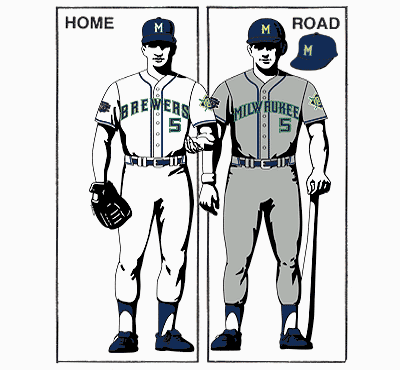
I should probably start by saying that, unless you’re a New Era cap collector or a Brewers fan, you might not remember this cap. It’s ok, not very many people in Milwaukee even remember this cap existing, but even crazier is that it’s next to impossible to track down. Much like the Brewers cap I wrote about on April 9th, it falls under the category of “What the f--- were they thinking?” but not because of the uniforms. To be honest, I actually really like this cap. I just hate the history surrounding it. See, back in 1994 is when it all started when the Brewers introduced these uniforms…


Bring an end to arguably one of the greatest uniform sets and caps in Major League Baseball history. But that’s not all. 1994 was the year that MLB decided to expand their playoff format by adding the Wild Card series to the mix. Some of you are probably thinking, “Now Ben, the Wild Card wasn’t added until 1995.” This is true; however, it was supposed to be used in 1994 but the players strike kind of put a halt on things until the end of April the following year. In order to make the Wild Card system work MLB broke up the original two divisions (East and West) and added a third (Central) to each side, moving the Brewers out of the East and into the Central and in turn giving the West four teams each between the American and National Leagues. Originally this should not have worked out, but luckily the Florida Marlins and Colorado Rockies were added in 1993 to balance the leagues out. So, everything is perfect, right? Nope! MLB had other plans which entailed even more expansion despite the fact that the strike was still in effect in March of 1995. Back then two new franchises (Arizona Diamondbacks and Tampa Bay Devil Rays) were awarded by MLB to begin play in 1998. It was decided to add one new team to each league. At the time, however, MLB did not want to have an odd number of teams per league because they would either have to give teams many more off-days than in the past, or interleague play would have to be extended year-round, or both (14 years later however, another realignment would cause there to be an odd number of teams in each league with year round interleague play). In order for MLB officials to continue the existing schedule, where teams play almost every day and where interleague play is limited to a few days per year, both leagues would need to carry an even number of teams. The decision was made to have one existing club switch leagues. This is the moment when MLB went full-retard. The problem that MLB had put them selves in was as a result of their poor planning when they allowed the Marlins and Rockies into the Majors in an attempt to even everything out. The real problem of their addition of the Diamondbacks and Devil Rays is that they made the mistake of adding one too many teams to the wrong division (Devil Rays to the AL East.) How did this happen? MLB made the mistake of keeping the Detroit Tigers in the AL East when the new divisions were set up in 1994. So now there were going to be 15 teams in each league with the NL having five teams per division while in the AL there was one division with four teams and another with six.

It’s funny to look at all of this now because even a group of third graders could have figured out the problem much faster than the owners and executives were able to. In my opinion (which would have been the correct move) MLB should have moved the Kansas City Royals out of their new place in the AL Central and BACK to the AL West where they have had all of their success including a World Series title in 1985. This move would have given each division five teams apiece and an even 15 teams per league. Yes, I understand that MLB was afraid of an odd number of teams in each league; however, look at what we’re dealing with today and how long it took for everyone to realize that 15 teams per league in even divisions is actually a blessing. More important, the shit that actually went down would have never put a dent in baseball’s legacy: REALIGNMENT.

That’s right; one team had to be moved from one league to another to form a balance, something that had NEVER occurred in MLB history. Teams had obviously moved from state-to-state or city-to-city, but nothing like this. The realignment was widely considered to have great financial benefit to the club moving; however, to avoid the appearance of a conflict of interest, Commissioner (then-Brewers owner) Bud Selig decided another team should have the first chance to switch leagues. The Royals were asked first, but they decided against it. The choice then fell to the Brewers, who, on November 6, 1997, elected to move to the NL Central Division. At the same time, the Tigers agreed to move from the AL East to the AL Central (to replace Milwaukee). The Devil Rays joined the AL East and the Diamondbacks joined the NL West. Had the Brewers elected not to move to the NL, the Minnesota Twins would have been offered the opportunity next. Even reading my own words absolutely blows my mind that this happened. But what does any of this have to do with the cap? Well…

’97: The Brewers got a lot of flack for the uniforms they introduced in 1994 and wore through the end of the 1996 season. So they decided to correct their mistake and come up with something more appealing to the fans. In the offseason the Brewers introduced these uniforms to be worn for the 1997 season.


From then until the end of the 1999 season the Brewers wore this cap for all of their home game and a similar model with a gold “M” (which I can’t find for sale anywhere) for all of their road games. It is still the only time in MLB history that a cap/uniform has been used in multiple leagues. The cap on my head was purchased while the team was still a member of the AL and in my mind the team will always be an AL team. When time came for realignment once again at the end of the 2012 season MLB could have done the smart thing and looked at my original proposal by moving the Royals to the AL West and moving the Brewers back to the AL Central to even things out, but they once again decided that going full-retard was the most fiscally sound option by moving the Houston Astros to the AL West. Because trying to fix the past is just silly and make too many people happy.


These are obviously not new stories. I’ve touched base on a few of these issues before, but they still drive me crazy. How it’s possible for an old man like Selig to take “something he loves” (baseball) and completely blow it off kilter and be satisfied with himself is beyond me. It’s shit like this why I made the conscious decision to have Bernie Brewer added to the AL side of my body. I figured one baseball-loving person had to have some sense.


As to who the girl is, that’s a gem for another post.


#5: If there was ever a player over the last 25 years or so who made a quiet, yet definite impact for the throughout his entire career, it has to be Geoff Jenkins. Jenkins was a three-sport varsity athlete at Cordova High School in Rancho Cucamonga, California, but elected to pursue baseball full-time after receiving a scholarship from USC. From 1993-1995 he played ball for the Trojans. In his final season, he batted .399 with 78 RBI and a .748 slugging percentage in 70 games, also scoring 75 runs to tie the school record held by Rich Dauer and Mark McGwire; his 23 home runs and 193 total bases ranked second in school history behind McGwire's 1984 totals of 32 and 216. He led the Trojans to the College World Series, where they reached the championship game; Jenkins was named to the all-CWS team, and also earned team co-MVP honors and was named a consensus All-American. In 1996, the year of the CWS' 50th tournament, Jenkins was named to the all-decade team for the 1990s. He finished his USC career with a .369 batting average, 45 home runs (second only to McGwire's 54), a .652 slugging percentage, 180 runs, and school records for runs batted in (175) and total bases (444). Yah, he was kind of a big deal, but he fell to the Brewers in the ninth round of the 1995 amateur draft and didn’t make his MLB debut until 1998.

 Not pictured- Brett Favre

Jenkins played 10 years with the Brewers at the MLB level and was consistently the team’s best player. Twice he led the team in batting average, the first of which came in 1999 when he hit .313 with 21 home runs and 82 RBI. In 2000, he was the Brewers' team MVP. He led the Brewers in batting average (.303) and home runs (34). His 2002 season was cut short when on June 17 in a game against the Astros he suffered a horrific-looking dislocated ankle when sliding into third base feet first during a game. He was safe on the play. He was selected to the NL All-Star team in 2003 via the MLB's All-Star Final Vote contest where a player is selected from both leagues by fans to join their respective team after the initial roster is announced.

Jenkins hit a bit streak of offensive woes starting in the 2006 season and was eventually replaced in his spot in the outfield for Corey Hart. At the end of the 2007 season Jenkins was not re-signed, thus ending his Brewer career with a .275 average, 221 home runs and 733 RBI. But, his baseball career wasn’t over. On December 20, 2007, he signed a two-year, $13 million deal with a vesting option for 2010 with the Philadelphia Phillies. Jenkins returned to Miller Park in a Phillies uniform on April 23, 2008, to a crowd of just over 30,000. He was welcomed back with a tribute video, highlighting his ten-year career with the Brewers, and the standing ovation that followed. He received a second ovation while leading off the second inning. Philadelphia would go on to lose the game, 5-4. He went 0 for 3, with a walk and a stolen base. In the postseason, his only hit came on a leadoff double in the bottom of the 6th in Game 5 of the World Series. His hit set the tone for the finale of the World Series as the Phillies won the World Series and earned Jenkins his first World Series ring of his 10 year career. The Phillies ultimately released him at the end of Spring Training in 2009 and in July he was signed by the Brewers on a one-day contract so he could officially retire with the team.


#20: Jeromy Burnitz played his collegiate ball at Oklahoma State University and played minor league ball with the Welsh Waves and the Buffalo Bisons. He batted left-handed and threw right-handed. He first came up with the New York Mets and exhibited both power and speed, but was traded by them to the Cleveland Indians. Burnitz never really cracked the Cleveland lineup and it was only after his trade to Milwaukee in 1996 that he emerged as an everyday player.

From 1996-2001 Burnitz was an absolute stud for the Brewers. In his first full season, 1997, Burnitz hit .281 with 27 home runs, 85 RBI and even stole 20 bases. His efforts gave him a top-30 finish for the AL MVP. The next season he hit a modest .263 but pounded a career-high 38 home runs and a career-high 125 RBI which ultimately improved his stock with a top-20 finish for the NL MVP. Clearly hitting in the NL improved his power game in just one season. In 1999 he made his first All-Star Game and even started in place of the injured Tony Gwynn, thus becoming the first Brewer to start an All-Star Game since Paul Molitor. In the six years he played in Milwaukee he hit .258 with 165 home runs and 525 RBI.

Burnitz played until the end of the 2006 season with the Mets for a second time (2002-2003), the Los Angeles Dodgers (2003), the Rockies (2004), the Chicago Cubs (2005) and then finally with Pittsburgh Pirates (2006).

Wednesday, November 6, 2013

August 6- Boston Red Sox


To get a full understanding of how important this cap and its marking are, I have to flashback 18 years to when I was a sixth grader in Mrs. Costello’s class at Discovery Elementary School in Bakersfield, California. Prior to my 12th birthday in February of 1995 my collection of sports memorabilia was actually pretty pathetic. Outside of collecting baseball cards since 1987, I really didn’t have anything as far as professional team hats or shirts to gallivant around town in. I kept things pretty simple, sporting brands like Stussy and a lot of graphic t-shirts with likes of Bart Simpson or the Teenage Mutant Ninja Turtles affixed to the front. Back then my interest were starting to evolve as well due to the fact that the Major League Baseball season was a bit of a question mark as the labor negotiations were still taking place. Since it was winter, I did what any other kid my age would have done; watch more basketball.

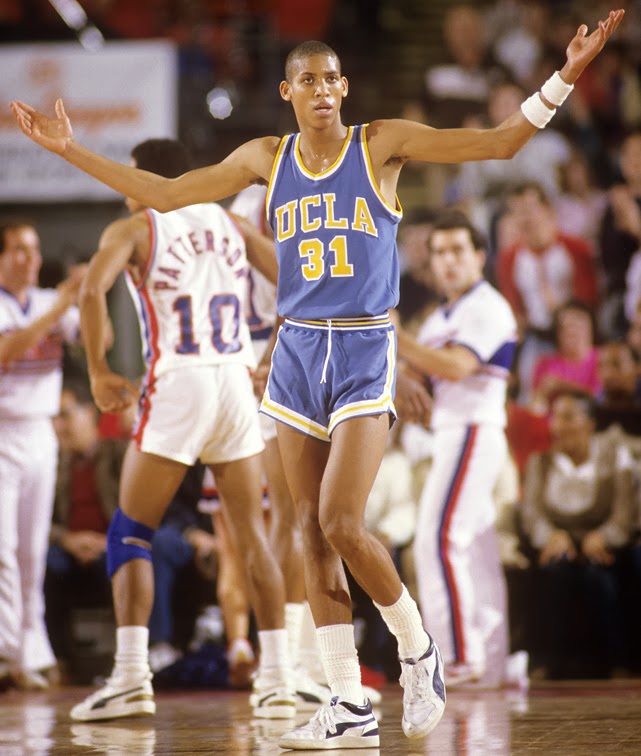
Around the time I started getting into baseball (October 1986) I had begun to develop a bit of a kinship for basketball. Who could blame me? The baseball season had just ended with the New York Mets defeating the Boston Red Sox in the World Series and my tiny little brain was starting to become interested in things other than Sesame Street and Marvel super heroes. But unlike most fans whose love for the game starts at the professional level, mine began in college. More specifically, it started with Reggie Miller and the UCLA Bruins. 


Reggie hadn’t become the trash-talking, heart-breaking, three-point assassin we all know him as today. Back then he was just a scoring machine with the most dominant college basketball program in the history of the NCAA. When it came time for him to move to the next level and enter the NBA Draft in 1987, my allegiance to Reggie continued as the Indiana Pacers drafted him with the 11th overall pick. From then on my time was perfectly divided baseball and basketball started and ended at the opposite ends of one another, thus creating a perfect balance in my sports-loving life. Baseball was still #1 in my eyes, but like I mentioned above, it took a back seat for a bit after the players strike of 1994. With the rest of the season cancelled, including the postseason, my interest went back to the hardwood, and the timing couldn’t have been better. Reggie and the Pacers were having a great year, UCLA was having a great year and on March 18th a press release was sent out by Michael Jordan with only two words attached to it, “I’m back.” Not only was Jordan back, but the competitive fire throughout the National Basketball Association was back, and it just so happened that his first game donning the 345 would take place against my Pacers at Market Square Arena. Jordan scored 19, Reggie scored 28. A little over two weeks later the UCLA Bruins captured their 11th NCAA title, the first without John Wooden at the helm. Even though the MLB season was just about to get underway after a new collective bargaining agreement had been put in place, my mind was too far gone. Basketball had me right where they wanted me. It even teased me in May when Reggie went off for 8 points in 8.9 seconds during a playoff game against the New York Knicks. 

But alas, the Pacers were eventually knocked out of the playoffs and I sought comfort again in the national game. But before I did, I picked up the first of many relics in my sports memorabilia collection, a Grant Hill rookie jersey.


Now, I realize that last sentence makes absolutely no sense to the rest of the story, but I assure you it will. See, one day I was out shopping with my parents at Valley Plaza Mall in Bakersfield and I decided to go browsing on my own, starting with my favorite store in the mall called Jerry’s Dugout. I had about $50 on me at the time and I was definitely in the market for a jersey. Unfortunately for me, they didn’t have any Reggie jerseys so I went with the next best thing, the co-Rookie of the Year from that season. Due to the fact that Champion NBA jerseys back then cost $40 apiece, it took me another three months to finally get the money together to finally add Reggie to my collection… after I picked up Anfernee Hardaway and Jason Kidd first. Oops! But in all fairness to Hill, I had idolized him and Christian Laettner during their days at Duke, so I was more than happy to make him my “first round draft pick of sorts” when it came to my inevitable jersey-buying habit, but what I wasn’t expecting is how that jersey putting me on the right path for the rest of my life.

Three years would pass and my baseball love had been fully restored thanks to some kid from Whittier, California, but I’ll get to that in a moment. My jersey collection had gotten pretty respectable when I entered my sophomore year of high school, the same year in which I had started to realize that my love of writing about sports was overtaking my love of playing them. The varsity basketball coach at my high school wasn’t my biggest supporter despite thee fact that I was clearly one of the better players in the school, but my personal struggles at home between my father and me had spilled over onto the court. As much as I take responsibility for not seeking help to handle my grief, the coach was also responsible for never giving me a chance by labeling me a hot head, rather than actually figure out what the problem was. Without the school team to play on during the winter, I spent a lot of time just watching games, analyzing them and bettering my writing talent as I write for the school newspaper. Mr. Anderson, the teacher in charge on the production of the paper, had begun letting me write my own sports opinion columns which ended up being the first real incarnation of what I’m doing today. I was never hateful in my rants, but I definitely gave perspectives on athletes and their on-court/off-court habits that most 15-year-olds weren’t really expected to touch in a high school newspaper. One article in particular centered around fighting on the playing field/court and the influences the athletes in question have on the kids who watch and idolize them. For a 15-year-old to take on this subject it’s kind of humorous because “what does a kid really know about psychology, let alone what a professional athlete’s opinion on the matter would be?” Rather than staring at a wall to solve this question, I hit the road with my father to Indianapolis as he had gotten tickets for two Pacers games on back-to-back nights against the Detroit Pistons and Charlotte Hornets for my upcoming 16th birthday. While most kids waltzed down to court level to try and get autographs from the players, I asked questions. Based on the time of the pre-game shoot around the Pistons took the court first and very few people were around to get autographs. As Hill wrapped up his session I asked if he would mind giving me three minutes to answer a few questions for thee article I was writing for my school paper. As I write this it all sounds so dumb, but in reality I admire the balls the younger version of me had. Not only did he give my five minutes to talk, he got Laettner to sit down as well and Hill ended up signing that first jersey I ever purchased as it I happened to have it in my backpack. My only regret from that moment was that I didn’t have my Laettner jersey on me, a thought that didn’t click in until my dad and I got back to Bakersfield. After my sit down with those two I headed over to the Pacers’ side and was given the same courtesy my point guard and former-Georgia Tech star Travis Best. I didn’t have any credentials, but that really didn’t seem to matter. All three of them get hounded by the press before and after every game and I highly doubt that very many kids had ever bothered to take on such an adult task. It may not seem like much, but that was the moment when I knew I had a gift. I’m still not sure if it is necessarily a gift for writing, but I most certainly have a talent for getting the interview, no matter how big or how small the story is. This takes me to the summer of 2000…

I was 17-years-old, working two jobs in between my junior and senior year of high school. My main job was that I was in my send year as the bat boy for the advanced-A Bakersfield Blaze, but my other job was as an umpire and scorekeeper for the youth baseball league run by the North of the River Recreation Department. This was the third year in which I held these positions, and they were definitely some of the most fun/rewarding jobs I’ve ever held. Three days a week I worked anywhere between two and three games, alternating my duties with whomever my partner was. On an especially hot day in June I had brought along a new all-baseball shopping magazine that my father had come across. Most of jersey ordering had come via catalog shopping, and since I had moved into collecting New Era caps two years prior, my dad thought I would enjoy it. He was right. In between games and whenever I had free time I coveted that magazine like as if I had boosted my mom’s Victoria’s Secret catalog. I wanted everything, but I was also a realist about what I would continue to wear as I got older. Of all the wares available with a phone call and a credit card the first, and only thing I bought was a home Red Sox jersey. The one thing I should point out with this purchase is that it was the first MLB-related jersey and/or shirt I ever purchased. This is an important detail because I was born and raised an Oakland Athletics fan. To be honest, I did have every Athletics jersey circled, but this jersey popped out. In fact, I still own it and wear it today.


I really don’t have much of a reason as to why I didn’t buy anything else from that magazine. I had the money to do it. I guess I just forgot. The one item I did have queued up and ready to go was the Red Sox cap that’s sitting on top of my head above. It would be 13 more years before I finally found and added this cap to my collection. I guess now is the time to explain why I took you on this journey.

The NBA, more specifically, Reggie Miller had taken the front seat in my love affair with sports, but baseball was certain on the wane. The Athletics were at a low point as then-manager Tony LaRussa had jumped ship along with pitching coach Dave Duncan to the St. Louis Cardinals, my most-hated team. I needed something good to help get me back into the game. That something came in the form of an up-and-coming rookie shortstop in 1996 by the name of Nomar Garciaparra. 

 Glamour shots!!!

Nomar grew up, as I mentioned above, in Whittier, California roughly 130 miles south of Bakersfield. His name first came to my attention in the early 1990s when he was originally drafted by the Milwaukee Brewers in the fifth round of the 1991 amateur draft, but he elected to go to college at Georgia Tech, the same place as future Red Sox teammate Jason Varitek and Travis Best, despite the fact that he had been offered a full-ride scholarship to UCLA as well. Nomar’s star took off immediately. In 1992 he was a member of the USA Olympic Baseball Team in Barcelona, Spain.


He even walked on as a kicker for the football team for a brief period of time in 1993, but 1994 proved to be the biggest year for the Yellow Jackets as they reached the College World Series title game, losing to the University of Oklahoma 13-5. Nomar and Varitek had done almost everything together; they played on the Olympic team together, in the Cape Cod League during the 1993 offseason together and they were both drafted in the first round one pick apart from one another (Nomar at 12th and Varitek at 14th). The only difference was that Varitek had graduated while Nomar left at the end of his junior year as the $895,000 signing bonus offered to him by the Red Sox was too hard to turn down. 


I did what I could to follow Nomar through the ranks of the minor league system, but it was next to impossible without the aid of the internet; funny how times have changed. Nomar took to the professional game like a duck to water, lighting it up on both sides of the ball in two-and-a-half seasons. With September call-ups just around the corner and Nomar hitting .343 with the AAA Pawtucket Red Sox, he was brought up a few days early and made his debut on August 31st as the Red Sox were in the midst of a battle for the American league Wild Card spot. As fate would have it Nomar’s first game came against my Athletics in which he went 0-1 as a pinch hitter for then-second baseman Jeff Frye. But the next day Nomar was penciled in as the starting shortstop which turned out to be a controversial move for then-manager Kevin Kennedy as John Valentin had been serving as the team’s full-time shortstop since 1992 and especially after his top-10 finish in the AL MVP vote the previous season. Nonetheless, Kennedy gave Nomar the field and made Valentin the designated hitter. Valentin went 1-5 with a RBI triple in the three spot while Nomar went 3-5 with a solo home run, two runs and scored and two RBI. It wasn’t long before the Fenway Faithful took a shine to the kid with the funny name.

Due to the fact that my mother has been a life-long Red Sox fan I found my affinity for Nomar to be an easy transition. Everything about the way he moved on the field, adjusted his batting gloves in between pitches and the way he conducted himself in public and with the media personified everything that was good and just about the game. Anytime the Red Sox games were broadcasted, I watched. Anytime they played the Athletics I did my best to make it up north for a game or two in the series. Every so often a special player comes into the league who makes it next to impossible to not root for, even New York Yankees fans have to admit this. He is the sole reason why I made that Red Sox jersey my first purchase. He is the reason why I searched so hard for this cap.


Unless you were a fan of the Red Sox in 1999 or an avid cap collector like myself, you probably don’t remember seeing these on the field. This was one of two alternate caps worn that season, the other having all-white panels, a navy blue bill and a red “B” logo. 


Not only is it incredibly hard to find one for sale, it’s twice as hard to find any history about it. Based on what I’ve been able to uncover the few Web sites and dealers who are selling this cap have it labeled as either the “1999 alternate” or the “1999-2000 alt” as shown by the sticker still affixed to the cap.


What I’ve been able to find is that the Red Sox only used it for a handful of games, but not in 1999. This bit I found courtesy of Uni-Watch; however, according to the write-up by Paul Lukas in 2007, the Red Sox never wore it again after 1997. So why does everyone believe it was used in 1999 and 2000? Well, back in 1999 New Era introduced the mesh batting practice caps. The first edition was used in 1999 and 2000 and featured the same color combination as the 1997 alternate cap.


What I find truly astonishing and coincidental is that Nomar’s three best years came in 1997, 1999 and 2000.

In 1997, Nomar’s first full season, he played in 153 games and took the Rookie of the Year honors, made his first All-Star Game appearance, won his first Silver Slugger Award and finished eighth for the AL MVP by hitting .306 with league-highs in hits (209) and triples (11) as well as 30 home runs, 98 RBI and 22 stolen bases. In 1999 and 2000 he made the All-Star team, but more importantly he won back-to-back batting titles, going .357 and .372 respectively. He also finished in the top-10 for the AL MVP in those seasons as well. Nomar played nine amazing seasons in Boston. He hit .323 with 178 home runs and 690 RBI, but sadly never won a Gold Glove thanks to Omar Vizquel (1993-2001), Alex Rodriguez (2002-2003) and some clown named Derek Jeter (2004-2006). On July 31, 2004 Nomar was traded to the Chicago Cubs as part of a four-team deal which brought Orlando Cabrera and Doug Mientkiewicz to Boston. When the deal was made every joyous feeling I ever had for the Red Sox was turned to anger. Nomar was the face of the franchise, the guy whose name was shouted by Jimmy Fallon every weekend on Saturday Night Live (NO-MAH!!!). Even though he had taken the field for the Sox that season, Nomar was not on the field when it counted, hoisting the Commissioner’s Trophy at the end of the World Series. I was happy that Nomar got a ring the following season, but everything about the rest of his career felt out of place.

From 2005-2009 Nomar battled with injuries, but made his sixth, and final All-Star Game appearance in 2006 as well as a 13th place finished for the National League MVP in his first of three years with the Los Angeles Dodgers. In 2009 he signed a contract for one season with my Athletics and I was fortunate enough to catch him in two games at the Coliseum, both of which happened to come in early April against the Red Sox. Nomar was granted free agency at the end of the season He signed a one-day contract in 2010 with the Red Sox, only to be able to officially retire as a member of the Red Sox.


While I identify completely with all the players who have ever donned the green and gold for the Athletics, I have, and will always have a spot in my heart for Nomar. Even though I played second base for all of my life, I played it with the same intensity and guile as the man who wore #5 for the Sox. I certainly wasn’t as fidgety at the plate, but I still swung the bat as if I was catching a glimpse of the Green Monster out of the corner of my left eye. Despite the fact that I never played ball beyond high school, one of my dreams was to one day shake hands and meet the man who restored my love in baseball. On May 8, 2012, my dream came true.

I was a little over a month into my time at the MLB Fan Cave when we got the word that a few of the members of the Baseball Tonight crew were going to be stopping by. It was already a jam packed day as David Price, Sean Rodriguez and James Shields from the Tampa Bay Rays were slated to stop by in the morning, but I’ll get to that story in another post. What I wasn’t expecting in between meeting both crews was that I was going to be taken down to the basement to be interrogated for an incident that had broken out between Cardinals’ representative Kyle Thompson and me from a few days before. It was by far one of the most humiliating experiences of my life as I was put into a corner by the executives despite the fact that our issue had already been resolved internally. For some reason “someone” had decided to rat me out for that and a bevy of other things that weren’t true. Nonetheless, when I went back upstairs to meet our guests I wasn’t exactly in the right state of mind. All I could think about was that I was going to be asked to pack up my things and go home. That moment wouldn’t come for a few more weeks. I did what I could to prepare myself. I had packed my Nomar player-T that I’ve had since I was 18-years-old and my home Athletics cap as Pedro Gomez, Mark Mulder and Nomar were the three that were stopping by. As they walked up to the front door I froze. My stomach started churning and I did whatever I could to keep from breaking down. This moment was way too important for me to let my emotions get the better of me.

The other eight Cave Dwellers and a few of the executives were the first to greet them. I hung back for a little bit, waiting to find the perfect time to step in and transition my emotion into something more positive. It took  a little bit, but Mulder and Nomar spotted me in front of the Cave Monster (the 15 TV display) and struck up a conversation based on the shirt and hat combination I was wearing. Nomar was pretty stoked that I was rocking his shirt, but Mulder was a little confused about why I was wearing an Athletics cap with it. I explained to him that I was first, and foremost an Athletics fan and that I wore because of the years that he spent with the team. I also made sure to mention that Nomar spent 2009 with the club without trying to sound like a jerk. He chuckled and then the two asked me about what it’s like being a Cave Dweller. I don’t remember the exact wording my Mulder, but somehow the topic of tattoos was brought up. It was intended to be a joke, like in the sense that he said, “Well at least you don’t have any tattoos” for my team. I turned my head to Nomar and then back and said, “I actually do have an A’s tattoo.” He responded, “Really?” I then looked back at Nomar and said, “I actually have a Red Sox tattoo as well.” “Yeah right,” joked Nomar. I then came back with, “No seriously, I honestly have every MLB team tattooed on my body.” Mulder and Nomar looked at one another, both with “yeah right” expressions on their face before Mulder said, “You have to prove this.” As I was propping my shirt up to show off the AL side one of the public relations executives, Jeff Heckelman, grabbed Gomez and said, “Pedro, you have to see this.” And then this happened…


There’s a reason why the expression ‘”a picture says a thousand words” exists, and this is one of those photos that brings me the most joy from my time in New York. All the troubles from before their arrival vanished, and I was finally myself again. One thing I did take away from this photo is that I had let myself go health-wise and cut out a lot of the junk food I had been chowing down on during my days of sitting around and watching baseball for 12-14 hours a day. I was stoked that all three were cool about the ink work, as that is something that also makes me a little bit nervous before I show it off to anyone who actually has a job in baseball.

The rest of the time they were there they spent answering a few questions for the Facebook page, shooting a few segments for that night’s show and Nomar even gave Yankees fan Eddie Mata a few pointers on how to accurately capture his approach to the plate. It was during this time that one of the members of the Fan Cave production crew, a Red Sox fan named Brad, came up to me and asked me how I was handling all of this. By “all of this” he meant the visit by Nomar. At the time I didn’t realize how loud I was talking, but one of the producers from Baseball Tonight overheard what I said, “This is unreal. Nomar is one of the top-three guys within baseball I have ever wanted to meet. It’s a crazy dream that has come true.” Unfortunately I don’t remember the name of the producer from Baseball Tonight, but he pulled me aside and asked if he could interview me for the show. Naturally, I was all about it. Here’s the interview.

Not too long after we wrapped up it was time for them to go. I made sure to stop and thank each person for their time, not really expecting to run into any of them ever again, unless I somehow got a job with ESPN. As it turned out, I ran into Gomez two more times before the end of the season during my cross-country baseball road trip. As for Mulder and Nomar, I wished them both best, but for Nomar I put a little bit more emphasis on how much of an honor it was to meet him. Like my moment in the seats of Market Square Arena with Hill and Laettner, the few moments I was able to spend talking baseball with Nomar was a crowning achievement in my journey to break in as a professional sports writer. No matter what meets me on my path of success, I can always check that one off of my list.


.357/.372- When it came to marking this cap up I couldn’t think anything more fitting than the two averages that Nomar posted in 1999 and 2000 when he won his batting crowns. Had I not spent so much time on the build up to the conclusion I probably would have given love to Pedro Martinez for his back-to-back AL Cy Young Award wins in the same years, but those are the breaks. Perhaps if I’m able to track down the actual mesh batting practice cap I’ll be able to out it together. Until then, it’s on to the next post.

Wednesday, October 30, 2013

August 5- St. Louis Cardinals


This post is kind of an interesting follow up to my Baltimore Orioles post on Rafael Palmeiro’s Hall of Fame career from yesterday. By the time you’re done reading this you’ll understand what I mean.


I first came across this cap in Buffalo, New York during the New Era Fan Appreciation (CrewEra13) event back on June 24th. When the time came to go on our totally bitchin’ shopping spree I saw this sitting underneath an old school Kansas City Athletics cap and made no mention that I even noticed. Why? Because I had no idea what it was. Upon first glance I could tell it was a St. Louis Cardinals cap of some variety, but outside of that I couldn’t pinpoint a timeframe. This became especially frustrating because I couldn’t get my phone to work in order to look it up to see if it was worth scooping up. So, without any real knowledge behind it, I let it sip through my fingers. When we got to the marketing part of the tour and we were shown the bevy of Turn Back the Clock caps New Era had in store for the season, that’s when everything had come into the light. However, still knowing what I did then, I still let it go.

It was kind of a weird move on my part for a few reasons, most of which had to do with the fact that I rarely ever let a Turn Back the Clock cap go unpurchased. But the one real oddity of this trip/moment was that at the time I only owned four total Cardinals caps, all of which I have written about (January 25th, May 1st, May 19th and June 17th). There is still one more cap the team currently wears that I still need to purchase, but there really is no rush in scooping that one up. As far as their Cooperstown Collection and Turn Back the Clock caps are concerned; yes, I really should have been more aggressive about things. Thankfully, I lucked out. I found this one on Hat Club while they were running a sale and made sure to out it at the top of my checkout list… but not before I did a background check.

Like a lot of caps from the turn of the 20th century, the Cardinals “technically” only used this cap for two seasons; however, the years in which they used it (1903 and 1906) were not the specific year in which the Cardinals were celebrating. See, back on May 5th of this year the Cardinals were playing on the road against their National League Central rival the Milwaukee Brewers when the whole Turn Back the Clock motif was presented. The timeframe that was selected was 1913, which played more heavily as a tribute to the Brewers than it ever did to the Cardinals as explained here…

Back in 1902 the original American League Milwaukee Brewers moved to St. Louis where they were known as the St. Louis Browns until 1953. With the absence of Major League Baseball in town, Milwaukee entered a new team that adopted the Brewers name into the minor league American Association. That minor league franchise lasted 50 years as an affiliate of the Browns, Chicago White Sox and Cubs, Cleveland Indians and Boston Braves. Its first American Association championship came in 1913. And that's the reason 1913 is being celebrated today.

The Braves' association with Milwaukee led to the demise of the American Association Brewers in 1954 when the parent club moved from Boston to Milwaukee. That relationship, however, would only last a little more than a decade as the major league club moved to Atlanta in time for the 1966 season. The American Association Brewers were moved to Toledo where they became known as the Mud Hens. While Milwaukee doesn't have any Major League Baseball championships to celebrate, the 1913 Cardinals hadn't yet begun their National League best run of 11 World Series wins by that point in franchise history.

So in some crazy way, the Brewers were trolling the Cardinals if you really break down the where each team was on a success scale back in 1913. Clever! But, what does that have to do with this hat? Well, as I mentioned above the Cardinals only used variations of this cap twice back in 1903…


And 1906 (right)…


Both of them featured the same style “STL” logo on the front of the cap, but only the 1906 version comes the closest to the Turn Back the Clock cap of 2013. So what exactly were the Cardinals wearing back in 1913? These…


Like a lot of the Turn Back the Clock caps that I’ve written about already, the logo on the modern cap is a new edition. Most of the caps back in the old days really didn’t feature any kind of logo or anything too flashy, that’s what the uniform was for. Some teams brandished across the chest, but most stuck to sleeve patches and an occasional patch over the heart. The 2013 Cardinals Turn Back the Clock uniforms were spot on, but I can only speculate as to why New Era elected to go with a different cap other than the pinstripe model shown above. My theory, because it looks cooler.


The logo on the sleeves of the road uniform had a pretty good run as they were used from 1909 through the end of the 1917 season.

Now, due to the fact that this cap was technically only used for the one game on May 5th I suppose I should mark it up with something having to do with that game. Matt Holliday and Allen Craig had great offensive nights and starting pitcher Jaime Garcia pitched eight strong innings while only allowing one run on eight hits and one walk. But, in keeping with the theme of the uniforms and tribute, I decided to go with something a little more historic. Rather, something that very few people outside of historians have ever really bothered to take a look at. For this, I had to go back to the origin of this cap in 1903.


PD: Contrary to my last name, Christensen (it’s Danish), I have a lot of Irish blood running through my veins which I inherited from my mother’s side of the family. The first tattoo I ever got marked the occasion.


My heritage though, goes beyond the traditional stereotype of drinking whiskey, eating potatoes and continually living with mistakes of the past. I for one am proud of my heritage and conduct research regularly on the men and women whose footsteps I have followed. This is the story of arguably the greatest Irish-born baseball player/mind to ever take the field.

It’s not secret that Irish players have come and gone throughout the ranks of Major League Baseball, some of the earliest players of the games weren’t too far removed from the boat that they had stepped off of when they picked up a bat and glove. Throughout the 144-year history of the league there have been 47 players and two additional managers to take the field who were born in Ireland. The last of which was born in 1945, Joe Clearly. Prior to that, the last Ireland-born player was in 1916. Since the 1960s the concept of foreign-born players started very small and has quickly worked its way into a regular part of the game. Countries like Mexico, the Dominican Republic and Venezuela have farm systems and plenty of talent ready to burst onto the Major League scene; however, you’d be hard pressed to find anyone in the league today who was originally born in a 150-mile circumference of the country that gave birth to the game we’ve come to know and love.

Back in the late 1800s the United States had just gotten finished the last war on home soil and all walks of life were taking a shine to this new game that was spreading throughout the East Coast like a wildfire. Despite claims that the Irish were blackballed from most jobs and contributions to the “American Way,” history has proven time and time again that the motto “Irish Need Not Apply” is merely a work of fiction. With that in mind, some of the greatest players early in baseball history were from the Emerald Isles. One of the first 46 born before 1917 played 17 seasons from 1890-1907 and was a player/manager for 11 of those years. His name was Patsy Donovan.

 Born in Queenstown, County Cork, Donovan established himself as the most successful Irish-born major leaguer. He broke into organized baseball in 1886 with the Lawrence, Massachusetts team in the New England League. In 1888 and 1889, Donovan played outfield for the London Tecumsehs of the International Association at Tecumseh Park (today's Labatt Park) in London, Ontario, Canada, where, in his first season in 1888, he led the league in batting with a .359 batting average (according to the Donovan family Web site; however, the London Tecumsehs' official scorer C.J. Moorehead, in a 1903 copy of The London Advertiser, cited Donovan's 1888 batting average as .398), had 201 hits, scored 103 runs and stole 80 bases. His second season with the Tecumsehs was less successful due to a leg injury.

In 1890 he made his Major League debut in the National League with the Boston Beaneaters, and moved to the Brooklyn Bridegrooms in midseason; it would be the only time in his career that he played for a league champion. In 1891 he played in the American Association (AA) for the Louisville Colonels and Washington Statesmen; he then returned to the NL in 1892, first with the Senators (the former Statesmen, who had joined the NL in a league merger) before going to the Pittsburgh Pirates for most of the year. Donovan starred with the Pirates from 1893 through 1899, notching six consecutive seasons batting .300 and serving as player/manager in 1897 and 1899. The team was sold late in 1899, during a time when the league was contracting from twelve teams to eight; new owner Barney Dreyfuss brought in Fred Clarke to be manager, with Donovan being sent to the Cardinals. He played for St. Louis from 1900–1903, sharing the league lead in stolen bases (45) in his first season, also managing the team in his last three seasons with them. By the end of the 1903 season he ranked among the NL's top ten career leaders in hits and at bats, though he would drop from among the leaders before his playing career ended. His 64 career double plays in the NL ranked one behind Jimmy Ryan's league record. He then served as player/manager for the American League's Washington Senators in 1904, his last season as a regular.

In 1903, he broke Sam Thompson's major league record of 1401 games in right field; Willie Keeler passed him in 1906, before Donovan played his last several games and retired with a total of 1620. In 1906, he became manager of the Brooklyn Superbas, and made his last few playing appearances that year, along with one more game at the end of the 1907 season. In a 17-season playing career, Donovan had 2246 hits, 1318 runs, 16 home runs and 736 RBI in 1821 games, along with 207 doubles and 75 triples. Donovan collected 302 stolen bases from 1890 to 1897 and 216 more after the statistic was revised to its modern definition in 1898. He batted .300 lifetime and set a major league record for career games in right field, as well as retiring among the career leaders in total games (fifth, 1813), assists (ninth, 264) and double plays (fifth, 69) as an outfielder.

Donovan joined the Boston Red Sox as a scout in 1909, and managed the team in 1910 and 1911. As a major league manager, he compiled a 684-879 record (.438) in 11 seasons. He was also instrumental in bringing Babe Ruth to the Sox in 1914 through his acquaintance with one of the Xaverian Brothers who coached Ruth at a Baltimore orphans' home. Later he went to the International League, where he led Buffalo to pennants in 1915 and 1916, and also managed Jersey City in 1921–22 and 1925–26. He finished out his career coaching High School baseball at Phillips Academy in Andover, where he coached the future 41st President, George H.W. Bush. Crazy!

Donovan died at the age of 88 in Lawrence, Massachusetts on Christmas Day 1953, and is interred at St. Mary Cemetery in Lawrence. Despite his accomplishments throughout the history of the league, let alone the game, he is not in the National Baseball Hall of Fame. Based on the time frame in which he played, his accomplishments should have gotten him in. He was a hell of a hitter, almost average by the standard of those days, but his is still one of the greatest defensive players to ever take the field. And yet, men who played less years and accomplished less than he did have found their way into the Hall by the Veteran’s Committee. None of it makes much sense.